
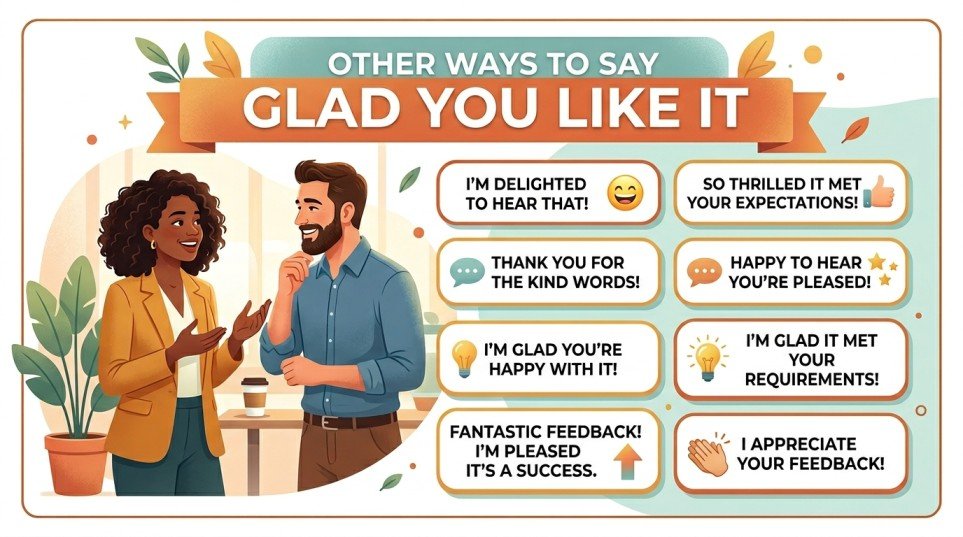
Quick Answer: Instead of saying glad you like it, you can say: happy you enjoyed it, I’m pleased you liked it, thrilled to hear that, happy it helped, delighted you enjoyed it.
The phrase “glad you like it” is commonly used when someone compliments your work, gift, idea, or effort. It’s a warm and positive response that shows appreciation.
Although it’s natural and widely used, repeating the same phrase can make your English sound limited. Native speakers often switch between formal, casual, and professional alternatives depending on the situation.
Learning alternatives to “glad you like it” helps you sound more fluent and expressive. It also improves your ability to adapt tone in conversations and helps you express excitement in English more naturally.
Quick Categories Section
Formal alternatives to “glad you like it”
- I’m pleased you liked it
- Delighted to hear that
- I’m happy it met your expectations
- I appreciate your feedback
Pro Tip: Use these in workplace conversations, presentations, or professional emails.
Casual alternatives
- Happy you liked it
- Awesome, glad you enjoyed it
- So happy you liked it
- Glad it worked out
Pro Tip: Great for everyday conversations with friends or family.
Professional alternatives
- I’m glad it was helpful
- Happy to hear that
- I’m pleased it was useful
- Delighted it met your needs
Pro Tip: Keep your tone warm but polished in professional communication.
Informal expressions
- That’s great to hear
- Love that you liked it
- Sweet, glad you enjoyed it
- Nice, happy you liked it
Pro Tip: Avoid overly casual expressions in formal settings.
“The right response makes your English sound more natural and engaging.”
Common Mistakes
- Repeating the same phrase too often
Example: Saying “glad you like it” in every reply sounds repetitive. - Using informal phrases professionally
Example: “Awesome, glad you liked it” in a formal email. - Sounding emotionally flat
Example: Responding without enthusiasm after receiving praise. - Using overly formal wording casually
Example: “Delighted it met your expectations” with close friends. - Ignoring tone and context
Example: Using slang in customer communication.
What Does “Glad You Like It” Mean?
It means you are happy someone appreciates or enjoys something you did, shared, or gave.
Grammatically, it is a shortened conversational structure of “I am glad that you like it.”
Example Sentence:
I’m glad you like the design.
When to Use “Glad You Like It”
- After receiving compliments
- When someone enjoys your work or gift
- In both personal and professional conversations
- During spoken and written communication
Spoken vs Written: Common in both
Formal vs Informal: Mostly neutral and conversational
Is It Professional or Polite to Say “Glad You Like It”?
Polite? ✔️ Yes
Professional? ✔️ Yes (in most cases)
Business Example:
“I’m glad you like the presentation. Thank you for the feedback.”
Pros and Cons of Using “Glad You Like It”
Pros
- Friendly and positive
- Easy to understand
- Works in many situations
- Natural conversational tone
Cons
- Can become repetitive
- Slightly casual in formal writing
- Limited emotional variety
- Less expressive than alternatives
“Expressive vocabulary makes conversations more memorable.”
Other Ways to Say “Glad You Like It” (With Examples)
These alternatives will help you sound more fluent, confident, and natural in different situations.
Use them based on tone, audience, and context.
1. Phrase: Happy you liked it
Meaning: Feeling pleased someone enjoyed something.
Explanation: Casual and friendly alternative.
Example Sentence: Happy you liked the gift.
Best Use: everyday talk
Worst Use: formal email
Tone: warm, casual
Context Variability: casual / spoken
2. Phrase: I’m pleased you liked it
Meaning: Feeling satisfied someone appreciated it.
Explanation: More polished and professional.
Example Sentence: I’m pleased you liked the proposal.
Best Use: workplace
Worst Use: slang context
Tone: professional, polite
Context Variability: professional / written
3. Phrase: Thrilled to hear that
Meaning: Extremely happy to know that.
Explanation: Shows strong enthusiasm.
Example Sentence: I’m thrilled to hear that you enjoyed it.
Best Use: positive feedback
Worst Use: serious context
Tone: excited, enthusiastic
Context Variability: casual / professional
4. Phrase: Delighted you enjoyed it
Meaning: Very happy someone enjoyed it.
Explanation: Formal and expressive.
Example Sentence: Delighted you enjoyed the event.
Best Use: formal communication
Worst Use: casual slang
Tone: elegant, warm
Context Variability: professional
5. Phrase: Happy it helped
Meaning: Glad your effort was useful.
Explanation: Common in support or advice situations.
Example Sentence: Happy it helped with your project.
Best Use: assistance context
Worst Use: emotional situations
Tone: supportive, friendly
Context Variability: casual / professional
“Fluent English speakers vary their reactions naturally.”
6. Phrase: That’s great to hear
Meaning: Positive reaction to good feedback.
Explanation: Natural and versatile expression.
Example Sentence: That’s great to hear, thank you.
Best Use: general use
Worst Use: strict formal writing
Tone: positive, warm
Context Variability: casual / professional
7. Phrase: I’m glad it worked out
Meaning: Happy the result was successful.
Explanation: Focuses on outcome.
Example Sentence: I’m glad it worked out for you.
Best Use: problem-solving
Worst Use: gift reactions
Tone: supportive, calm
Context Variability: casual
8. Phrase: Wonderful to hear that
Meaning: Very pleased by the feedback.
Explanation: Slightly formal and expressive.
Example Sentence: Wonderful to hear that you enjoyed it.
Best Use: professional tone
Worst Use: slang context
Tone: warm, polished
Context Variability: professional
9. Phrase: I’m happy you enjoyed it
Meaning: Feeling pleased about their enjoyment.
Explanation: Slightly fuller version.
Example Sentence: I’m happy you enjoyed the experience.
Best Use: general use
Worst Use: overly formal writing
Tone: warm, natural
Context Variability: casual / professional
10. Phrase: Glad it was useful
Meaning: Happy your effort had value.
Explanation: Common in professional settings.
Example Sentence: Glad it was useful for your team.
Best Use: workplace
Worst Use: emotional context
Tone: professional, supportive
Context Variability: professional
11. Phrase: I appreciate that
Meaning: Thankful for the positive feedback.
Explanation: Focuses on gratitude.
Example Sentence: I appreciate that you liked it.
Best Use: customer communication
Worst Use: playful context
Tone: polite, appreciative
Context Variability: professional
12. Phrase: So happy you liked it
Meaning: Very pleased someone enjoyed it.
Explanation: More emotional and friendly.
Example Sentence: I’m so happy you liked the surprise.
Best Use: personal situations
Worst Use: formal emails
Tone: emotional, cheerful
Context Variability: casual
13. Phrase: Love hearing that
Meaning: Enjoy hearing positive feedback.
Explanation: Informal and enthusiastic.
Example Sentence: Love hearing that you enjoyed it.
Best Use: casual conversations
Worst Use: formal reports
Tone: enthusiastic, informal
Context Variability: casual
14. Phrase: I’m delighted it met your expectations
Meaning: Happy the result satisfied someone.
Explanation: Professional and polished.
Example Sentence: I’m delighted it met your expectations.
Best Use: business context
Worst Use: casual talk
Tone: formal, professional
Context Variability: professional
15. Phrase: Nice to hear that
Meaning: Pleasant reaction to feedback.
Explanation: Simple and neutral.
Example Sentence: Nice to hear that you liked it.
Best Use: everyday use
Worst Use: emotional moments
Tone: calm, friendly
Context Variability: casual
“The best communicators know how to match tone with context.”
16. Phrase: I’m grateful you enjoyed it
Meaning: Thankful someone appreciated it.
Explanation: Adds sincerity and warmth.
Example Sentence: I’m grateful you enjoyed the workshop.
Best Use: heartfelt communication
Worst Use: playful banter
Tone: sincere, warm
Context Variability: professional / spoken
17. Phrase: Happy to hear that
Meaning: Pleased by the feedback.
Explanation: Very common and flexible.
Example Sentence: Happy to hear that it helped.
Best Use: general use
Worst Use: highly formal writing
Tone: friendly, supportive
Context Variability: casual / professional
18. Phrase: I’m thrilled you enjoyed it
Meaning: Extremely pleased by someone’s enjoyment.
Explanation: Strong emotional reaction.
Example Sentence: I’m thrilled you enjoyed the concert.
Best Use: exciting situations
Worst Use: serious business issues
Tone: enthusiastic, energetic
Context Variability: casual
19. Phrase: Glad it made a difference
Meaning: Happy your effort had impact.
Explanation: Useful in supportive conversations.
Example Sentence: Glad it made a difference for you.
Best Use: mentoring
Worst Use: casual joking
Tone: thoughtful, supportive
Context Variability: professional
20. Phrase: That means a lot
Meaning: The compliment is appreciated deeply.
Explanation: Emotional and sincere response.
Example Sentence: That means a lot, thank you.
Best Use: meaningful praise
Worst Use: neutral business reply
Tone: heartfelt, appreciative
Context Variability: spoken
21. Phrase: I’m happy it turned out well
Meaning: Pleased with the final result.
Explanation: Focuses on success or outcome.
Example Sentence: I’m happy it turned out well for everyone.
Best Use: projects
Worst Use: casual gifts
Tone: positive, reassuring
Context Variability: professional
22. Phrase: Great to know you liked it
Meaning: Positive response to appreciation.
Explanation: Conversational and smooth.
Example Sentence: Great to know you liked the recommendation.
Best Use: general use
Worst Use: formal letters
Tone: friendly, natural
Context Variability: casual / spoken
23. Phrase: I’m so glad it helped
Meaning: Very happy your effort was useful.
Explanation: Adds emotional emphasis.
Example Sentence: I’m so glad it helped you prepare.
Best Use: support situations
Worst Use: formal contracts
Tone: caring, warm
Context Variability: casual
24. Phrase: Delighted to hear your feedback
Meaning: Very pleased to receive positive feedback.
Explanation: Professional and polished expression.
Example Sentence: Delighted to hear your feedback on the presentation.
Best Use: workplace
Worst Use: casual slang
Tone: professional, appreciative
Context Variability: professional
25. Phrase: Glad you enjoyed yourself
Meaning: Happy someone had a good experience.
Explanation: Often used after events or outings.
Example Sentence: Glad you enjoyed yourself at the party.
Best Use: social events
Worst Use: office reports
Tone: friendly, warm
Context Variability: casual
26. Phrase: I’m happy it was meaningful
Meaning: Pleased it had emotional value.
Explanation: Adds depth and sincerity.
Example Sentence: I’m happy it was meaningful to you.
Best Use: emotional moments
Worst Use: casual jokes
Tone: sincere, thoughtful
Context Variability: spoken
27. Phrase: Wonderful, I’m glad you liked it
Meaning: Enthusiastic positive response.
Explanation: Combines excitement and appreciation.
Example Sentence: Wonderful, I’m glad you liked the design.
Best Use: compliments
Worst Use: strict formal writing
Tone: cheerful, expressive
Context Variability: casual / professional
28. Phrase: I’m pleased it was helpful
Meaning: Happy your contribution provided value.
Explanation: Professional and supportive.
Example Sentence: I’m pleased it was helpful for your project.
Best Use: workplace
Worst Use: playful situations
Tone: professional, supportive
Context Variability: professional
29. Phrase: That’s lovely to hear
Meaning: Warm reaction to good feedback.
Explanation: Soft and natural expression.
Example Sentence: That’s lovely to hear, thank you.
Best Use: friendly conversations
Worst Use: technical writing
Tone: warm, pleasant
Context Variability: casual
30. Phrase: I’m glad it made you happy
Meaning: Happy that something brought joy.
Explanation: Emotional and personal response.
Example Sentence: I’m glad it made you happy.
Best Use: gifts or surprises
Worst Use: formal reports
Tone: heartfelt, caring
Context Variability: spoken
“Fluent speakers don’t rely on one phrase—they adapt naturally.”
Mini Quiz / Self-Check
1. Best phrase for professional communication?
A. Love hearing that
B. I’m pleased you liked it
C. Sweet, glad you liked it
Answer: B
2. Which phrase sounds most enthusiastic?
A. Nice to hear that
B. I’m thrilled you enjoyed it
C. Glad it was useful
Answer: B
3. Which phrase works best after helping someone?
A. Happy it helped
B. Have fun
C. Glad you enjoyed yourself
Answer: A
Comparison Table: Top Alternatives
| Phrase | Tone | Best Use |
|---|---|---|
| Happy you liked it | Casual | Friends |
| I’m pleased you liked it | Professional | Work |
| Thrilled to hear that | Enthusiastic | Positive feedback |
| Delighted you enjoyed it | Formal | Professional settings |
| Happy it helped | Supportive | Assistance |
| That’s great to hear | Neutral | General use |
| Wonderful to hear that | Warm | Workplace |
| Glad it was useful | Professional | Business |
| So happy you liked it | Emotional | Personal situations |
| I appreciate that | Polite | Customer communication |
FAQs
1. What are the best alternatives to “glad you like it”?
Popular alternatives include happy you liked it, thrilled to hear that, and I’m pleased you liked it.
2. Is “glad you like it” professional?
Yes, it is polite and suitable for many professional situations.
3. What phrase sounds more formal?
Use delighted you enjoyed it or I’m pleased you liked it.
4. Can I use informal expressions in workplace conversations?
Only in relaxed environments; otherwise, choose more polished wording.
5. Why learn other ways to say “glad you like it”?
It improves fluency, tone variety, and conversational confidence.
Conclusion
Using different other ways to say “glad you like it” helps you sound more expressive, fluent, and confident. It also allows you to match your tone to professional, casual, or emotional situations.
Practice these phrases regularly and pay attention to context. The more variation you use, the more natural your English will sound.
CTA: Which alternative will you start using today?
Discover More:-
- Other Ways to Say I Am Writing to Let You Know (30+ Examples)
- Other Ways to Say I’m Glad to Hear That (30+ Examples)

Lisa Thompson is a USA-based content writer and language specialist focused on grammar, writing improvement and digital publishing.
She holds a degree in English Language and Communication and has professional experience in educational and web content creation.
As the author of Gramtivo.Com, she aims to help readers improve their writing skills through clear and practical guidance.