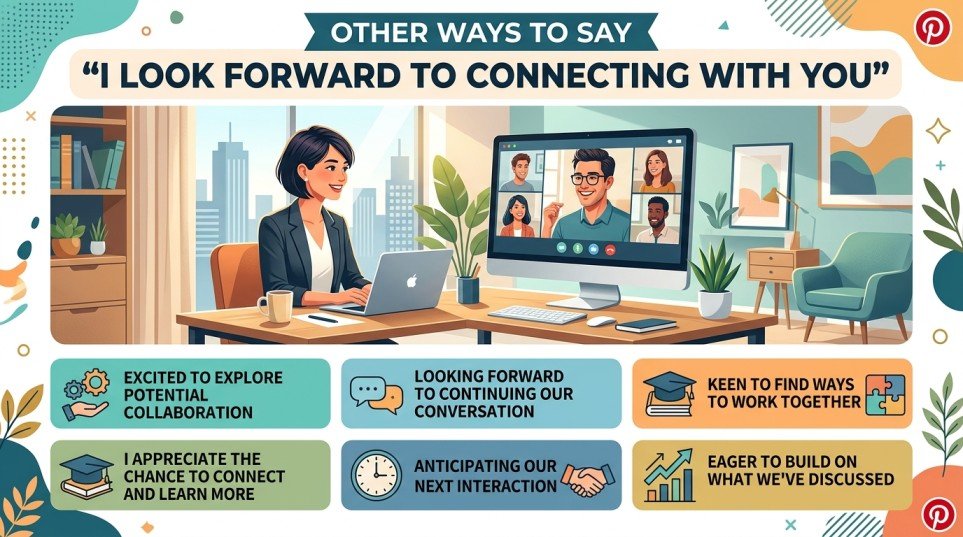
Quick Answer: Instead of saying I look forward to connecting with you, you can say: excited to speak with you, looking forward to our conversation, eager to connect, happy to stay in touch, can’t wait to chat.
The phrase “I look forward to connecting with you” is commonly used in professional emails, networking messages, and business communication. It expresses anticipation and interest in future communication.
Although it sounds polite and professional, repeating the same phrase too often can make your writing feel repetitive or overly formal.
Learning alternatives to “I look forward to connecting with you” helps you sound more natural, confident, and fluent. It also improves your ability to adjust tone for professional networking, friendly conversations, and business communication while helping you express excitement in English more effectively.
Quick Categories Section
Formal alternatives to “I look forward to connecting with you”
- I anticipate our conversation
- I look forward to speaking with you
- I look forward to our discussion
- I appreciate the opportunity to connect
Pro Tip: Use these in formal emails, interviews, or corporate communication.
Casual alternatives
- Can’t wait to chat
- Excited to talk soon
- Looking forward to catching up
- Happy to connect
Pro Tip: These work well for friendly or relaxed communication.
Professional alternatives
- Looking forward to our conversation
- Eager to connect with you
- I’m excited to collaborate
- Looking forward to discussing this further
Pro Tip: Maintain a polished and respectful tone in workplace communication.
Informal expressions
- Let’s chat soon
- Looking forward to talking
- Can’t wait to connect
- Talk soon
Pro Tip: Avoid these in highly formal business situations.
“The right professional phrase can instantly improve your communication.”
Common Mistakes
- Using the phrase too often
Example: Repeating it in every email sounds robotic. - Sounding overly formal in casual conversations
Example: Using it with close friends may feel unnatural. - Using vague wording
Example: “Looking forward to connecting” without context. - Choosing an overly casual phrase professionally
Example: “Can’t wait to chat” in a formal interview email. - Using unnecessary repetition
Example: “I look forward to connecting and speaking with you.”
What Does “I Look Forward to Connecting With You” Mean?
It means you are excited or eager to communicate with someone in the future.
Grammatically, it’s a formal expression using the verb phrase “look forward to” followed by a gerund.
Example Sentence:
I look forward to connecting with you next week.
When to Use “I Look Forward to Connecting With You”
- In professional emails
- During networking conversations
- After scheduling meetings
- In LinkedIn messages
- In both spoken and written English
Spoken vs Written: More common in writing
Formal vs Informal: Mostly professional and formal
Is It Professional or Polite to Say “I Look Forward to Connecting With You”?
Polite? ✔️ Yes
Professional? ✔️ Yes
Business Example:
“Thank you for your time today. I look forward to connecting with you again soon.”
Pros and Cons of Using “I Look Forward to Connecting With You”
Pros
- Professional and polite
- Widely accepted in business communication
- Friendly yet respectful
- Easy to understand
Cons
- Overused in emails
- Can sound robotic
- Slightly formal for casual conversations
- Lacks personality when repeated
“Strong networking starts with natural and confident communication.”
Other Ways to Say “I Look Forward to Connecting With You” (With Examples)
These alternatives will help you sound more fluent, professional, and natural in different situations.
Use them according to tone, audience, and context.
1. Phrase: Looking forward to our conversation
Meaning: Excited about an upcoming discussion.
Explanation: Professional and versatile expression.
Example Sentence: Looking forward to our conversation tomorrow.
Best Use: business emails
Worst Use: slang context
Tone: professional, polite
Context Variability: professional / written
2. Phrase: Excited to speak with you
Meaning: Enthusiastic about talking soon.
Explanation: Warmer and more energetic tone.
Example Sentence: I’m excited to speak with you next week.
Best Use: networking
Worst Use: legal writing
Tone: positive, friendly
Context Variability: professional / spoken
3. Phrase: Eager to connect
Meaning: Very interested in communicating.
Explanation: Short and modern expression.
Example Sentence: I’m eager to connect and learn more.
Best Use: LinkedIn
Worst Use: overly casual talk
Tone: professional, enthusiastic
Context Variability: professional
4. Phrase: Looking forward to speaking with you
Meaning: Anticipating future communication.
Explanation: Traditional business phrase.
Example Sentence: Looking forward to speaking with you soon.
Best Use: formal email
Worst Use: casual text
Tone: formal, professional
Context Variability: professional / written
5. Phrase: Happy to connect
Meaning: Pleased to establish communication.
Explanation: Friendly and welcoming tone.
Example Sentence: Happy to connect with you today.
Best Use: networking
Worst Use: legal communication
Tone: warm, professional
Context Variability: casual / professional
“Natural language helps you build stronger professional relationships.”
6. Phrase: Can’t wait to chat
Meaning: Very excited to talk soon.
Explanation: Casual and energetic expression.
Example Sentence: Can’t wait to chat with you tomorrow.
Best Use: casual networking
Worst Use: formal business email
Tone: informal, enthusiastic
Context Variability: casual
7. Phrase: Looking forward to discussing this further
Meaning: Interested in continuing the discussion.
Explanation: Common in business communication.
Example Sentence: I look forward to discussing this further.
Best Use: workplace
Worst Use: personal texting
Tone: professional, serious
Context Variability: professional
8. Phrase: Excited to learn more from you
Meaning: Interested in hearing someone’s ideas.
Explanation: Respectful and engaging.
Example Sentence: I’m excited to learn more from you during our meeting.
Best Use: mentorship
Worst Use: casual chat
Tone: respectful, positive
Context Variability: professional
9. Phrase: Hope to speak with you soon
Meaning: Expecting future communication.
Explanation: Softer and polite tone.
Example Sentence: Hope to speak with you soon.
Best Use: email closing
Worst Use: urgent discussions
Tone: polite, calm
Context Variability: professional / spoken
10. Phrase: Looking forward to catching up
Meaning: Excited to reconnect.
Explanation: More casual and friendly.
Example Sentence: Looking forward to catching up soon.
Best Use: friends or colleagues
Worst Use: formal meetings
Tone: friendly, relaxed
Context Variability: casual
11. Phrase: I’m excited about our meeting
Meaning: Positive anticipation for a meeting.
Explanation: Professional yet warm.
Example Sentence: I’m excited about our meeting next week.
Best Use: interviews
Worst Use: casual texting
Tone: enthusiastic, professional
Context Variability: professional
12. Phrase: Looking forward to hearing your thoughts
Meaning: Interested in someone’s opinion.
Explanation: Encourages discussion.
Example Sentence: Looking forward to hearing your thoughts on this project.
Best Use: collaboration
Worst Use: casual chat
Tone: professional, engaging
Context Variability: professional
13. Phrase: Let’s stay in touch
Meaning: Continue communicating in the future.
Explanation: Friendly networking phrase.
Example Sentence: It was great meeting you. Let’s stay in touch.
Best Use: networking
Worst Use: formal contracts
Tone: warm, casual
Context Variability: casual / professional
14. Phrase: Talk soon
Meaning: Expecting communication shortly.
Explanation: Very informal and brief.
Example Sentence: Thanks again. Talk soon.
Best Use: casual communication
Worst Use: formal writing
Tone: informal, friendly
Context Variability: casual
15. Phrase: Looking forward to collaborating with you
Meaning: Excited to work together.
Explanation: Ideal for teamwork situations.
Example Sentence: Looking forward to collaborating with you on this project.
Best Use: workplace
Worst Use: personal messages
Tone: professional, positive
Context Variability: professional
“Fluent professionals vary their language instead of repeating the same phrases.”
16. Phrase: I appreciate the opportunity to connect
Meaning: Thankful for the chance to communicate.
Explanation: Formal and respectful.
Example Sentence: I appreciate the opportunity to connect with you.
Best Use: professional networking
Worst Use: casual texting
Tone: formal, respectful
Context Variability: professional
17. Phrase: I anticipate our discussion
Meaning: Looking forward to an upcoming conversation.
Explanation: Formal business expression.
Example Sentence: I anticipate our discussion next week.
Best Use: corporate communication
Worst Use: friendly chat
Tone: formal, professional
Context Variability: professional
18. Phrase: Looking forward to getting to know you
Meaning: Interested in building a relationship.
Explanation: Warm and friendly phrase.
Example Sentence: I’m looking forward to getting to know you better.
Best Use: networking
Worst Use: legal context
Tone: warm, friendly
Context Variability: professional / casual
19. Phrase: Excited to connect soon
Meaning: Happy about future communication.
Explanation: Modern and concise.
Example Sentence: Excited to connect soon and discuss ideas.
Best Use: LinkedIn
Worst Use: highly formal emails
Tone: energetic, professional
Context Variability: professional
20. Phrase: Looking forward to meeting you
Meaning: Excited about an upcoming meeting.
Explanation: Common and professional phrase.
Example Sentence: Looking forward to meeting you in person.
Best Use: interviews
Worst Use: casual texting
Tone: professional, warm
Context Variability: professional
21. Phrase: I’m eager to hear from you
Meaning: Interested in receiving communication.
Explanation: Useful in email closings.
Example Sentence: I’m eager to hear from you soon.
Best Use: professional emails
Worst Use: informal chat
Tone: polite, professional
Context Variability: professional
22. Phrase: I’m glad we could connect
Meaning: Happy about current communication.
Explanation: Friendly and positive.
Example Sentence: I’m glad we could connect today.
Best Use: networking
Worst Use: formal reports
Tone: warm, conversational
Context Variability: casual / professional
23. Phrase: Looking forward to exchanging ideas
Meaning: Excited to share thoughts and opinions.
Explanation: Collaborative tone.
Example Sentence: Looking forward to exchanging ideas with you.
Best Use: teamwork
Worst Use: casual text
Tone: professional, collaborative
Context Variability: professional
24. Phrase: Hope we can connect soon
Meaning: Wanting future communication.
Explanation: Soft and friendly phrase.
Example Sentence: Hope we can connect soon regarding the project.
Best Use: networking
Worst Use: urgent requests
Tone: polite, friendly
Context Variability: professional / casual
25. Phrase: Looking forward to continuing our conversation
Meaning: Interested in ongoing communication.
Explanation: Professional and engaging.
Example Sentence: Looking forward to continuing our conversation next week.
Best Use: meetings
Worst Use: casual texting
Tone: professional, thoughtful
Context Variability: professional
26. Phrase: I’m excited to work with you
Meaning: Positive anticipation for collaboration.
Explanation: Great for workplace communication.
Example Sentence: I’m excited to work with you on this initiative.
Best Use: teamwork
Worst Use: casual friendships
Tone: positive, professional
Context Variability: professional
27. Phrase: Looking forward to learning from you
Meaning: Interested in gaining knowledge.
Explanation: Respectful and humble tone.
Example Sentence: Looking forward to learning from you during the session.
Best Use: mentorship
Worst Use: casual talk
Tone: respectful, professional
Context Variability: professional
28. Phrase: It’ll be great to connect
Meaning: Future communication will be valuable.
Explanation: Conversational but polite.
Example Sentence: It’ll be great to connect next week.
Best Use: networking
Worst Use: legal documents
Tone: friendly, professional
Context Variability: casual / professional
29. Phrase: I look forward to staying in touch
Meaning: Interested in ongoing communication.
Explanation: Useful after meetings or networking.
Example Sentence: I look forward to staying in touch after the conference.
Best Use: networking
Worst Use: urgent matters
Tone: professional, warm
Context Variability: professional
30. Phrase: Looking forward to connecting again
Meaning: Excited to communicate in the future.
Explanation: Useful after previous interaction.
Example Sentence: Looking forward to connecting again soon.
Best Use: follow-up emails
Worst Use: first introductions
Tone: warm, professional
Context Variability: professional / spoken
“Professional English becomes stronger when your language feels natural and varied.”
Mini Quiz / Self-Check
1. Which phrase is best for a formal business email?
A. Can’t wait to chat
B. Looking forward to our conversation
C. Talk soon
Answer: B
2. Which phrase is most informal?
A. I anticipate our discussion
B. Talk soon
C. Looking forward to discussing this further
Answer: B
3. Which phrase works best for networking?
A. Happy to connect
B. No problem
C. Forget about it
Answer: A
Comparison Table: Top Alternatives
| Phrase | Tone | Best Use |
|---|---|---|
| Looking forward to our conversation | Professional | Business emails |
| Excited to speak with you | Warm | Networking |
| Eager to connect | Professional | |
| Looking forward to speaking with you | Formal | Corporate communication |
| Happy to connect | Friendly | Networking |
| Looking forward to discussing this further | Professional | Meetings |
| Hope to speak with you soon | Polite | Email closings |
| Looking forward to collaborating with you | Professional | Team projects |
| Let’s stay in touch | Casual | Networking |
| Looking forward to meeting you | Professional | Interviews |
FAQs
1. What are the best alternatives to “I look forward to connecting with you”?
Popular options include looking forward to our conversation, eager to connect, and happy to connect.
2. Is “I look forward to connecting with you” professional?
Yes, it’s professional, polite, and widely used in business communication.
3. What should I say instead in casual communication?
Use phrases like can’t wait to chat or talk soon.
4. Why should I learn alternatives to this phrase?
Using different expressions improves fluency, tone variety, and natural communication.
5. Which phrase works best for networking emails?
Happy to connect and looking forward to speaking with you work especially well.
Conclusion
Learning other ways to say “I look forward to connecting with you” helps you sound more natural, polished, and confident in both professional and casual communication.
Practice these alternatives regularly and choose phrases based on tone and context. Over time, your English will sound more fluent, engaging, and professional.
CTA: Try replacing your usual email closing with one of these alternatives today.
Discover More:-

Lisa Thompson is a USA-based content writer and language specialist focused on grammar, writing improvement and digital publishing.
She holds a degree in English Language and Communication and has professional experience in educational and web content creation.
As the author of Gramtivo.Com, she aims to help readers improve their writing skills through clear and practical guidance.