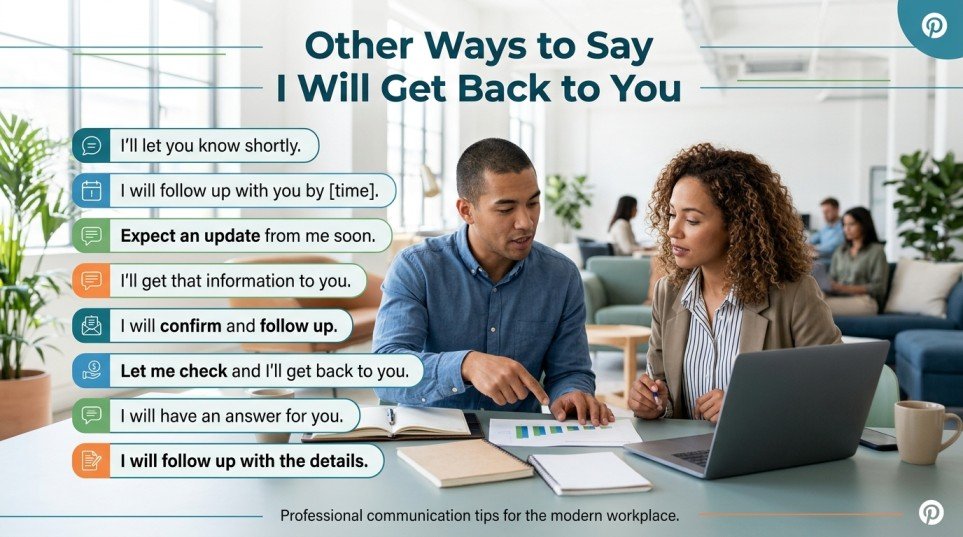
Quick Answer: Instead of saying I will get back to you, you can use I’ll follow up with you, I’ll let you know, I’ll keep you posted, I’ll be in touch, I’ll update you soon.
The phrase “I will get back to you” is commonly used when you need more time before giving an answer, making a decision, or providing information. It signals that you haven’t forgotten the conversation and intend to respond later.
While the phrase is clear and professional, using it repeatedly can make your communication sound repetitive. Native speakers often choose different expressions depending on whether they’re speaking casually, professionally, or formally.
Learning alternatives to “I will get back to you” helps you sound more fluent and adaptable. It also improves workplace communication and gives you more options when responding to requests, questions, or follow-up discussions.
Quick Categories Section
Formal alternatives to “I will get back to you”
- I will respond shortly
- I will provide an update
- I will follow up accordingly
- I will revert to you
Pro Tip: These phrases work well in formal emails, reports, and client communications.
Casual alternatives
- I’ll let you know
- I’ll get back to you
- I’ll keep you posted
- I’ll check and tell you
Pro Tip: Use these with friends, family, or informal colleagues.
Professional alternatives
- I’ll follow up with you
- I’ll update you soon
- I’ll circle back with you
- I’ll be in touch
Pro Tip: These expressions sound polished without being overly formal.
Informal expressions
- I’ll hit you back
- I’ll catch up with you later
- I’ll give you an update
- Let me check first
Pro Tip: Avoid these in client-facing communication.
“Professional communication becomes stronger when you vary your wording instead of repeating the same phrase.”
Common Mistakes
1. Making vague promises
Example: “I’ll get back to you sometime.”
2. Never following up
Example: Saying you’ll respond but never replying.
3. Using overly casual phrases professionally
Example: “I’ll hit you back” in a client email.
4. Sounding uncertain
Example: “Maybe I’ll get back to you.”
5. Giving no timeline
Example: “I’ll let you know” without indicating when.
What Does “I Will Get Back to You” Mean?
The phrase means you will provide an answer, update, or response after gathering more information or taking additional time to consider something.
It is commonly used in both professional and personal communication.
Example Sentence:
I need to review the details first, but I will get back to you tomorrow.
When to Use “I Will Get Back to You”
- When you need time to research information
- When making decisions
- When consulting colleagues
- When responding to customer inquiries
- During meetings and negotiations
Spoken vs Written: Common in both forms.
Formal vs Informal: Generally neutral and professional.
Is It Professional or Polite to Say “I Will Get Back to You”?
Polite? ✔️ Yes
Professional? ✔️ Yes
Unlike many common expressions, “I will get back to you” is both polite and professional when used appropriately.
Business Example:
“I need to discuss this with the team first. I’ll get back to you by Friday.”
Pros and Cons of Using “I Will Get Back to You”
Pros
- Clear and direct
- Professional tone
- Widely understood
- Sets expectations
Cons
- Can sound repetitive
- Sometimes vague
- Overused in business communication
- Doesn’t always provide a timeline
“Adding a timeframe makes your follow-ups more professional and trustworthy.”
Other Ways to Say “I Will Get Back to You” (With Examples)
These alternatives will help you sound more fluent, confident, and natural in different situations.
Use them according to tone, context, and audience to communicate updates professionally and effectively.
1. Phrase: I’ll let you know
Meaning: I will provide information later.
Explanation: One of the most common alternatives.
Example Sentence: I’ll let you know once I receive confirmation.
Best Use: everyday communication
Worst Use: legal documents
Tone: friendly, neutral
Context Variability: casual / professional / spoken
2. Phrase: I’ll follow up with you
Meaning: I will contact you again regarding the matter.
Explanation: Common in workplace communication.
Example Sentence: I’ll follow up with you next week regarding the proposal.
Best Use: workplace communication
Worst Use: casual chats
Tone: professional, proactive
Context Variability: professional / written
3. Phrase: I’ll keep you posted
Meaning: I will continue sharing updates.
Explanation: Useful when information is evolving.
Example Sentence: I’ll keep you posted on any developments.
Best Use: ongoing projects
Worst Use: formal reports
Tone: conversational, helpful
Context Variability: casual / professional
4. Phrase: I’ll be in touch
Meaning: I will contact you again soon.
Explanation: A polished professional phrase.
Example Sentence: Thank you for your time. I’ll be in touch soon.
Best Use: networking
Worst Use: urgent matters
Tone: professional, polite
Context Variability: professional / spoken
5. Phrase: I’ll update you soon
Meaning: I will provide new information shortly.
Explanation: Direct and professional.
Example Sentence: I’ll update you soon after speaking with management.
Best Use: workplace updates
Worst Use: personal chats
Tone: professional, clear
Context Variability: professional
“The right follow-up phrase can make you sound more organized and reliable.”
6. Phrase: I’ll circle back with you
Meaning: I will revisit the discussion later.
Explanation: Popular corporate expression.
Example Sentence: I’ll circle back with you once I have more details.
Best Use: business meetings
Worst Use: casual conversations
Tone: corporate, professional
Context Variability: professional
7. Phrase: I’ll provide an update
Meaning: I will share new information.
Explanation: Formal and clear.
Example Sentence: I’ll provide an update by the end of the day.
Best Use: management communication
Worst Use: casual talk
Tone: formal, professional
Context Variability: professional / written
8. Phrase: I’ll respond shortly
Meaning: I will reply soon.
Explanation: Indicates a short wait.
Example Sentence: I’ll respond shortly after reviewing the document.
Best Use: email communication
Worst Use: long-term projects
Tone: professional, efficient
Context Variability: written / professional
9. Phrase: Let me check and get back to you
Meaning: I need to verify information first.
Explanation: Very common in customer service.
Example Sentence: Let me check and get back to you this afternoon.
Best Use: customer support
Worst Use: immediate answers
Tone: helpful, professional
Context Variability: professional / spoken
10. Phrase: I’ll get back to you shortly
Meaning: I will respond soon.
Explanation: Adds a timeframe.
Example Sentence: I’ll get back to you shortly with the details.
Best Use: business communication
Worst Use: long-term discussions
Tone: professional, reassuring
Context Variability: professional
11. Phrase: I’ll reach out to you
Meaning: I will contact you later.
Explanation: Common professional expression.
Example Sentence: I’ll reach out to you next week.
Best Use: networking
Worst Use: urgent matters
Tone: professional, friendly
Context Variability: professional
12. Phrase: I’ll touch base with you
Meaning: I will reconnect later.
Explanation: Frequently used in business settings.
Example Sentence: I’ll touch base with you after the meeting.
Best Use: workplace communication
Worst Use: formal reports
Tone: professional, conversational
Context Variability: professional
13. Phrase: I’ll come back to you
Meaning: I will provide an answer later.
Explanation: Common in British English.
Example Sentence: I’ll come back to you after reviewing the options.
Best Use: professional discussions
Worst Use: legal writing
Tone: neutral, professional
Context Variability: professional
14. Phrase: I’ll share an update
Meaning: I will communicate new information.
Explanation: Suitable for team environments.
Example Sentence: I’ll share an update tomorrow morning.
Best Use: project management
Worst Use: casual chats
Tone: professional, informative
Context Variability: workplace
15. Phrase: I’ll revert to you
Meaning: I will respond after reviewing the matter.
Explanation: Common in international business English.
Example Sentence: I’ll revert to you once I receive approval.
Best Use: formal business communication
Worst Use: casual conversation
Tone: formal, professional
Context Variability: professional / written
“Clear follow-ups build trust and demonstrate professionalism.”
16. Phrase: I’ll notify you
Meaning: I will inform you later.
Explanation: Formal notification language.
Example Sentence: I’ll notify you when the results are available.
Best Use: official communication
Worst Use: casual chats
Tone: formal, direct
Context Variability: professional
17. Phrase: I’ll inform you shortly
Meaning: I will provide information soon.
Explanation: Formal alternative.
Example Sentence: I’ll inform you shortly of our decision.
Best Use: business updates
Worst Use: informal speech
Tone: formal, professional
Context Variability: written
18. Phrase: I’ll get back with an answer
Meaning: I will return with a response.
Explanation: Emphasizes providing a solution.
Example Sentence: I’ll get back with an answer tomorrow.
Best Use: customer service
Worst Use: legal contexts
Tone: helpful, professional
Context Variability: spoken / professional
19. Phrase: I’ll contact you later
Meaning: I will communicate at a later time.
Explanation: Direct and simple.
Example Sentence: I’ll contact you later today.
Best Use: general communication
Worst Use: highly formal writing
Tone: neutral, clear
Context Variability: casual / professional
20. Phrase: I’ll send an update
Meaning: I will provide information through a message.
Explanation: Common in remote work.
Example Sentence: I’ll send an update once everything is finalized.
Best Use: workplace communication
Worst Use: face-to-face casual talk
Tone: professional, practical
Context Variability: written
21. Phrase: I’ll report back
Meaning: I will return with findings or results.
Explanation: Often used after research or investigation.
Example Sentence: I’ll report back after speaking with the team.
Best Use: project work
Worst Use: casual chats
Tone: professional, responsible
Context Variability: workplace
22. Phrase: Let me look into that
Meaning: I need to investigate first.
Explanation: Common support phrase.
Example Sentence: Let me look into that and get back to you.
Best Use: customer support
Worst Use: immediate answers
Tone: helpful, professional
Context Variability: professional
23. Phrase: I’ll check on that
Meaning: I will verify information.
Explanation: Simple and natural.
Example Sentence: I’ll check on that and let you know.
Best Use: everyday communication
Worst Use: formal reports
Tone: friendly, practical
Context Variability: casual / professional
24. Phrase: I’ll confirm shortly
Meaning: I will verify and confirm soon.
Explanation: Useful when awaiting approval.
Example Sentence: I’ll confirm shortly after speaking with the manager.
Best Use: workplace communication
Worst Use: social conversations
Tone: professional, concise
Context Variability: professional
25. Phrase: Expect an update from me
Meaning: You will hear from me later.
Explanation: Sets expectations clearly.
Example Sentence: Expect an update from me tomorrow.
Best Use: client communication
Worst Use: casual chats
Tone: confident, professional
Context Variability: professional
26. Phrase: I’ll get back with more information
Meaning: I will return with additional details.
Explanation: Useful when information is incomplete.
Example Sentence: I’ll get back with more information later today.
Best Use: workplace discussions
Worst Use: immediate decisions
Tone: professional, informative
Context Variability: professional
27. Phrase: I’ll communicate the details
Meaning: I will share information later.
Explanation: Formal business language.
Example Sentence: I’ll communicate the details once finalized.
Best Use: corporate communication
Worst Use: casual conversation
Tone: formal, professional
Context Variability: written
28. Phrase: I’ll have an answer for you soon
Meaning: A response will be provided shortly.
Explanation: Reassures the listener.
Example Sentence: I’ll have an answer for you soon.
Best Use: customer inquiries
Worst Use: formal reports
Tone: reassuring, professional
Context Variability: spoken / professional
29. Phrase: Give me some time and I’ll let you know
Meaning: More time is needed before responding.
Explanation: Honest and conversational.
Example Sentence: Give me some time and I’ll let you know.
Best Use: casual communication
Worst Use: formal writing
Tone: friendly, transparent
Context Variability: casual
30. Phrase: I’ll follow up shortly
Meaning: I will reconnect soon with information.
Explanation: Professional and concise.
Example Sentence: I’ll follow up shortly after reviewing the proposal.
Best Use: business communication
Worst Use: personal chats
Tone: professional, proactive
Context Variability: professional / written
“A good follow-up phrase is not just polite—it shows reliability and accountability.”
Mini Quiz / Self-Check
1. Which phrase is most professional?
A. I’ll hit you back
B. I’ll follow up with you
Answer: B
2. Which phrase is best for a client email?
A. I’ll keep you posted
B. I’ll provide an update
Answer: B
3. Which phrase is the most informal?
A. I’ll touch base with you
B. I’ll hit you back
Answer: B
4. Which phrase clearly indicates investigation?
A. Let me look into that
B. I’ll be in touch
C. I’ll contact you later
Answer: A
Comparison Table: Top Alternatives
| Phrase | Tone | Best Use |
|---|---|---|
| I’ll let you know | Neutral | Everyday communication |
| I’ll follow up with you | Professional | Workplace |
| I’ll keep you posted | Conversational | Ongoing updates |
| I’ll be in touch | Professional | Networking |
| I’ll update you soon | Professional | Team communication |
| I’ll circle back with you | Corporate | Meetings |
| I’ll provide an update | Formal | Management |
| Let me check and get back to you | Helpful | Customer service |
| I’ll reach out to you | Professional | Business relationships |
| I’ll follow up shortly | Professional | Client communication |
FAQs
1. What are the best alternatives to “I will get back to you”?
Some of the best alternatives include I’ll follow up with you, I’ll let you know, I’ll update you soon, and I’ll be in touch.
2. Is “I will get back to you” professional?
Yes, it is widely accepted in professional communication and business environments.
3. What is a more formal way to say “I will get back to you”?
You can say I will provide an update or I will revert to you.
4. What should I say in a customer service situation?
Try Let me check and get back to you or I’ll have an answer for you soon.
5. Why learn other ways to say “I will get back to you”?
Using different expressions improves fluency, reduces repetition, and helps you adapt to different communication styles.
Conclusion
Learning other ways to say “I will get back to you” helps you sound more professional, confident, and adaptable in both workplace and everyday conversations.
Practice these alternatives regularly and choose the one that best fits the situation. The more variety you use, the more natural and polished your English communication will become.
CTA: Which of these alternatives do you use most often? Try incorporating three new phrases into your conversations this week.
Discover More:-
- Other Ways to Say I Look Forward to the Meeting (30+ Examples)
- Other Ways to Say I Love You (30+ Examples)

Lisa Thompson is a USA-based content writer and language specialist focused on grammar, writing improvement and digital publishing.
She holds a degree in English Language and Communication and has professional experience in educational and web content creation.
As the author of Gramtivo.Com, she aims to help readers improve their writing skills through clear and practical guidance.