
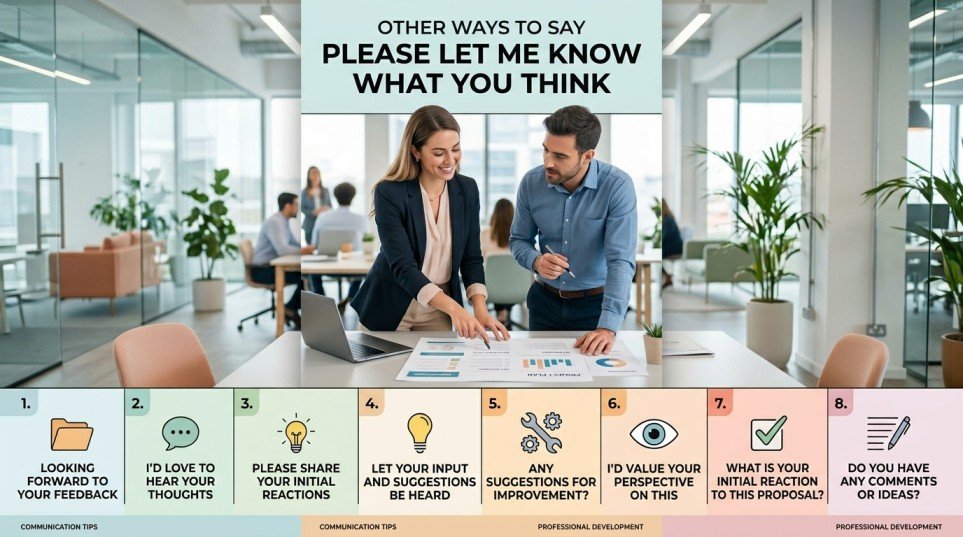
Quick Answer: Instead of saying please let me know what you think, you can use phrases like I’d appreciate your feedback, what are your thoughts, I’d love to hear your opinion, please share your thoughts, and let me know your perspective.
The phrase “please let me know what you think” is commonly used when asking for feedback, opinions, or suggestions. It’s polite, clear, and widely accepted in both personal and professional communication.
However, using the same expression repeatedly can make your writing sound repetitive. Native speakers often choose different alternatives depending on whether they are writing an email, requesting professional feedback, or having a casual conversation.
Learning alternatives to “please let me know what you think” helps you sound more natural, confident, and adaptable. It also strengthens your communication skills in workplace settings and improves your ability to use professional reaction phrases and informal expressions in English appropriately.
Quick Categories Section
Formal alternatives to “please let me know what you think”
- I would appreciate your feedback
- Kindly share your thoughts
- I welcome your input
- Please provide your perspective
Pro Tip: These phrases work well in business emails, reports, and professional discussions.
Casual alternatives
- What do you think?
- Let me know your thoughts
- I’d love to hear your opinion
- What’s your take on this?
Pro Tip: Use these when talking with friends, colleagues, or familiar contacts.
Professional alternatives
- I look forward to your feedback
- Please share your insights
- I’d value your opinion
- Let me know your perspective
Pro Tip: Professional alternatives sound collaborative and respectful without being overly formal.
Informal expressions
- What are your thoughts?
- Give me your take
- Tell me what you think
- How does it sound to you?
Pro Tip: These expressions are ideal for relaxed conversations and brainstorming sessions.
“The way you ask for feedback can influence the quality of responses you receive.”
Common Mistakes
- Sounding too demanding Example: “Tell me what you think immediately.”
- Being too vague Example: “Thoughts?” without context.
- Using informal phrases in formal emails Example: “Give me your take.”
- Repeating the same phrase excessively Example: Ending every email with “please let me know what you think.”
- Not specifying what feedback you need Example: Asking for opinions without mentioning the topic.
What Does “Please Let Me Know What You Think” Mean?
The phrase means asking someone to share their opinion, feedback, or perspective about something.
It is commonly used as a polite request in emails, conversations, presentations, and collaborative projects.
Example Sentence:
I’ve attached the proposal. Please let me know what you think.
When to Use “Please Let Me Know What You Think”
- Requesting feedback on a project
- Asking for opinions on an idea
- Seeking suggestions before making a decision
- Gathering input from colleagues or clients
- Sharing creative work for review
Spoken vs Written: Common in both
Formal vs Informal: Generally neutral and adaptable
Is It Professional or Polite to Say “Please Let Me Know What You Think”?
Polite? ✔️ Yes
Professional? ✔️ Yes
Unlike many conversational expressions, this phrase is widely accepted in professional communication because it encourages collaboration and feedback.
Business Example:
“I’ve revised the report based on our discussion. Please let me know what you think.”
Pros and Cons of Using “Please Let Me Know What You Think”
Pros
- Polite and professional
- Encourages feedback
- Easy to understand
- Suitable for most situations
Cons
- Can become repetitive
- Slightly generic
- Lacks personality
- May seem passive in some contexts
“The best communicators know how to invite feedback in different ways.”
Other Ways to Say “Please Let Me Know What You Think” (With Examples)
These alternatives will help you sound more fluent, confident, and natural in different situations.
Use them according to tone, context, and audience when requesting opinions, feedback, or suggestions.
1. Phrase: I’d appreciate your feedback
Meaning: I would value your comments or suggestions.
Explanation: A professional and respectful way to request input.
Example Sentence: I’d appreciate your feedback on the presentation draft.
Best Use: business email
Worst Use: casual texting
Tone: professional, respectful
Context Variability: professional / written
2. Phrase: What are your thoughts?
Meaning: Asking for someone’s opinion.
Explanation: Common and conversational.
Example Sentence: What are your thoughts on the new marketing strategy?
Best Use: meetings
Worst Use: legal documents
Tone: neutral, collaborative
Context Variability: casual / professional
3. Phrase: I’d love to hear your opinion
Meaning: You genuinely want their viewpoint.
Explanation: Friendly and engaging.
Example Sentence: I’d love to hear your opinion on this design.
Best Use: discussions
Worst Use: formal reports
Tone: warm, friendly
Context Variability: spoken / casual
4. Phrase: Please share your thoughts
Meaning: Invite someone to express their ideas.
Explanation: Works well in professional communication.
Example Sentence: Please share your thoughts when you have a moment.
Best Use: workplace
Worst Use: urgent requests
Tone: professional, polite
Context Variability: professional / written
5. Phrase: Let me know your perspective
Meaning: Request someone’s viewpoint.
Explanation: Useful when discussing different angles.
Example Sentence: Let me know your perspective on this proposal.
Best Use: strategic discussions
Worst Use: casual jokes
Tone: thoughtful, professional
Context Variability: professional
“Asking for feedback respectfully encourages honest and useful responses.”
6. Phrase: I’d value your opinion
Meaning: Your opinion is important to me.
Explanation: Shows respect for the other person’s expertise.
Example Sentence: I’d value your opinion before making a final decision.
Best Use: professional settings
Worst Use: playful chats
Tone: respectful, appreciative
Context Variability: professional
7. Phrase: What do you think?
Meaning: Asking directly for an opinion.
Explanation: One of the most common alternatives.
Example Sentence: What do you think about this idea?
Best Use: everyday conversation
Worst Use: highly formal writing
Tone: direct, friendly
Context Variability: casual / spoken
8. Phrase: I welcome your input
Meaning: Your feedback is encouraged.
Explanation: Formal and professional.
Example Sentence: I welcome your input on the proposed changes.
Best Use: workplace communication
Worst Use: casual text messages
Tone: professional, open
Context Variability: professional
9. Phrase: I’d be interested in your thoughts
Meaning: You want to hear someone’s ideas.
Explanation: Polite and conversational.
Example Sentence: I’d be interested in your thoughts on this topic.
Best Use: discussions
Worst Use: urgent business requests
Tone: curious, respectful
Context Variability: casual / professional
10. Phrase: Please provide your feedback
Meaning: Requesting comments or suggestions.
Explanation: Direct and professional.
Example Sentence: Please provide your feedback by Friday.
Best Use: business communication
Worst Use: informal conversations
Tone: professional, direct
Context Variability: professional / written
11. Phrase: Let me know how you feel about it
Meaning: Asking for personal impressions.
Explanation: More emotional and conversational.
Example Sentence: Let me know how you feel about the plan.
Best Use: personal discussions
Worst Use: legal correspondence
Tone: warm, conversational
Context Variability: spoken / casual
12. Phrase: I’d appreciate your thoughts
Meaning: Your ideas would be valuable.
Explanation: Similar to requesting feedback politely.
Example Sentence: I’d appreciate your thoughts on this approach.
Best Use: professional settings
Worst Use: casual banter
Tone: respectful, professional
Context Variability: professional
13. Phrase: What’s your take on this?
Meaning: Asking for someone’s interpretation or opinion.
Explanation: Slightly informal but common.
Example Sentence: What’s your take on this situation?
Best Use: discussions
Worst Use: formal reports
Tone: conversational, friendly
Context Variability: casual
14. Phrase: I’d like to hear your feedback
Meaning: Requesting comments or evaluation.
Explanation: Professional and straightforward.
Example Sentence: I’d like to hear your feedback on the draft.
Best Use: workplace
Worst Use: casual texting
Tone: professional, polite
Context Variability: professional
15. Phrase: Please share your insights
Meaning: Asking for knowledgeable input.
Explanation: Ideal when speaking with experts.
Example Sentence: Please share your insights on the project.
Best Use: expert discussions
Worst Use: casual chats
Tone: professional, respectful
Context Variability: professional
“Different situations require different ways of requesting feedback.”
16. Phrase: I look forward to your feedback
Meaning: You expect and value their response.
Explanation: Common in professional emails.
Example Sentence: I look forward to your feedback on the proposal.
Best Use: business emails
Worst Use: informal texts
Tone: professional, courteous
Context Variability: professional / written
17. Phrase: Tell me what you think
Meaning: Asking directly for an opinion.
Explanation: Casual and straightforward.
Example Sentence: Tell me what you think about this logo.
Best Use: friendly conversations
Worst Use: formal correspondence
Tone: direct, casual
Context Variability: casual
18. Phrase: I’d love your feedback
Meaning: Enthusiastically requesting input.
Explanation: Friendly and positive.
Example Sentence: I’d love your feedback on the article.
Best Use: creative work
Worst Use: formal legal documents
Tone: warm, enthusiastic
Context Variability: casual / professional
19. Phrase: Kindly share your opinion
Meaning: Politely request an opinion.
Explanation: More formal than everyday alternatives.
Example Sentence: Kindly share your opinion regarding the proposal.
Best Use: formal emails
Worst Use: casual conversations
Tone: formal, polite
Context Variability: professional
20. Phrase: How does this sound to you?
Meaning: Asking for a reaction or evaluation.
Explanation: Natural and conversational.
Example Sentence: How does this sound to you so far?
Best Use: brainstorming
Worst Use: official reports
Tone: friendly, collaborative
Context Variability: spoken
21. Phrase: I’d appreciate your input
Meaning: Your contribution would be valuable.
Explanation: Frequently used in professional environments.
Example Sentence: I’d appreciate your input before we proceed.
Best Use: workplace
Worst Use: casual texting
Tone: respectful, professional
Context Variability: professional
22. Phrase: Let me know your thoughts
Meaning: Requesting opinions.
Explanation: Flexible and widely used.
Example Sentence: Let me know your thoughts when you review it.
Best Use: general communication
Worst Use: highly formal documents
Tone: neutral, friendly
Context Variability: casual / professional
23. Phrase: I’d welcome your feedback
Meaning: Feedback is encouraged.
Explanation: Professional and inviting.
Example Sentence: I’d welcome your feedback on these recommendations.
Best Use: workplace
Worst Use: casual chats
Tone: professional, open
Context Variability: professional
24. Phrase: What is your opinion?
Meaning: Asking directly for a viewpoint.
Explanation: More formal than “What do you think?”
Example Sentence: What is your opinion on this matter?
Best Use: formal discussions
Worst Use: friendly banter
Tone: formal, direct
Context Variability: professional
25. Phrase: Please let me have your feedback
Meaning: Requesting comments or evaluation.
Explanation: Common in British English.
Example Sentence: Please let me have your feedback at your convenience.
Best Use: business communication
Worst Use: casual texting
Tone: professional, courteous
Context Variability: professional
26. Phrase: I’d be grateful for your thoughts
Meaning: Expressing appreciation in advance.
Explanation: Formal and respectful.
Example Sentence: I’d be grateful for your thoughts on the proposal.
Best Use: formal emails
Worst Use: casual conversation
Tone: formal, appreciative
Context Variability: professional
27. Phrase: Share your perspective
Meaning: Requesting a unique viewpoint.
Explanation: Encourages deeper discussion.
Example Sentence: Please share your perspective on the issue.
Best Use: strategic discussions
Worst Use: casual jokes
Tone: thoughtful, professional
Context Variability: professional
28. Phrase: Give me your take
Meaning: Tell me your opinion.
Explanation: Informal and conversational.
Example Sentence: Give me your take on the new design.
Best Use: casual discussions
Worst Use: formal emails
Tone: informal, friendly
Context Variability: casual
29. Phrase: I’d like your honest opinion
Meaning: Requesting truthful feedback.
Explanation: Encourages candid responses.
Example Sentence: I’d like your honest opinion about the presentation.
Best Use: constructive feedback
Worst Use: formal reports
Tone: sincere, direct
Context Variability: casual / professional
30. Phrase: Feel free to share your thoughts
Meaning: The person is welcome to provide feedback.
Explanation: Friendly and inviting.
Example Sentence: Feel free to share your thoughts whenever you’re ready.
Best Use: open discussions
Worst Use: urgent requests
Tone: welcoming, relaxed
Context Variability: casual / professional
“The most effective feedback requests are clear, respectful, and appropriate for the situation.”
Mini Quiz / Self-Check
1. Which phrase is best for a business email?
A. Give me your take
B. I’d appreciate your feedback
C. Tell me what you think
Answer: B
2. Which phrase is the most informal?
A. Kindly share your opinion
B. Give me your take
C. I welcome your input
Answer: B
3. Which phrase sounds most professional?
A. I’d value your opinion
B. What’s your take on this?
C. Tell me what you think
Answer: A
Comparison Table: Top Alternatives
| Phrase | Tone | Best Use |
|---|---|---|
| I’d appreciate your feedback | Professional | Business emails |
| What are your thoughts? | Neutral | Discussions |
| I’d value your opinion | Professional | Decision-making |
| Please share your thoughts | Professional | Workplace |
| I look forward to your feedback | Professional | Email closing |
| What do you think? | Casual | Everyday conversations |
| Let me know your perspective | Professional | Strategic discussions |
| I’d love to hear your opinion | Friendly | Personal discussions |
| Kindly share your opinion | Formal | Professional writing |
| Feel free to share your thoughts | Friendly | Open discussions |
FAQs
What are the best alternatives to “please let me know what you think”?
Some of the best alternatives include I’d appreciate your feedback, what are your thoughts?, I’d value your opinion, and please share your insights.
Is “please let me know what you think” professional?
Yes. It is both polite and professional, making it suitable for emails, meetings, and collaborative projects.
What can I say instead in a business email?
Try phrases such as I look forward to your feedback, I’d appreciate your input, or please provide your feedback.
Which alternatives sound more formal?
Formal options include kindly share your opinion, I welcome your input, and I’d be grateful for your thoughts.
Why should I learn other ways to say “please let me know what you think”?
Using varied expressions improves fluency, prevents repetition, and helps you adapt your tone for different audiences and situations.
Conclusion
Learning other ways to say “please let me know what you think” can significantly improve your communication skills. Whether you’re requesting feedback from a manager, client, colleague, or friend, having multiple options allows you to sound more natural and professional.
Practice these alternatives regularly and pay attention to tone. The more variety you use, the more confident, fluent, and effective your English communication will become.
CTA: Which of these phrases do you use most often? Try replacing it with a new alternative in your next email or conversation.
Discover More:-
- Other Ways to Say At Your Earliest Convenience (30+ Examples)
- Other Ways to Say Happy to Be Part of the Team (30+ Examples)

Lisa Thompson is a USA-based content writer and language specialist focused on grammar, writing improvement and digital publishing.
She holds a degree in English Language and Communication and has professional experience in educational and web content creation.
As the author of Gramtivo.Com, she aims to help readers improve their writing skills through clear and practical guidance.