
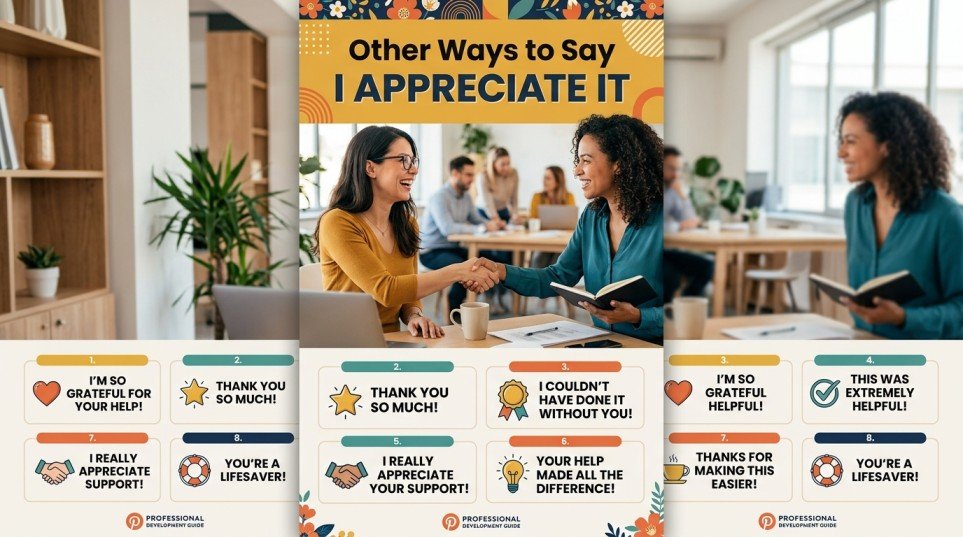
Quick Answer: Instead of saying I appreciate it, you can say: thank you so much, I’m grateful, much appreciated, I truly value it, thanks a lot.
The phrase “I appreciate it” is commonly used to express gratitude, recognition, or sincere thanks. It’s polite, versatile, and widely used in both casual and professional English.
Although it’s an excellent phrase, using it too often can sound repetitive. Native speakers frequently switch between different expressions depending on tone, relationship, and context.
Learning alternatives to “I appreciate it” helps you sound more fluent, natural, and expressive. It also improves your ability to use professional reaction phrases and informal expressions in English while helping you express excitement in English more naturally.
Quick Categories Section
Formal alternatives to “I appreciate it”
- I sincerely appreciate it
- I’m truly grateful
- Your assistance is greatly appreciated
- Thank you for your support
Pro Tip: Use these in emails, meetings, and formal communication.
Casual alternatives
- Thanks a lot
- I owe you one
- Much appreciated
- You’re awesome
Pro Tip: Friendly expressions work best with people you know well.
Professional alternatives
- I truly value your help
- Your support means a lot
- Thank you for your assistance
- I greatly appreciate your time
Pro Tip: Professional phrases should sound warm but concise.
Informal expressions
- Big thanks
- You’re the best
- Thanks a bunch
- Really appreciate it
Pro Tip: Keep informal phrases out of formal workplace writing.
“Expressing gratitude naturally makes your English sound more confident and authentic.”
Common Mistakes
- Overusing the same phrase repeatedly
Example: Saying “I appreciate it” in every email reply. - Using overly casual phrases professionally
Example: “You’re awesome” in a business email. - Sounding insincere
Example: Using short responses without warmth. - Choosing the wrong tone
Example: “Thanks a bunch” in legal communication. - Being too vague
Example: Not specifying what you appreciate.
What Does “I Appreciate It” Mean?
It means you are thankful for someone’s help, effort, kindness, or support.
Grammatically, it’s a present tense expression used to show gratitude and recognition.
Example Sentence:
I appreciate it more than you know.
When to Use “I Appreciate It”
- When someone helps you
- After receiving support or kindness
- In workplace communication
- In both spoken and written English
Spoken vs Written: Common in both
Formal vs Informal: Neutral and versatile
Is It Professional or Polite to Say “I Appreciate It”?
Polite? ✔️ Yes
Professional? ✔️ Yes
Business Example:
“I appreciate your quick response and support on this project.”
Pros and Cons of Using “I Appreciate It”
Pros
- Professional and polite
- Easy to understand
- Works in many situations
- Sounds sincere
Cons
- Can become repetitive
- Slightly generic
- Limited emotional variety
- Less expressive in casual conversations
“Small changes in gratitude expressions can make your communication more memorable.”
Other Ways to Say “I Appreciate It” (With Examples)
These alternatives will help you sound more fluent, confident, and natural in different situations.
Use them based on tone, audience, and context.
1. Phrase: Thank you so much
Meaning: Strong expression of gratitude.
Explanation: Common and warm.
Example Sentence: Thank you so much for your help today.
Best Use: general use
Worst Use: sarcastic tone
Tone: warm, grateful
Context Variability: casual / professional
2. Phrase: Much appreciated
Meaning: Your help is valued.
Explanation: Short and professional.
Example Sentence: Your quick reply is much appreciated.
Best Use: workplace
Worst Use: emotional talk
Tone: professional, polite
Context Variability: professional / written
3. Phrase: I’m truly grateful
Meaning: Deep appreciation.
Explanation: More emotional and sincere.
Example Sentence: I’m truly grateful for your support.
Best Use: heartfelt thanks
Worst Use: casual jokes
Tone: sincere, emotional
Context Variability: professional / spoken
4. Phrase: Thanks a lot
Meaning: Strong thanks.
Explanation: Casual and common.
Example Sentence: Thanks a lot for helping me move.
Best Use: friendly talk
Worst Use: formal letter
Tone: casual, warm
Context Variability: casual
5. Phrase: I truly value it
Meaning: You deeply appreciate something.
Explanation: Professional and thoughtful.
Example Sentence: I truly value your advice.
Best Use: workplace
Worst Use: slang context
Tone: professional, respectful
Context Variability: professional
“Fluent English speakers use different gratitude phrases for different situations.”
6. Phrase: I can’t thank you enough
Meaning: Extremely thankful.
Explanation: Strong emotional gratitude.
Example Sentence: I can’t thank you enough for your kindness.
Best Use: emotional support
Worst Use: small favors
Tone: heartfelt, emotional
Context Variability: spoken
7. Phrase: Your help means a lot
Meaning: The help is important to you.
Explanation: Warm and sincere.
Example Sentence: Your help means a lot to me.
Best Use: personal support
Worst Use: formal reports
Tone: sincere, appreciative
Context Variability: casual / professional
8. Phrase: Many thanks
Meaning: Formal gratitude.
Explanation: Common in professional writing.
Example Sentence: Many thanks for your assistance.
Best Use: emails
Worst Use: casual slang
Tone: formal, polite
Context Variability: professional / written
9. Phrase: I owe you one
Meaning: You want to return the favor.
Explanation: Casual and friendly.
Example Sentence: I owe you one for helping me out.
Best Use: friends
Worst Use: workplace email
Tone: informal, friendly
Context Variability: casual
10. Phrase: Thanks a bunch
Meaning: Friendly gratitude.
Explanation: Informal and cheerful.
Example Sentence: Thanks a bunch for the ride.
Best Use: casual talk
Worst Use: formal communication
Tone: cheerful, informal
Context Variability: casual
11. Phrase: I’m thankful for your help
Meaning: Appreciation for assistance.
Explanation: Clear and sincere.
Example Sentence: I’m thankful for your help during the project.
Best Use: workplace
Worst Use: sarcastic use
Tone: sincere, professional
Context Variability: professional
12. Phrase: Your support is greatly appreciated
Meaning: Formal gratitude.
Explanation: Very professional wording.
Example Sentence: Your support is greatly appreciated.
Best Use: business communication
Worst Use: casual chats
Tone: formal, respectful
Context Variability: professional
13. Phrase: I really appreciate that
Meaning: Genuine gratitude.
Explanation: Slightly more personal.
Example Sentence: I really appreciate that you checked in on me.
Best Use: personal conversations
Worst Use: formal legal writing
Tone: warm, sincere
Context Variability: casual / spoken
14. Phrase: Thanks for everything
Meaning: Gratitude for overall support.
Explanation: Broader appreciation.
Example Sentence: Thanks for everything you’ve done.
Best Use: emotional thanks
Worst Use: tiny favors
Tone: heartfelt, warm
Context Variability: spoken
15. Phrase: I appreciate your time
Meaning: Thankful for someone’s effort or availability.
Explanation: Common in professional settings.
Example Sentence: I appreciate your time and feedback.
Best Use: meetings
Worst Use: casual jokes
Tone: professional, polite
Context Variability: professional
“The right gratitude phrase can strengthen both personal and professional relationships.”
16. Phrase: I’m grateful for your support
Meaning: Appreciation for encouragement or help.
Explanation: Sincere and professional.
Example Sentence: I’m grateful for your support throughout the process.
Best Use: workplace
Worst Use: jokes
Tone: sincere, respectful
Context Variability: professional
17. Phrase: Thank you kindly
Meaning: Polite gratitude.
Explanation: Slightly old-fashioned but respectful.
Example Sentence: Thank you kindly for your assistance.
Best Use: formal speech
Worst Use: modern slang
Tone: formal, polite
Context Variability: professional
18. Phrase: Big thanks
Meaning: Strong casual appreciation.
Explanation: Informal and energetic.
Example Sentence: Big thanks for helping us today.
Best Use: casual groups
Worst Use: formal email
Tone: cheerful, informal
Context Variability: casual
19. Phrase: You’re the best
Meaning: Strong praise and gratitude.
Explanation: Very friendly expression.
Example Sentence: You’re the best for covering my shift.
Best Use: friends
Worst Use: corporate emails
Tone: playful, warm
Context Variability: casual
20. Phrase: I appreciate your support
Meaning: Thankful for assistance or encouragement.
Explanation: Balanced and versatile.
Example Sentence: I appreciate your support on this project.
Best Use: workplace
Worst Use: sarcasm
Tone: professional, sincere
Context Variability: professional / spoken
21. Phrase: Thanks for your help
Meaning: Gratitude for assistance.
Explanation: Direct and common.
Example Sentence: Thanks for your help with the report.
Best Use: everyday use
Worst Use: highly emotional moments
Tone: neutral, polite
Context Variability: casual / professional
22. Phrase: I’m deeply thankful
Meaning: Strong emotional gratitude.
Explanation: More heartfelt and serious.
Example Sentence: I’m deeply thankful for your kindness.
Best Use: emotional support
Worst Use: small casual favors
Tone: emotional, sincere
Context Variability: spoken
23. Phrase: Thank you for your kindness
Meaning: Appreciation for thoughtful actions.
Explanation: Warm and respectful.
Example Sentence: Thank you for your kindness during a difficult time.
Best Use: emotional situations
Worst Use: jokes
Tone: warm, respectful
Context Variability: professional / spoken
24. Phrase: I value your help
Meaning: Your assistance matters greatly.
Explanation: Professional and appreciative.
Example Sentence: I value your help and expertise.
Best Use: workplace
Worst Use: casual slang
Tone: professional, respectful
Context Variability: professional
25. Phrase: Thanks for being there
Meaning: Appreciation for emotional support.
Explanation: Personal and heartfelt.
Example Sentence: Thanks for being there when I needed help.
Best Use: close relationships
Worst Use: business communication
Tone: emotional, warm
Context Variability: spoken
26. Phrase: I appreciate your effort
Meaning: Recognition of hard work.
Explanation: Often used professionally.
Example Sentence: I appreciate your effort on this assignment.
Best Use: workplace
Worst Use: jokes
Tone: professional, supportive
Context Variability: professional
27. Phrase: Thanks again
Meaning: Repeated gratitude.
Explanation: Useful in follow-up messages.
Example Sentence: Thanks again for your support today.
Best Use: emails
Worst Use: emotional speeches
Tone: polite, friendly
Context Variability: professional / casual
28. Phrase: I’m so thankful
Meaning: Strong appreciation.
Explanation: Emotional and warm.
Example Sentence: I’m so thankful for everything you’ve done.
Best Use: heartfelt moments
Worst Use: formal reports
Tone: sincere, emotional
Context Variability: spoken
29. Phrase: Your assistance means a lot
Meaning: Help is highly valued.
Explanation: Professional and warm.
Example Sentence: Your assistance means a lot to our team.
Best Use: workplace
Worst Use: slang contexts
Tone: respectful, appreciative
Context Variability: professional
30. Phrase: I sincerely appreciate it
Meaning: Deep and genuine gratitude.
Explanation: Formal and versatile.
Example Sentence: I sincerely appreciate it and thank you again.
Best Use: professional communication
Worst Use: sarcastic tone
Tone: formal, sincere
Context Variability: professional / written
“The more gratitude expressions you know, the more natural your English becomes.”
Mini Quiz / Self-Check
1. Which phrase is best for a professional email?
A. You’re the best
B. I sincerely appreciate it
C. Thanks a bunch
Answer: B
2. Which phrase is most informal?
A. Many thanks
B. Big thanks
C. Your support is greatly appreciated
Answer: B
3. Which expression sounds most emotional?
A. I’m deeply thankful
B. Thanks again
C. Much appreciated
Answer: A
Comparison Table: Top Alternatives
| Phrase | Tone | Best Use |
|---|---|---|
| Thank you so much | Warm | General |
| Much appreciated | Professional | Work |
| I’m truly grateful | Emotional | Heartfelt thanks |
| Thanks a lot | Casual | Friends |
| I truly value it | Professional | Workplace |
| I can’t thank you enough | Emotional | Strong gratitude |
| Many thanks | Formal | Emails |
| I owe you one | Informal | Friends |
| I appreciate your time | Professional | Meetings |
| I sincerely appreciate it | Formal | Business |
FAQs
1. What are the best alternatives to “I appreciate it”?
Popular options include thank you so much, much appreciated, and I sincerely appreciate it.
2. Is “I appreciate it” professional?
Yes, it’s polite and professional in most workplace situations.
3. What should I say instead in formal emails?
Use phrases like many thanks or your support is greatly appreciated.
4. Can I use informal expressions in English professionally?
Only in relaxed workplaces; otherwise, choose professional reaction phrases.
5. Why learn other ways to say “I appreciate it”?
It improves fluency, tone variety, and communication confidence.
Conclusion
Learning different other ways to say “I appreciate it” helps you sound more natural, expressive, and fluent. It also allows you to communicate gratitude appropriately in both personal and professional situations.
Practice these expressions regularly and pay attention to tone. Over time, your English will sound more polished, confident, and engaging.
CTA: Which gratitude phrase do you use most often? Try a new one today.
Discover More:-

Robert Mitchell is a U.S.-based writer at Gramtivo.Com who focuses on grammar, writing improvement, and language-related content. He holds a degree in English and Linguistics from a U.S. university. His work aims to help readers enhance their writing skills with clear and practical guidance.