
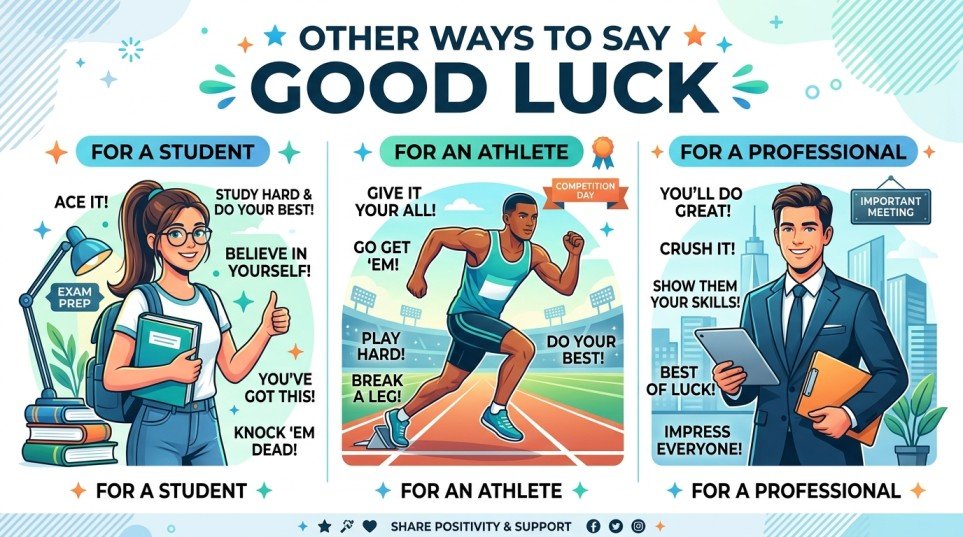
Quick Answer: Instead of saying good luck, you can say best of luck, wishing you success, you’ve got this, fingers crossed, go crush it depending on the situation and tone.
The phrase “good luck” is one of the most common ways to wish someone success before an important event, challenge, or opportunity. People use it before exams, job interviews, presentations, competitions, and many other situations.
Although it is universally understood, repeating the same phrase can make your English sound predictable. Native speakers often use different expressions to better match the occasion and relationship.
Learning alternatives to “good luck” helps you sound more natural and expressive. It also improves your ability to adapt your tone in professional, casual, and social settings. Expanding your vocabulary is a great way to express excitement in English and encourage others more effectively.
Quick Categories Section
Formal alternatives to “good luck”
- Wishing you success
- Best wishes
- I wish you every success
- All the best
Pro Tip: These phrases work well in professional emails, academic settings, and formal conversations.
Casual alternatives
- You’ve got this
- Fingers crossed
- Go for it
- Knock ’em dead
Pro Tip: Use these with friends, classmates, or family members.
Professional alternatives
- Wishing you the best
- Best of luck with your project
- I’m confident you’ll do well
- Wishing you a successful outcome
Pro Tip: Professional alternatives sound encouraging without being overly personal.
Informal expressions
- Go crush it
- Break a leg
- Smash it
- Rock it
Pro Tip: Save these expressions for casual conversations and friendly interactions.
“The right encouragement can boost confidence before any challenge.”
Common Mistakes
- Using overly casual phrases in formal situations
Example: “Go crush it” in a corporate email. - Choosing expressions without understanding meaning
Example: Using “break a leg” without knowing it’s an encouragement. - Overusing “good luck” in every situation
Example: Repeating the phrase instead of using variety. - Using slang in professional communication
Example: Saying “smash it” to a client. - Ignoring cultural context
Example: Some idioms may not be familiar to all English speakers.
What Does “Good Luck” Mean?
“Good luck” is an expression used to wish someone success, favorable results, or positive outcomes.
Grammatically, it is a fixed expression rather than a complete sentence.
Example Sentence:
Good luck with your presentation tomorrow.
When to Use “Good Luck”
- Before exams or tests
- Prior to job interviews
- Before sports competitions
- During important life events
- Before presentations or performances
Spoken vs Written: Common in both
Formal vs Informal: Generally neutral
Is It Professional or Polite to Say “Good Luck”?
Polite? ✔️ Yes
Professional? ✔️ Yes
Business Example:
“Good luck with the client presentation this afternoon.”
Pros and Cons of Using “Good Luck”
Pros
- Simple and natural
- Universally understood
- Works in many situations
- Friendly and supportive
Cons
- Very common
- Can sound repetitive
- Lacks personality
- May feel generic
“A thoughtful alternative often feels more personal than a simple ‘good luck.’”
Other Ways to Say “Good Luck” (With Examples)
These alternatives will help you sound more fluent, confident, and natural in different situations.
Use them according to tone, context, and audience.
1. Phrase: Best of luck
Meaning: Wishing someone great success.
Explanation: A slightly more polished version of “good luck.”
Example Sentence: Best of luck with your interview tomorrow.
Best Use: interviews, exams
Worst Use: casual jokes
Tone: supportive, positive
Context Variability: professional / spoken
2. Phrase: All the best
Meaning: Wishing success and happiness.
Explanation: Common in both formal and informal settings.
Example Sentence: All the best for your new role.
Best Use: career changes
Worst Use: competitive banter
Tone: warm, polite
Context Variability: professional / casual
3. Phrase: Wishing you success
Meaning: Hoping someone achieves their goal.
Explanation: Formal and professional.
Example Sentence: Wishing you success in your upcoming project.
Best Use: workplace
Worst Use: casual chat
Tone: professional, encouraging
Context Variability: professional / written
4. Phrase: You’ve got this
Meaning: You are capable of succeeding.
Explanation: Focuses on confidence rather than luck.
Example Sentence: You’ve got this, just stay focused.
Best Use: motivation
Worst Use: formal email
Tone: confident, supportive
Context Variability: casual / spoken
5. Phrase: Fingers crossed
Meaning: Hoping for a positive outcome.
Explanation: A popular informal expression.
Example Sentence: Fingers crossed everything goes well today.
Best Use: uncertain outcomes
Worst Use: formal reports
Tone: hopeful, friendly
Context Variability: casual
“Encouragement sounds stronger when it focuses on confidence, not just luck.”
6. Phrase: Go for it
Meaning: Take the opportunity confidently.
Explanation: Encourages action and courage.
Example Sentence: Go for it; you have nothing to lose.
Best Use: decision-making
Worst Use: formal writing
Tone: motivating, casual
Context Variability: spoken
7. Phrase: I’m rooting for you
Meaning: I support your success.
Explanation: Shows personal encouragement.
Example Sentence: I’m rooting for you in the competition.
Best Use: personal support
Worst Use: business emails
Tone: warm, supportive
Context Variability: casual
8. Phrase: Knock ’em dead
Meaning: Perform exceptionally well.
Explanation: Popular informal idiom.
Example Sentence: Knock ’em dead at the audition.
Best Use: performances
Worst Use: formal communication
Tone: energetic, informal
Context Variability: casual
9. Phrase: Wishing you the best
Meaning: Hoping for a positive outcome.
Explanation: Flexible and professional.
Example Sentence: Wishing you the best in your future endeavors.
Best Use: workplace
Worst Use: playful situations
Tone: polite, supportive
Context Variability: professional
10. Phrase: I know you’ll do great
Meaning: Expressing confidence in someone.
Explanation: More personal than wishing luck.
Example Sentence: I know you’ll do great on the exam.
Best Use: encouragement
Worst Use: formal announcements
Tone: confident, positive
Context Variability: spoken
“Confidence-based phrases often feel more meaningful than luck-based ones.”
11. Phrase: Break a leg
Meaning: Perform successfully.
Explanation: Common theater expression.
Example Sentence: Break a leg during tonight’s performance.
Best Use: performances
Worst Use: literal contexts
Tone: playful, encouraging
Context Variability: casual
12. Phrase: Go crush it
Meaning: Achieve outstanding results.
Explanation: Modern motivational expression.
Example Sentence: Go crush it in the meeting today.
Best Use: motivation
Worst Use: formal writing
Tone: energetic, positive
Context Variability: casual
13. Phrase: I wish you every success
Meaning: Hoping for complete success.
Explanation: Formal and polished.
Example Sentence: I wish you every success in your new position.
Best Use: professional settings
Worst Use: casual chats
Tone: formal, respectful
Context Variability: professional
14. Phrase: Wishing you a successful outcome
Meaning: Hoping for positive results.
Explanation: Professional alternative.
Example Sentence: Wishing you a successful outcome for the negotiations.
Best Use: workplace
Worst Use: friendly banter
Tone: professional, supportive
Context Variability: professional
15. Phrase: May everything go well
Meaning: Hoping for smooth success.
Explanation: Gentle and sincere.
Example Sentence: May everything go well for you today.
Best Use: thoughtful wishes
Worst Use: slang contexts
Tone: warm, sincere
Context Variability: casual / professional
16. Phrase: Hope it all works out
Meaning: Wishing for a positive result.
Explanation: Friendly and natural.
Example Sentence: Hope it all works out for you.
Best Use: everyday conversation
Worst Use: formal letters
Tone: casual, supportive
Context Variability: casual
17. Phrase: You’ll be amazing
Meaning: Expressing confidence in someone.
Explanation: Encouraging and uplifting.
Example Sentence: You’ll be amazing during the presentation.
Best Use: motivation
Worst Use: formal communication
Tone: positive, enthusiastic
Context Variability: spoken
18. Phrase: Bring home the win
Meaning: Achieve victory.
Explanation: Common in sports contexts.
Example Sentence: Go bring home the win.
Best Use: sports
Worst Use: office emails
Tone: energetic, competitive
Context Variability: casual
19. Phrase: Wishing you good fortune
Meaning: Hoping luck is on your side.
Explanation: Formal and traditional.
Example Sentence: Wishing you good fortune in your endeavors.
Best Use: formal writing
Worst Use: casual chats
Tone: formal, respectful
Context Variability: professional
20. Phrase: Do your best
Meaning: Give maximum effort.
Explanation: Focuses on effort rather than luck.
Example Sentence: Just do your best and stay calm.
Best Use: exams
Worst Use: farewell messages
Tone: encouraging, practical
Context Variability: spoken
“The strongest encouragement often highlights effort and ability rather than luck.”
21. Phrase: Rock it
Meaning: Perform extremely well.
Explanation: Informal motivational phrase.
Example Sentence: You’re going to rock it.
Best Use: friends
Worst Use: formal emails
Tone: energetic, casual
Context Variability: casual
22. Phrase: Smash it
Meaning: Achieve great success.
Explanation: Popular British expression.
Example Sentence: You’ll smash the interview.
Best Use: motivation
Worst Use: formal settings
Tone: enthusiastic, informal
Context Variability: casual
23. Phrase: Here’s to your success
Meaning: Celebrating future achievement.
Explanation: Slightly formal and uplifting.
Example Sentence: Here’s to your success in the competition.
Best Use: speeches
Worst Use: casual texting
Tone: positive, inspiring
Context Variability: professional
24. Phrase: Make us proud
Meaning: Encouragement to succeed.
Explanation: Often used by family and friends.
Example Sentence: Go out there and make us proud.
Best Use: personal support
Worst Use: formal emails
Tone: encouraging, emotional
Context Variability: casual
25. Phrase: Give it your all
Meaning: Put forth maximum effort.
Explanation: Motivational and practical.
Example Sentence: Give it your all and stay confident.
Best Use: competitions
Worst Use: farewell notes
Tone: motivating, supportive
Context Variability: spoken
26. Phrase: I believe in you
Meaning: Expressing confidence in someone’s abilities.
Explanation: Personal and meaningful encouragement.
Example Sentence: I believe in you completely.
Best Use: emotional support
Worst Use: formal documents
Tone: supportive, sincere
Context Variability: casual
27. Phrase: Go make it happen
Meaning: Take action and succeed.
Explanation: Motivational expression.
Example Sentence: Go make it happen today.
Best Use: goals
Worst Use: formal reports
Tone: energetic, encouraging
Context Variability: casual
28. Phrase: May fortune favor you
Meaning: Wishing luck and success.
Explanation: Literary and dramatic expression.
Example Sentence: May fortune favor you in the tournament.
Best Use: creative contexts
Worst Use: business emails
Tone: dramatic, formal
Context Variability: spoken
29. Phrase: I’m sure you’ll succeed
Meaning: Expressing certainty in success.
Explanation: Confidence-focused encouragement.
Example Sentence: I’m sure you’ll succeed in the interview.
Best Use: motivation
Worst Use: casual jokes
Tone: confident, supportive
Context Variability: casual / professional
30. Phrase: Wishing you every success and happiness
Meaning: Hoping for success and well-being.
Explanation: Formal and comprehensive wish.
Example Sentence: Wishing you every success and happiness in your new journey.
Best Use: formal messages
Worst Use: quick chats
Tone: formal, warm
Context Variability: professional / written
“The best encouragement combines positivity, confidence, and sincerity.”
Mini Quiz / Self-Check
1. Which phrase is best for a professional email?
A. Go crush it
B. Wishing you success
C. Smash it
Answer: B
2. Which expression is commonly used in theater?
A. Break a leg
B. Fingers crossed
C. Rock it
Answer: A
3. Which phrase focuses on confidence instead of luck?
A. You’ve got this
B. Good luck
C. Fingers crossed
Answer: A
4. Which phrase is most formal?
A. I wish you every success
B. Go for it
C. Knock ’em dead
Answer: A
Comparison Table: Top Alternatives
| Phrase | Tone | Best Use |
|---|---|---|
| Best of luck | Polite | Exams, interviews |
| All the best | Warm | General wishes |
| Wishing you success | Professional | Workplace |
| You’ve got this | Encouraging | Motivation |
| Fingers crossed | Casual | Uncertain outcomes |
| I’m rooting for you | Supportive | Friends |
| Break a leg | Informal | Performances |
| Wishing you the best | Professional | Career events |
| I believe in you | Personal | Emotional support |
| I wish you every success | Formal | Business communication |
FAQs
1. What are the best alternatives to “good luck”?
Some of the best alternatives include best of luck, all the best, you’ve got this, and wishing you success.
2. Is “good luck” professional?
Yes. It is polite and professional, though more formal alternatives may be better in business communication.
3. What can I say instead of “good luck” in a job interview?
You can say best of luck, wishing you success, or I’m confident you’ll do well.
4. What is a more encouraging alternative to “good luck”?
You’ve got this and I believe in you focus on confidence rather than luck.
5. Why should I learn other ways to say “good luck”?
Using different expressions improves fluency, avoids repetition, and helps you match the right tone to the situation.
Conclusion
Learning other ways to say “good luck” allows you to communicate encouragement more effectively. Different situations require different tones, and having a wider vocabulary helps you sound more natural and confident.
Practice these alternatives regularly in conversations, emails, and social interactions. The more variety you use, the more fluent and expressive your English will become.
CTA: Which alternative to good luck is your favorite? Try using it in your next conversation.
Discover More:-
- Other Ways to Say Thank You for Your Understanding (30+ Examples)
- Other Ways to Say Please Forward This Email (30+ Examples)

Lisa Thompson is a USA-based content writer and language specialist focused on grammar, writing improvement and digital publishing.
She holds a degree in English Language and Communication and has professional experience in educational and web content creation.
As the author of Gramtivo.Com, she aims to help readers improve their writing skills through clear and practical guidance.