
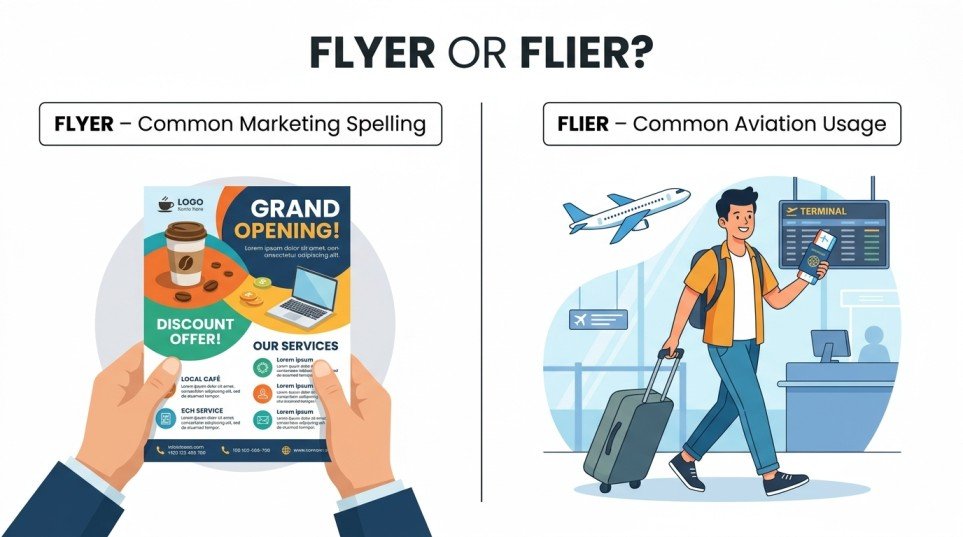
Quick Ans: The difference between flyer or flier is mainly spelling and usage. Both words refer to a person, object, or advertisement that flies, but flyer is the more common spelling in modern English, especially for printed promotional materials. Meanwhile, flier remains accepted and is often preferred in certain style guides and official names.
Many writers, marketers, students, and business owners wonder whether they should use flyer or flier. At first glance, the two words seem interchangeable. After all, they sound exactly the same and often carry the same meaning.
However, spelling preferences can vary depending on context.
For example, a company advertising an event may create a flyer. A frequent airline passenger might be called a frequent flier. Certain organizations also choose one spelling over the other for branding purposes.
This small spelling difference creates confusion for many English learners and native speakers alike. As a result, people often search for grammar guides before writing advertisements, business documents, or academic papers.
Understanding the distinction between flyer or flier helps improve writing accuracy and professionalism. It also ensures consistency when creating marketing materials or following editorial guidelines.
This complete guide explains the meanings, differences, advantages, usage examples, common mistakes, and grammar rules associated with flyer and flier.
Quick Answer: Flyer or Flier
For most situations, flyer is the preferred spelling.
Both words are correct. Nevertheless, modern dictionaries and common usage favor flyer, especially when referring to printed advertisements.
| Usage | Flyer | Flier |
|---|---|---|
| Printed advertisement | Common | Less common |
| Person who flies | Accepted | Accepted |
| Frequent airline traveler | Less common | Often preferred |
| Modern business usage | Most common | Less common |
| General English writing | Preferred | Accepted |
In simple terms, use flyer for marketing materials and general writing. Use flier when following specific style guides or official names.
What Does Flyer Mean?
The word flyer has several meanings in English.
Most commonly, it refers to a printed sheet used for advertising, promotion, or announcements.
Examples include:
- Event advertisements
- Business promotions
- Restaurant menus
- Community announcements
- Sales notices
Common Uses of Flyer
Businesses frequently use flyers to attract customers.
Examples:
- A restaurant distributes flyers promoting a new menu.
- A school creates flyers for a fundraising event.
- A real estate agent hands out flyers about available properties.
In addition, flyer can describe something that flies.
Examples:
- The bird is a strong flyer.
- The athlete became a high flyer in the competition.
Because of its broad acceptance, flyer appears more often in everyday writing.
Why Flyer Became Popular
Language naturally evolves over time. Consequently, certain spellings become more common.
Today, most dictionaries list flyer as the primary spelling. Furthermore, businesses, marketers, and advertisers overwhelmingly use flyer when discussing promotional materials.
What Does Flier Mean?
The word flier is also a correct spelling.
Historically, flier appeared frequently in English writing and still remains accepted by major dictionaries.
Common Uses of Flier
You may encounter flier in several situations:
- Frequent airline traveler
- Person who flies aircraft
- Official organization names
- Certain newspaper style guides
Examples:
- She is a frequent flier with several airlines.
- The experienced flier landed the plane safely.
Although flier remains correct, it appears less often in modern advertising and marketing contexts.
Why Flier Still Exists
English contains many words with multiple accepted spellings.
For instance:
- Adviser and advisor
- Canceled and cancelled
- Theater and theatre
Similarly, flyer and flier coexist because both forms developed through historical language usage.
Key Differences Between Flyer or Flier
Spelling Preference
The most obvious difference involves spelling.
Modern English generally favors flyer. However, flier remains acceptable.
Advertising Usage
When referring to promotional materials, flyer dominates.
Marketing professionals, printers, and businesses almost always choose flyer.
Aviation Usage
In aviation contexts, flier appears more frequently.
For example:
- Frequent flier programs
- Experienced fliers
- Aviation publications
Style Guide Differences
Some style guides prefer one spelling over the other.
For example:
- Many dictionaries prefer flyer.
- Certain journalism guides prefer flier for people who fly.
Therefore, context matters when choosing between flyer or flier.
Flyer vs Flier Comparison Table
| Feature | Flyer | Flier |
|---|---|---|
| Dictionary Acceptance | Yes | Yes |
| Marketing Materials | Most common | Less common |
| Airline Traveler | Acceptable | Often preferred |
| Business Writing | Preferred | Less common |
| Modern Usage Frequency | Higher | Lower |
| Advertising Industry | Standard choice | Rare |
This comparison highlights why flyer is usually the safer option.
Advantages and Disadvantages
Advantages of Using Flyer
- Most widely recognized spelling
- Common in marketing and advertising
- Preferred by many dictionaries
- Easier for readers to recognize
Disadvantages of Using Flyer
- May not match certain style guides
- Less common in aviation terminology
Advantages of Using Flier
- Accepted spelling
- Often used in aviation contexts
- Preferred by some organizations
Disadvantages of Using Flier
- Less familiar to many readers
- Can appear unusual in marketing materials
Because of these factors, flyer generally works best for broad audiences.
Real World Examples
Business Marketing
A local restaurant prints 5,000 flyers promoting weekend specials.
Most customers expect the word flyer on advertising materials.
Airline Industry
An airline launches a frequent flier rewards program.
In this case, flier may appear because it follows established aviation terminology.
School Events
Schools often distribute flyers announcing sports events, fundraisers, and parent meetings.
Community Organizations
Local groups commonly post flyers on bulletin boards to promote activities and meetings.
These examples demonstrate how context influences the flyer or flier choice.
Regional and Global Usage
United States
In the United States, flyer dominates advertising and business communication.
Flier still appears in aviation and official program names.
United Kingdom
British English also tends to favor flyer for promotional materials.
Nevertheless, both spellings remain acceptable.
International English
Around the world, flyer is generally the more recognizable spelling.
As a result, international businesses usually choose flyer for marketing campaigns.
Related Concepts and Comparisons
Flyer vs Brochure
A flyer is usually a single sheet.
A brochure often contains multiple folds and more detailed information.
Flyer vs Poster
Flyers are small and distributed individually.
Posters are larger and designed for wall display.
Flyer vs Leaflet
These terms are similar.
However, leaflet is more common in British English.
Flyer vs Advertisement
A flyer is one type of advertisement.
Advertisements can also include television, radio, digital, and print media.
Understanding these related terms helps clarify the broader marketing landscape.
Common Mistakes About Flyer or Flier
Assuming One Spelling Is Wrong
Many people believe only one spelling is correct.
In reality, both flyer and flier are accepted.
Mixing Spellings in the Same Document
Consistency matters.
Choose one spelling and use it throughout your document unless a specific name requires otherwise.
Using Flier for Marketing Materials Unnecessarily
Most readers expect flyer when discussing printed advertisements.
Using flier may create confusion.
Ignoring Brand Names
Some organizations intentionally choose one spelling.
Always respect official branding.
Beginner to Advanced Writing Tips
Beginner Level
Use flyer whenever you create advertisements or promotional materials.
This choice works correctly in most situations.
Intermediate Level
Learn the audience and style guide requirements before choosing between flyer or flier.
Advanced Level
Match spelling to industry standards.
For example:
- Marketing industry: flyer
- Aviation industry: flier
- Official organization names: follow the brand preference
These practices improve professional writing quality.
Step By Step Usage Scenario
Imagine you are creating promotional material for a local event.
You should:
- Design the advertisement
- Add event information
- Print the flyer
- Distribute copies around the community
Now imagine discussing airline loyalty programs.
You might write:
- Join the frequent flier program
- Earn travel rewards
- Redeem points for flights
The correct choice depends on the situation.
Exercises With Answers
Exercise 1
Which spelling is more common for printed advertisements?
Answer: Flyer.
Exercise 2
Which spelling often appears in airline reward programs?
Answer: Flier.
Exercise 3
True or False: Flyer and flier are both accepted spellings.
Answer: True.
Exercise 4
Which spelling is generally preferred in marketing?
Answer: Flyer.
Exercise 5
Should you mix flyer and flier throughout the same article?
Answer: No.
When Should You Choose Flyer or Flier?
Choose flyer if you:
- Create advertisements
- Write business content
- Produce marketing materials
- Want the most common spelling
Choose flier if you:
- Follow a specific style guide
- Write aviation related content
- Reference a frequent flier program
- Use an official organization name
For most writers, flyer remains the safest choice.
FAQs About Flyer or Flier
What is the difference between flyer or flier?
The main difference is spelling preference. Both are correct, but flyer is more common in modern English.
Is flyer or flier correct?
Both spellings are correct. However, flyer is generally preferred for advertisements and business materials.
Which spelling should I use for advertising?
Use flyer. It is the standard choice for promotional materials.
Why do airlines use flier?
Many airlines adopted flier through industry tradition and branding choices.
Do dictionaries accept both flyer and flier?
Yes. Major dictionaries recognize both spellings.
Is flyer more common than flier?
Yes. Flyer appears more frequently in modern writing and marketing.
Can I use flyer in academic writing?
Yes. Flyer is widely accepted in formal and informal contexts.
Should businesses use flyer or flier?
Most businesses should use flyer because readers recognize it more easily.
Are flyer and leaflet the same thing?
They are similar. However, leaflet is more commonly used in British English.
Can I switch between flyer and flier in the same document?
No. Consistency improves readability and professionalism.
Conclusion
The debate over flyer or flier is less about correctness and more about usage preferences. Both spellings are accepted in English, and both appear in major dictionaries.
Nevertheless, flyer has become the dominant spelling in modern communication. Businesses, marketers, schools, and community organizations commonly use flyer when referring to printed advertisements.
Flier remains valid and continues to appear in aviation contexts, loyalty programs, and certain editorial styles. Therefore, the best choice depends on audience expectations and industry standards.
For most writing projects, flyer provides the clearest and safest option. Readers recognize it immediately, and it aligns with common marketing usage.
Whenever possible, choose one spelling and remain consistent throughout your document. Doing so creates a professional appearance and reduces confusion.
By understanding the differences between flyer or flier, you can write with greater confidence and accuracy.
Discover More:-
- Swifty or Swiftie: Which Spelling Is Correct for Taylor Swift Fans?
- Smash or Pass Meaning: Origins, Rules, Examples, and Social Media Impac

Lisa Thompson is a USA-based content writer and language specialist focused on grammar, writing improvement and digital publishing.
She holds a degree in English Language and Communication and has professional experience in educational and web content creation.
As the author of Gramtivo.Com, she aims to help readers improve their writing skills through clear and practical guidance.