
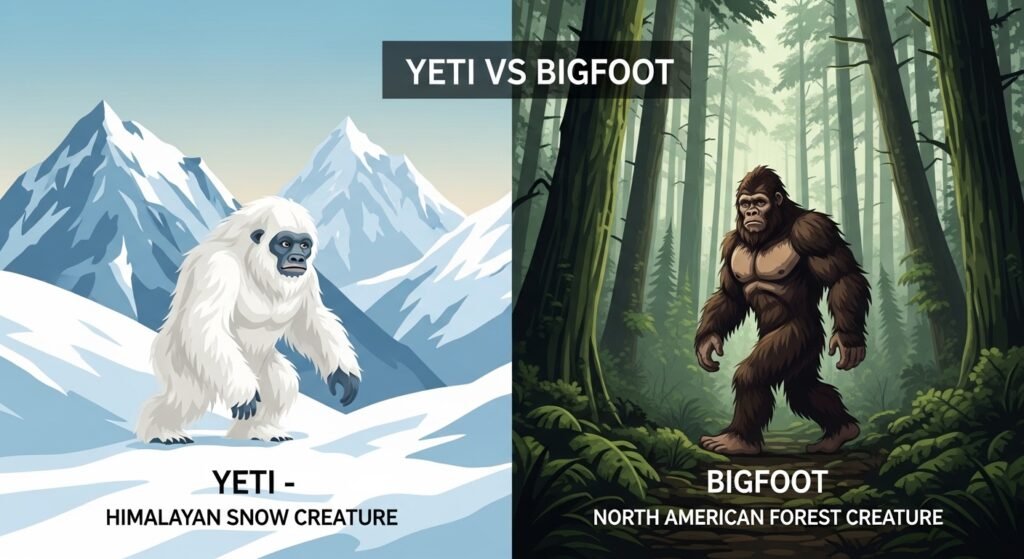
Quick Ans: The main difference between yeti vs bigfoot lies in their origin and habitat. The Yeti is said to live in the snowy Himalayan mountains of Asia, while Bigfoot is believed to roam the forests of North America. Both are legendary ape-like creatures, but they belong to different cultures and environments.
Many people search for yeti vs bigfoot because both creatures sound very similar. Each one is described as large, hairy, and mysterious. Stories about them have existed for many years. However, they are not exactly the same.
The confusion often begins because both are considered cryptids, meaning creatures that may exist but are not proven by science. In addition, both are linked to footprints, strange sightings, and local legends. Despite these similarities, their locations and cultural backgrounds differ greatly.
For example, the Yeti is associated with snowy mountains. Bigfoot, on the other hand, is linked to dense forests. These environmental differences shape how each creature is described.
Understanding yeti vs bigfoot helps separate myth from myth. It also provides insight into folklore, storytelling, and human curiosity about the unknown.
In this guide, you will explore definitions, origins, differences, advantages of each legend, real world examples, and common misconceptions. By the end, the distinction will be clear.
Quick Answer: Yeti vs Bigfoot
To quickly understand yeti vs bigfoot, focus on location and cultural origin.
| Feature | Yeti | Bigfoot |
|---|---|---|
| Region | Himalayas (Asia) | North America |
| Climate | Snowy mountains | Forests and woodlands |
| Other Name | Abominable Snowman | Sasquatch |
| Appearance | White or light fur | Brown or dark fur |
| Cultural Origin | Himalayan folklore | Native American folklore |
In short, the Yeti lives in snowy mountains, while Bigfoot lives in forests.
What Is a Yeti?
The Yeti is a legendary creature said to live in the Himalayan mountains. Many stories come from countries like Nepal and Tibet. It is often described as a large, ape-like being covered in white or light colored fur.
Typical Yeti Features
Descriptions of the Yeti usually include:
- Tall, human-like figure
- Thick fur for cold climates
- Large footprints in snow
- Strong and elusive behavior
Because of the extreme mountain environment, the Yeti is often linked to survival in freezing conditions.
Cultural Background
The Yeti has deep roots in Himalayan folklore. Local communities have passed down stories for generations. In many cases, the creature is seen as mysterious rather than dangerous.
Interestingly, early Western explorers helped popularize the legend. Reports of strange footprints in snow attracted global attention.
Reported Sightings
Several climbers and travelers have claimed to see footprints or distant figures in snowy regions. However, no scientific proof confirms the Yeti’s existence.
What Is Bigfoot?
Bigfoot, also known as Sasquatch, is a legendary creature believed to live in North American forests. Most reports come from the United States and Canada.
The creature is usually described as a large, hairy, human-like being with dark fur.
Typical Bigfoot Features
Common descriptions include:
- Very tall height
- Broad shoulders
- Dark brown or black fur
- Large footprints
- Strong smell
Because it lives in forests, Bigfoot is often associated with wilderness and isolation.
Cultural Background
Bigfoot stories originate from Native American traditions. Many families describe similar creatures with different names. These stories existed long before modern sightings.
Later, media and documentaries increased public interest. As a result, Bigfoot became a well known figure in popular culture.
Reported Sightings
Thousands of people claim to have seen Bigfoot. Some report footprints, sounds, or brief visual encounters. Despite these claims, scientific evidence remains unconfirmed.
Key Differences Between Yeti vs Bigfoot
Location
The most important difference in yeti vs bigfoot is location. The Yeti belongs to the Himalayan mountains. Bigfoot is linked to North American forests.
Climate
Cold snowy conditions define Yeti sightings. Forest environments define Bigfoot reports.
Appearance
The Yeti is often described with lighter fur. Bigfoot usually appears darker.
Cultural Origin
Asian folklore shapes the Yeti legend. Native American traditions influence Bigfoot stories.
Naming
People also call the Yeti the Abominable Snowman. Bigfoot is often called Sasquatch.
Advantages and Disadvantages
Yeti Legend Advantages
- Strong cultural history
- Unique connection to mountain environments
- Inspires exploration stories
Yeti Legend Disadvantages
- Very limited sightings
- Harsh habitat makes verification difficult
Bigfoot Legend Advantages
- Large number of reported sightings
- Deep roots in indigenous traditions
- Popular in media and documentaries
Bigfoot Legend Disadvantages
- Many hoaxes reported
- Lack of scientific proof
These factors influence how people view yeti vs bigfoot today.
Real World Examples
Mountaineering Stories
Climbers in the Himalayas sometimes report unusual footprints. These stories are often linked to the Yeti legend.
Forest Encounters
Hikers and campers in North America occasionally claim to hear strange sounds or see large figures. These reports connect to Bigfoot.
Media Influence
Movies, books, and documentaries frequently feature both creatures. As a result, public interest continues to grow.
Regional and Global Usage
Asia
In Himalayan regions, the Yeti is part of local folklore. Communities treat the legend with cultural respect.
North America
Bigfoot stories appear across the United States and Canada. Many regions even host festivals or museums related to the legend.
Global Interest
Both creatures are known worldwide. However, Bigfoot tends to appear more often in global media.
Therefore, the yeti vs bigfoot comparison reflects both regional traditions and global curiosity.
Related Concepts and Comparisons
Yeti vs Bigfoot vs Sasquatch
Bigfoot and Sasquatch refer to the same creature. Yeti is a separate legend from a different region.
Cryptids
Both Yeti and Bigfoot are cryptids. This term describes creatures that lack scientific proof.
Myth vs Reality
Neither creature has confirmed scientific evidence. However, both remain important in storytelling and folklore.
Common Mistakes About Yeti vs Bigfoot
Assuming They Are the Same
Although similar in appearance, they come from different regions and cultures.
Ignoring Cultural Origins
Each legend has deep roots in local traditions. Mixing them removes important context.
Believing Every Sighting
Many reports lack reliable evidence. Some are misidentifications or hoaxes.
Confusing Names
Bigfoot and Sasquatch are the same. Yeti is a different creature entirely.
Avoiding these mistakes improves understanding of yeti vs bigfoot.
Beginner to Advanced Insights
Beginner Level
Learn the basic differences in location and appearance.
Intermediate Level
Explore folklore and regional stories behind each creature.
Advanced Level
Study how media, psychology, and human perception influence sightings.
These levels help deepen knowledge step by step.
Step By Step Comparison Scenario
Imagine someone reports a sighting.
If the sighting occurs in snowy mountains:
- It is likely described as a Yeti.
If the sighting occurs in dense forests:
- It is likely described as Bigfoot.
Location plays a major role in identifying the legend.
Exercises With Answers
Exercise 1
Which creature is associated with the Himalayas?
Answer: Yeti.
Exercise 2
Which creature is also called Sasquatch?
Answer: Bigfoot.
Exercise 3
Which environment is linked to Bigfoot?
Answer: Forests.
Exercise 4
Which creature is known as the Abominable Snowman?
Answer: Yeti.
Exercise 5
True or False: Yeti and Bigfoot are scientifically proven.
Answer: False.
When Should You Use Yeti vs Bigfoot?
Use Yeti when:
- Referring to Himalayan folklore
- Discussing snowy mountain legends
Use Bigfoot when:
- Talking about North American forests
- Referring to Sasquatch sightings
Context determines which term is appropriate.
FAQs About Yeti vs Bigfoot
What is the main difference between yeti vs bigfoot?
The main difference is location. The Yeti is linked to the Himalayas, while Bigfoot is associated with North American forests.
Are Yeti and Bigfoot the same creature?
No. In the yeti vs bigfoot comparison, they belong to different regions and cultural traditions.
Which is more popular, Yeti or Bigfoot?
Bigfoot is more widely known in global media.
Is there scientific proof of Yeti or Bigfoot?
No. Neither creature has confirmed scientific evidence.
Why do people believe in these creatures?
Stories, cultural traditions, and unexplained sightings contribute to belief.
What does Sasquatch mean?
Sasquatch is another name for Bigfoot.
Where are most Bigfoot sightings reported?
Most reports come from forests in the United States and Canada.
Why is the Yeti associated with snow?
Its legend originates in the cold Himalayan mountains.
Are sightings reliable?
Many sightings are unverified and may involve misidentification.
Can these creatures exist?
There is no scientific evidence, but the idea remains part of folklore and curiosity.
Conclusion
The comparison of yeti vs bigfoot highlights how similar legends can exist in different parts of the world. Both creatures are described as large, mysterious, and human-like. However, their environments and cultural origins set them apart.
The Yeti belongs to the snowy Himalayan mountains and reflects Asian folklore. Bigfoot lives in North American forests and has roots in Native American traditions. These differences shape how each legend is told and understood.
Although no scientific proof confirms their existence, both figures remain powerful symbols of mystery and exploration. Stories about them continue to inspire curiosity and imagination.
Understanding yeti vs bigfoot allows you to appreciate the cultural value behind each legend. It also helps separate facts from fiction when exploring these fascinating myths.
Discover More:-
- Sarape vs Poncho: Key Differences, Uses, and Cultural Guide
- Morphine vs Oxycodone: Differences, Uses, Safety, and Pain Relief Guide

Lisa Thompson is a USA-based content writer and language specialist focused on grammar, writing improvement and digital publishing.
She holds a degree in English Language and Communication and has professional experience in educational and web content creation.
As the author of Gramtivo.Com, she aims to help readers improve their writing skills through clear and practical guidance.


Pingback: 9mm vs 22: Key Differences, Power, Recoil, and Best Use Guide