
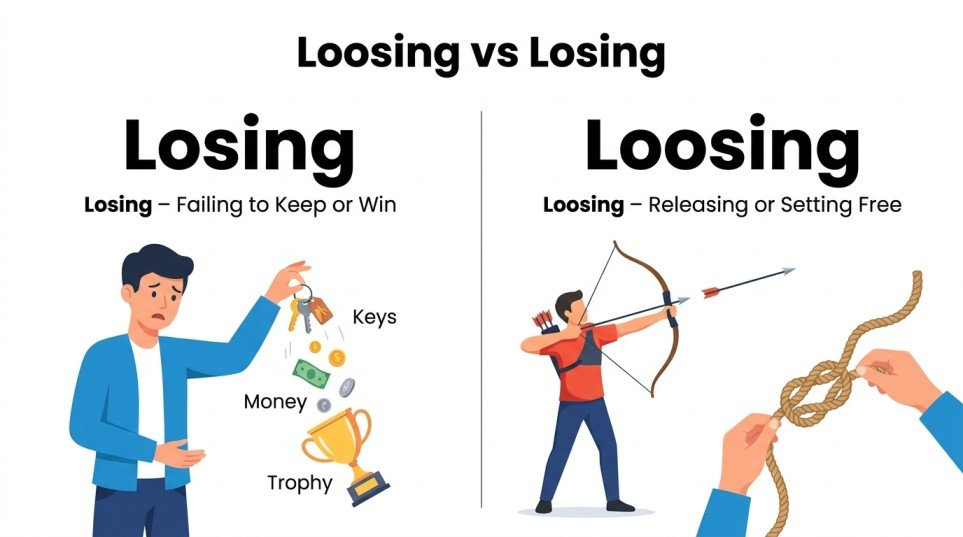
Quick Ans: The difference between loosing or losing is simple but important. Losing means failing to win, misplacing something, or becoming deprived of it, while loosing means releasing, setting free, or loosening something. Although the words look similar, they have very different meanings and uses.
Many English learners and even native speakers get confused about loosing or losing. The words look almost identical. Only one extra letter separates them. Because of that, people often use the wrong spelling in emails, social media posts, essays, and professional writing.
The confusion usually happens because both words come from the word loose. As a result, many writers assume that adding -ing creates loosing. However, that is not always correct.
In most situations, people actually mean losing, not loosing. For example, someone might write, “I am loosing my keys,” when they really mean, “I am losing my keys.”
Understanding the difference is important because the wrong word can change the meaning of a sentence completely. Fortunately, the distinction is easy once you learn a few simple rules.
This guide explains loosing or losing in detail. You will learn definitions, examples, common mistakes, exercises, and practical tips to use both words correctly.
Quick Answer: Loosing or Losing
Here is the short answer.
| Word | Meaning | Example |
|---|---|---|
| Losing | Failing to win, misplacing, or no longer having something | “She is losing her phone again.” |
| Loosing | Releasing, letting go, or setting free | “The hunter is loosing an arrow.” |
In most everyday situations, losing is the correct word.
What Does Losing Mean?
Losing is the present participle of the verb lose.
It refers to:
- Failing to win
- Misplacing something
- No longer possessing something
- Becoming deprived of something
People use losing far more often than loosing in modern English.
Common Examples of Losing
Consider these examples:
- I am losing my patience.
- Our team is losing the game.
- She is losing weight.
- They are losing money.
- He keeps losing his keys.
In each sentence, something is being lost, misplaced, reduced, or defeated.
Everyday Situations Using Losing
You may hear losing in situations involving:
- Sports competitions
- Personal belongings
- Business finances
- Health and fitness
- Relationships
Because these situations occur frequently, losing is one of the most commonly used English verbs.
What Does Loosing Mean?
Loosing is the present participle of the verb loose when it means to release, free, or let something go.
Unlike losing, this word is relatively rare in modern English.
Common Examples of Loosing
Here are some examples:
- The archer is loosing an arrow.
- Soldiers were loosing projectiles at the enemy.
- The sailor was loosing the ropes.
- They were loosing the hunting dogs.
In each case, something is being released or set free.
Why Loosing Is Rare
Modern English speakers rarely use loosing in everyday conversation.
Instead, they often choose words such as:
- Releasing
- Freeing
- Letting go
- Unfastening
Therefore, when people write loosing, they often mean losing.
Key Differences Between Loosing or Losing
Meaning
The biggest difference between loosing or losing is meaning.
Losing means failing to keep, possess, or win something.
Loosing means releasing or setting something free.
Frequency
Losing appears regularly in daily communication.
Loosing appears much less often.
Context
Losing usually relates to:
- Games
- Money
- Possessions
- Opportunities
Loosing usually relates to:
- Arrows
- Ropes
- Animals
- Objects being released
Comparison Table
| Feature | Losing | Loosing |
|---|---|---|
| Common Usage | Very common | Rare |
| Meaning | Failing to keep or win | Releasing or freeing |
| Root Word | Lose | Loose |
| Used in Daily Conversation | Frequently | Occasionally |
| Example | Losing a wallet | Loosing an arrow |
Why People Confuse Loosing and Losing
Several factors contribute to the confusion.
Similar Spellings
The two words differ by only one letter.
Compare them:
- Losing
- Loosing
Because they look nearly identical, mistakes happen easily.
Pronunciation Similarities
Many speakers pronounce the words similarly during fast speech.
As a result, writers sometimes choose the wrong spelling.
Influence of the Word “Loose”
People know that “lose” and “loose” are related words.
Consequently, they may incorrectly assume the present participle of lose should be loosing.
However, English spelling does not work that way.
Advantages and Disadvantages of Knowing the Difference
Advantages
Learning the distinction helps you:
- Write professionally
- Avoid embarrassing mistakes
- Improve grammar accuracy
- Communicate clearly
- Build credibility
Disadvantages of Using the Wrong Word
Mistakes can lead to:
- Confusion
- Misunderstood messages
- Poor academic writing
- Reduced professionalism
Therefore, mastering loosing or losing is worthwhile.
Real World Examples
In Business Emails
Incorrect:
“I am loosing customers this quarter.”
Correct:
“I am losing customers this quarter.”
In Sports Reporting
Incorrect:
“The team is loosing every game.”
Correct:
“The team is losing every game.”
In Historical Writing
Correct:
“The archers were loosing arrows during the battle.”
Here, loosing is appropriate because arrows are being released.
In Personal Communication
Incorrect:
“I keep loosing my phone.”
Correct:
“I keep losing my phone.”
These examples show why context matters.
Regional and Global Usage
American English
American English strongly favors losing because it appears in everyday communication.
British English
British English follows the same distinction between losing and loosing.
Global English Learning
English learners worldwide commonly confuse these words.
However, grammar guides consistently treat them as separate words with different meanings.
Therefore, the rules remain the same regardless of region.
Related Concepts and Comparisons
Lose vs Loose
Many people confuse these words before they confuse loosing or losing.
| Word | Meaning |
|---|---|
| Lose | To fail to keep or win |
| Loose | Not tight |
Examples:
- Do not lose your wallet.
- The screw is loose.
Lost vs Loose
Another common mistake involves these two words.
Examples:
- I lost my keys. ✔
- My shirt feels loose. ✔
Understanding these related terms makes the difference between loosing and losing easier to remember.
Common Mistakes About Loosing or Losing
Using Loosing When You Mean Losing
This is the most frequent mistake.
Incorrect:
- I am loosing money.
Correct:
- I am losing money.
Adding Extra O Letters
Some writers automatically add an extra “o” because they think of the word “loose.”
However, the verb lose becomes losing, not loosing.
Ignoring Context
Always ask yourself what the sentence means.
If something is being released, loosing may be correct.
If something is being misplaced or forfeited, use losing.
Relying Only on Spell Check
Spell check may not catch the error because both words exist.
Therefore, context remains essential.
Beginner to Advanced Learning Tips
Beginner Level
Remember this simple rule:
Losing = not keeping something.
Intermediate Level
Practice identifying whether the sentence involves:
- Winning or losing
- Keeping or losing
- Releasing or freeing
Advanced Level
Study historical and literary uses of loosing. Many older texts use the word when describing arrows, ropes, or animals being released.
This deeper understanding improves vocabulary precision.
Step By Step Usage Scenario
Imagine you are writing a sentence.
First, ask yourself what is happening.
If something is disappearing, being misplaced, or not being won, choose losing.
Example:
- She is losing confidence.
If something is being released or set free, choose loosing.
Example:
- The archer is loosing an arrow.
Checking the meaning first usually prevents mistakes.
Exercises With Answers
Exercise 1
Choose the correct word:
“I keep _____ my car keys.”
Answer: Losing.
Exercise 2
Choose the correct word:
“The hunter was _____ the dogs.”
Answer: Loosing.
Exercise 3
Choose the correct word:
“Our team is _____ the match.”
Answer: Losing.
Exercise 4
Choose the correct word:
“The soldier was _____ arrows.”
Answer: Loosing.
Exercise 5
True or False: Losing means releasing something.
Answer: False.
When Should You Use Loosing or Losing?
Use losing when:
- Misplacing something
- Failing to win
- Giving up possession
- Experiencing reduction
Use loosing when:
- Releasing something
- Setting something free
- Unfastening ropes
- Letting arrows fly
In modern communication, losing is far more common.
FAQs About Loosing or Losing
What is the difference between loosing or losing?
Losing means failing to keep or win something, while loosing means releasing or setting something free.
Is loosing a real word?
Yes. Loosing is a legitimate English word, but it is much less common than losing.
Why do people write loosing instead of losing?
Many people confuse the spelling because losing and loosing look very similar.
Which is more common, loosing or losing?
Losing is significantly more common in everyday English.
Is “I am loosing weight” correct?
No. The correct sentence is “I am losing weight.”
Can loosing ever be correct?
Yes. It is correct when something is being released, such as loosing an arrow.
How can I remember the difference?
Think of losing as failing to keep something and loosing as setting something free.
Do grammar checkers catch this mistake?
Not always. Since both words exist, software may not recognize the context error.
Is losing used in professional writing?
Yes. Losing appears frequently in business, academic, and everyday communication.
What is the easiest rule for loosing or losing?
If you mean misplacing, failing, or no longer having something, use losing. If you mean releasing something, use loosing.
Conclusion
Understanding loosing or losing is important for clear and professional writing. Although the words differ by only one letter, their meanings are completely different.
Losing refers to failing to win, misplacing something, or no longer having it. Because these situations occur frequently, losing appears in everyday conversations, emails, articles, and business communication.
Loosing, on the other hand, means releasing or setting something free. Modern English uses this word far less often, which is why many writers mistakenly replace losing with loosing.
A simple memory trick can help. If something is being lost, choose losing. If something is being released, choose loosing.
By understanding the context before writing, you can avoid one of the most common English spelling mistakes and communicate with greater confidence.
Discover More:-
- Ipamorelin vs Tesamorelin: Key Differences, Benefits, and Peptide Comparison
- Yuca vs Yucca: Differences, Uses, Benefits, and Complete Guide

Jennifer Collins is a professional grammar expert and language educator at gramtivo.com, specializing in English grammar, writing skills, and language improvement. She holds a Master’s degree in English Language and Literature from a recognized university in the United States. With years of teaching and content development experience, she is dedicated to helping learners improve their communication skills with clear and practical guidance.