
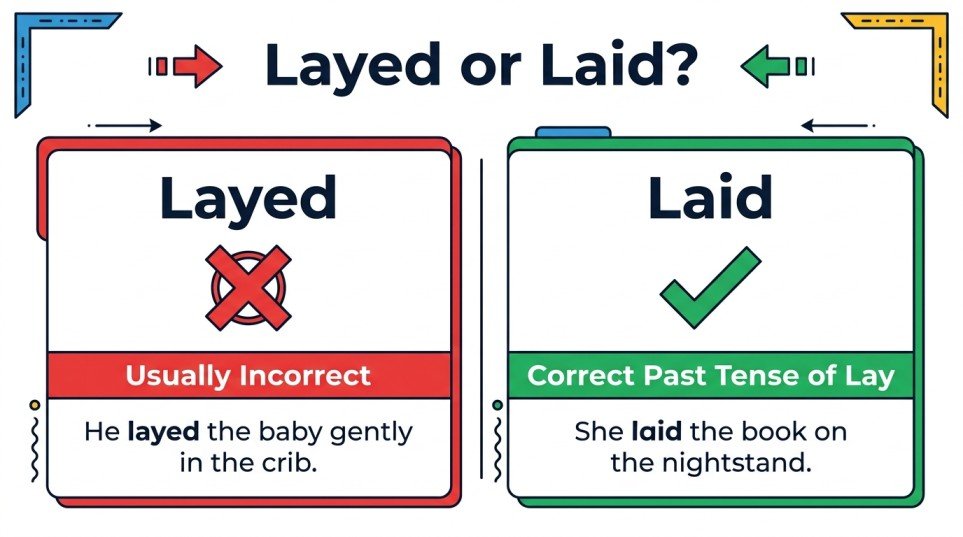
Quick Ans: The correct word in standard English is laid, not layed, when referring to the past tense and past participle of the verb lay. While layed occasionally appears in specialized contexts, such as laying rope or preparing surfaces with specific materials, laid is the correct choice in almost all everyday writing and speech.
Many people wonder about layed or laid because the two words look similar. Spell check tools sometimes miss the mistake. As a result, writers often use the wrong form without realizing it.
The confusion usually comes from the verbs lay and lie. These verbs have different meanings and different past tense forms. Because English contains many irregular verbs, remembering the correct word can feel challenging.
Fortunately, the rule is simpler than many people think.
In most situations, laid is the correct spelling. Whether you are talking about placing an object somewhere, setting a foundation, or laying plans for the future, the proper past tense is usually laid.
Understanding the difference between layed or laid helps improve grammar, writing quality, and professional communication. This guide explains the meaning, usage, examples, common mistakes, and grammar rules behind these commonly confused words.
By the end, you will know exactly when to use laid and when the rare word layed may actually be correct.
Quick Answer: Layed or Laid
If you are deciding between layed or laid, choose laid in almost every case.
| Word | Correct? | Common Usage |
|---|---|---|
| Laid | Yes | Past tense of lay |
| Layed | Usually No | Rare technical uses only |
Examples
Correct:
- She laid the book on the table.
- They laid new flooring last week.
- He laid the keys by the door.
Incorrect:
- She layed the book on the table.
- They layed the flooring.
- He layed the keys down.
For everyday English, laid is the correct spelling.
What Does Laid Mean?
Laid is the past tense and past participle of the verb lay.
The verb lay means:
- To put something down
- To place something somewhere
- To set or establish something
Examples of Laid
- Sarah laid her phone on the desk.
- The workers laid bricks for the wall.
- The company laid the groundwork for expansion.
In each example, an object is being placed or established.
Why Laid Is So Common
English speakers use laid frequently because the verb lay appears in many situations.
You may hear it when discussing:
- Construction projects
- Business plans
- Household tasks
- Farming
- Everyday actions
Therefore, learning the correct use of laid is important for clear communication.
What Does Layed Mean?
The word layed exists, but its use is extremely limited.
Most dictionaries identify layed as a specialized term rather than the standard past tense of lay.
Rare Technical Uses of Layed
In certain industries, layed may refer to:
- Rope manufacturing
- Cable construction
- Specific surface preparation techniques
For example:
- The rope was carefully layed according to industry standards.
Outside these technical fields, writers should use laid instead.
Why People Use Layed Incorrectly
Many people assume regular grammar rules apply.
For example:
- Play → Played
- Stay → Stayed
- Delay → Delayed
Following the same pattern, some writers incorrectly create:
- Lay → Layed
However, lay is an irregular verb. Consequently, its correct past tense becomes laid, not layed.
Understanding the Verb Lay
To understand layed or laid, you must first understand the verb lay.
Present Tense
- I lay the book down.
- They lay the carpet carefully.
Past Tense
- I laid the book down.
- They laid the carpet carefully.
Past Participle
- I have laid the book down.
- They have laid the carpet.
Notice that laid appears in both forms.
Understanding Lay vs Lie
Much of the confusion surrounding layed or laid comes from another verb: lie.
Lay
The verb lay requires an object.
Examples:
- Lay the blanket on the bed.
- Lay the papers on the desk.
Lie
The verb lie means to recline or rest.
Examples:
- I lie on the couch.
- The cat lies near the fireplace.
Comparison Table
| Verb | Meaning | Present | Past |
|---|---|---|---|
| Lay | Put something down | Lay | Laid |
| Lie | Recline or rest | Lie | Lay |
Because the past tense of lie is lay, confusion becomes very common.
Key Differences Between Layed or Laid
Grammar Accuracy
Laid follows standard English grammar rules.
Layed is usually considered incorrect in general writing.
Dictionary Acceptance
Most major dictionaries recognize laid as the proper past tense of lay.
Meanwhile, layed appears only in specialized technical definitions.
Professional Writing
Business documents, academic papers, and professional emails should use laid.
Using layed in these contexts may create grammar errors.
Everyday Communication
For daily conversation and writing, laid is almost always the correct choice.
Advantages and Disadvantages
Advantages of Using Laid
- Grammatically correct
- Accepted in professional writing
- Recognized by all English speakers
- Improves credibility
Disadvantages of Using Laid
- Can be confused with the verb lie
- Requires understanding irregular grammar rules
Advantages of Using Layed
- May be correct in rare technical industries
Disadvantages of Using Layed
- Usually considered incorrect
- Creates confusion
- May trigger grammar checker warnings
- Looks unprofessional in formal writing
For most writers, laid is the safer and more accurate option.
Real World Examples
Business Writing
Correct:
- The team laid the foundation for future growth.
Incorrect:
- The team layed the foundation for future growth.
Construction Industry
Correct:
- Workers laid the concrete yesterday.
Incorrect:
- Workers layed the concrete yesterday.
School Assignments
Correct:
- The scientist laid the equipment on the table.
Incorrect:
- The scientist layed the equipment on the table.
These examples demonstrate why laid dominates standard English usage.
Regional and Global Usage
American English
American English strongly favors laid.
Schools, publishers, and businesses all use this form.
British English
British English follows the same rule.
Writers and editors prefer laid in nearly every situation.
International English
English learners worldwide are taught that laid is the correct past tense of lay.
As a result, laid remains the global standard.
Common Mistakes About Layed or Laid
Treating Lay as a Regular Verb
Many writers assume all verbs ending in “ay” follow the same pattern.
Examples include:
- Play → Played
- Stay → Stayed
However, lay is irregular.
Correct:
- Lay → Laid
Confusing Lay and Lie
Another common mistake occurs when people mix the two verbs.
Incorrect:
- Yesterday I laid on the couch.
Correct:
- Yesterday I lay on the couch.
Using Layed in Professional Documents
Some writers use layed in reports or emails.
Editors generally mark this as incorrect.
Ignoring Grammar Checkers
Modern writing tools often flag layed as an error.
Reviewing suggestions can help avoid mistakes.
Beginner to Advanced Grammar Tips
Beginner Level
Remember one simple rule:
Lay becomes laid.
Intermediate Level
Practice identifying whether the verb has an object.
Example:
- She laid the notebook down.
The notebook is the object.
Advanced Level
Study irregular verb patterns.
Examples include:
| Present | Past |
|---|---|
| Lay | Laid |
| Say | Said |
| Pay | Paid |
Recognizing these patterns improves overall grammar accuracy.
Step By Step Usage Scenario
Imagine you are writing about placing a package on a table.
Present Tense
- I lay the package on the table.
Past Tense
- Yesterday, I laid the package on the table.
Present Perfect
- I have laid the package on the table.
Notice that laid appears whenever you need the past form.
Exercises With Answers
Exercise 1
Which word is correct?
- She ___ the keys on the counter.
Answer: Laid
Exercise 2
Choose the correct sentence.
A. He layed the blanket down.
B. He laid the blanket down.
Answer: B
Exercise 3
What is the past tense of lay?
Answer: Laid
Exercise 4
True or False: Layed is the standard past tense of lay.
Answer: False
Exercise 5
Which sentence is correct?
A. They laid new carpet.
B. They layed new carpet.
Answer: A
Related Concepts and Comparisons
Lay vs Lie
One verb requires an object. The other does not.
Examples:
- Lay the book down.
- Lie on the sofa.
Paid vs Payed
This comparison resembles layed or laid.
Correct:
- Pay → Paid
Rare technical form:
- Payed
Said vs Sayed
English contains many irregular verbs.
Correct forms often differ from expected spelling patterns.
Understanding these relationships makes grammar easier to remember.
FAQs About Layed or Laid
Is laid or layed correct?
In standard English, laid is correct. The word layed appears only in rare technical contexts.
Why is layed usually wrong?
Because lay is an irregular verb. Its past tense is laid, not layed.
What is the past tense of lay?
The past tense of lay is laid.
Can I use layed in an essay?
No. Academic writing should use laid unless discussing a rare technical industry term.
Why do people confuse layed or laid?
Many assume lay follows the same pattern as verbs like play and stay.
Is laid correct in business writing?
Yes. Professional writing should use laid when referring to the past tense of lay.
Does British English use laid or layed?
British English uses laid as the standard form.
Does American English use layed?
No. American English overwhelmingly uses laid.
Is layed ever correct?
Yes, but only in uncommon technical contexts involving ropes, cables, or specialized manufacturing.
How can I remember the correct form?
Use this simple rule: Lay becomes laid, just as pay becomes paid.
Conclusion
The debate over layed or laid has a clear answer for most writers. In standard English, laid is the correct past tense and past participle of the verb lay. Whether you are writing emails, reports, essays, or social media posts, laid is almost always the right choice.
Confusion occurs because English contains irregular verbs and because the verb lie introduces additional complexity. Nevertheless, one simple rule solves most problems: lay becomes laid.
Although layed exists in a few technical industries, it rarely appears in everyday communication. Most readers, teachers, editors, and employers expect to see laid instead.
When in doubt, choose laid. Doing so improves grammar accuracy, strengthens professional writing, and helps avoid common language mistakes.
Discover More:-
- Theragun vs Hypervolt: Detailed Comparison, Features, and Buying Guide
- Medicaid vs Obamacare: Key Differences, Eligibility, Costs, and Benefits

Lisa Thompson is a USA-based content writer and language specialist focused on grammar, writing improvement and digital publishing.
She holds a degree in English Language and Communication and has professional experience in educational and web content creation.
As the author of Gramtivo.Com, she aims to help readers improve their writing skills through clear and practical guidance.