
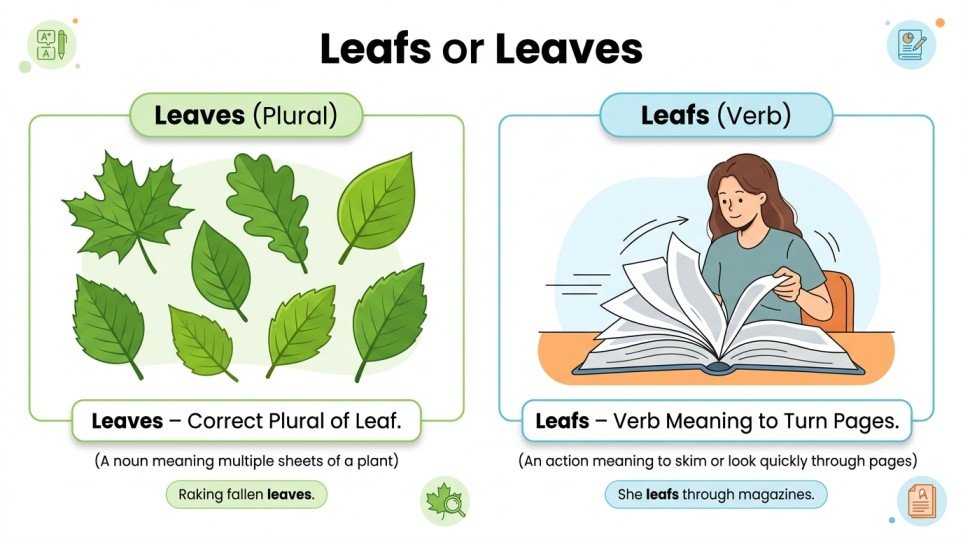
Quick Ans: The correct plural form of leaf is usually leaves. However, leafs is also a real word used in specific situations, such as in bookbinding, printing, and certain proper names. Understanding leafs or leaves helps avoid common grammar mistakes and improves writing accuracy.
Many English learners and native speakers get confused about leafs or leaves. The words look similar. Both appear in dictionaries. Yet only one is usually correct when talking about more than one leaf on a tree.
This confusion happens because English contains many irregular plural forms. For example, knife becomes knives and wolf becomes wolves. The word leaf follows the same pattern most of the time.
Still, there are situations where leafs is the correct choice. As a result, writers often wonder which version should be used in a sentence.
Understanding the difference between leafs or leaves can improve grammar, writing, and communication. Whether you are writing an essay, creating business content, or learning English, knowing when to use each word is important.
This guide explains everything from basic grammar rules to advanced usage examples. Along the way, you will learn definitions, comparisons, common mistakes, exercises, and practical examples.
Quick Answer: Leafs or Leaves
When deciding between leafs or leaves, the correct choice depends on context.
| Word | Usage | Example |
|---|---|---|
| Leaves | Standard plural of leaf | The leaves fell from the tree. |
| Leafs | Specialized usage or proper names | He leafs through the magazine. |
In most situations:
- Leaves is the correct plural noun.
- Leafs is used mainly as a verb or in special contexts.
Therefore, if you are talking about multiple leaves on a plant, use leaves.
What Does “Leaf” Mean?
A leaf is the flat green part of a plant or tree. Leaves absorb sunlight and help plants create food through photosynthesis.
Examples include:
- Maple leaf
- Oak leaf
- Palm leaf
- Rose leaf
Plants rely on leaves for growth and survival. Without them, photosynthesis becomes difficult.
Singular and Plural Forms
English changes some words when forming plurals.
| Singular | Plural |
|---|---|
| Leaf | Leaves |
| Knife | Knives |
| Wolf | Wolves |
| Shelf | Shelves |
Because of this pattern, leaf normally becomes leaves rather than leafs.
What Does “Leaves” Mean?
Leaves is the standard plural form of leaf.
Whenever you refer to more than one leaf, this is usually the correct word.
Examples of Leaves
Consider these sentences:
- The leaves changed color during autumn.
- Strong winds scattered the leaves across the yard.
- Green leaves covered the branches.
In each example, leaves refers to multiple plant leaves.
Why Does Leaf Become Leaves?
English contains several nouns ending in f or fe that change to ves in the plural form.
Examples include:
- Leaf → Leaves
- Life → Lives
- Calf → Calves
- Wife → Wives
Therefore, leaves follows a well-established grammar rule.
What Does “Leafs” Mean?
Although less common, leafs is still a correct English word in certain contexts.
Most often, it appears as a verb form of leaf.
Leafs as a Verb
The verb leaf means to turn pages quickly.
Examples include:
- She leafs through a catalog every morning.
- He leafs through the newspaper while drinking coffee.
- The student leafs through the textbook before class.
In these cases, leafs is not a plural noun. Instead, it functions as a verb.
Leafs in Proper Names
Some organizations and names use leafs intentionally.
One famous example is the sports team:
- Toronto Maple Leafs
The team name uses Leafs rather than Leaves for historical reasons.
As a result, people sometimes assume leafs is the normal plural form when it is not.
Key Differences Between Leafs or Leaves
Grammar Function
The biggest difference between leafs or leaves involves grammar.
- Leaves is usually a plural noun.
- Leafs is often a verb form.
Everyday Usage
Most everyday conversations use leaves.
For example:
- The leaves are falling.
- The leaves look beautiful.
Meanwhile, leafs appears far less frequently.
Frequency
In modern English writing, leaves is much more common than leafs.
Consequently, choosing leaves is usually the safer option when discussing plants.
Advantages and Disadvantages of Each Usage
Advantages of Using Leaves
- Grammatically correct plural noun
- Widely recognized
- Common in formal writing
- Easy for readers to understand
Disadvantages of Using Leaves
- Can be confused with the verb leave in some sentences
Advantages of Using Leafs
- Correct when used as a verb
- Appropriate for specific names and industries
- Useful in publishing terminology
Disadvantages of Using Leafs
- Often mistaken as the plural noun
- Less common in everyday English
- Can create confusion for readers
Therefore, understanding context is essential.
Real World Examples
In Nature Writing
A writer describing autumn would use leaves.
Example:
“The colorful leaves covered the hiking trail.”
In Education
A teacher discussing plants would also use leaves.
Example:
“Leaves help plants make food.”
In Publishing
Book professionals may use leafs differently.
Example:
“The printer leafs through the proofs before approval.”
In Sports
Fans often encounter Leafs through the hockey team name.
Because of these different contexts, understanding leafs or leaves becomes especially important.
Regional and Global Usage
American English
American English overwhelmingly uses leaves as the plural noun.
British English
British English follows the same grammar rule.
Consequently, both major English varieties agree on this usage.
International English Learning
Students around the world often struggle with irregular plurals. Therefore, leafs or leaves is a common grammar topic in language courses.
Regardless of region, leaves remains the accepted plural of leaf.
Related Concepts and Comparisons
Leaf vs Leaves
| Word | Meaning |
|---|---|
| Leaf | One leaf |
| Leaves | More than one leaf |
Leave vs Leaves
Many learners confuse these words.
| Word | Meaning |
|---|---|
| Leave | To go away |
| Leaves | Plural of leaf or third person form of leave |
Examples:
- She leaves work at five.
- The leaves are falling.
Although spelled the same, the meanings differ.
Leafs vs Leaves
| Word | Most Common Usage |
|---|---|
| Leafs | Verb form or proper name |
| Leaves | Standard plural noun |
Understanding these comparisons helps prevent grammar errors.
Common Mistakes About Leafs or Leaves
Using Leafs as the Plural Noun
Incorrect:
- The leafs are turning yellow.
Correct:
- The leaves are turning yellow.
Confusing Leaves With Leave
Incorrect:
- The tree has many leave.
Correct:
- The tree has many leaves.
Assuming All F Words Follow the Rule
Not every word ending in f changes to ves.
Examples:
- Roof → Roofs
- Chief → Chiefs
- Belief → Beliefs
Therefore, memorization is sometimes necessary.
Copying Proper Names
Seeing the word Leafs in a sports team name does not change the grammar rule for ordinary writing.
Avoiding these mistakes will improve accuracy.
Beginner to Advanced Grammar Tips
Beginner Level
Remember this simple rule:
- One leaf
- Many leaves
Intermediate Level
Learn other irregular plural forms.
Examples include:
- Wolf → Wolves
- Knife → Knives
- Shelf → Shelves
Advanced Level
Study exceptions that do not follow the f to ves pattern.
Examples:
- Roof → Roofs
- Proof → Proofs
- Safe → Safes
As your grammar knowledge grows, these patterns become easier to recognize.
Step By Step Usage Scenario
Imagine you are writing about autumn trees.
If you mention one leaf:
- The leaf is red.
If you mention several:
- The leaves are red.
Now imagine someone reading a magazine.
You would write:
- She leafs through the magazine.
This simple approach helps distinguish leafs or leaves correctly.
Exercises With Answers
Exercise 1
Choose the correct word:
The ______ fell from the tree.
Answer: Leaves.
Exercise 2
Choose the correct word:
He ______ through the catalog.
Answer: Leafs.
Exercise 3
Which is the standard plural of leaf?
Answer: Leaves.
Exercise 4
True or False: Leafs is usually the plural noun form of leaf.
Answer: False.
Exercise 5
Which sentence is correct?
A. The leafs are green.
B. The leaves are green.
Answer: B. The leaves are green.
When Should You Use Leafs or Leaves?
Use leaves when:
- Talking about plant leaves
- Referring to multiple leaves
- Writing academic content
- Creating formal documents
Use leafs when:
- Describing page turning
- Writing about printing terminology
- Referring to specific names like the Toronto Maple Leafs
Following these guidelines helps ensure grammatical accuracy.
FAQs About Leafs or Leaves
What is correct, leafs or leaves?
Leaves is the correct plural form of leaf in standard English.
Why is it leaves instead of leafs?
Many nouns ending in f change to ves when pluralized. Therefore, leaf becomes leaves.
Is leafs ever correct?
Yes. Leafs is correct as a verb meaning to turn pages or in certain proper names.
Can I say leafs on a tree?
No. The correct phrase is “leaves on a tree.”
What does leafs mean as a verb?
It means to flip through pages quickly.
Why is Toronto Maple Leafs spelled that way?
The team name uses Leafs for historical and branding reasons rather than standard grammar.
Do British and American English use leaves?
Yes. Both forms of English use leaves as the plural noun.
Is leaves always a noun?
No. Leaves can also be a verb, as in “She leaves work at six.”
Are there other words like leaf and leaves?
Yes. Examples include knife and knives, wolf and wolves, and shelf and shelves.
How can I remember leafs or leaves?
Think of the pattern: leaf becomes leaves just as knife becomes knives.
Conclusion
Understanding leafs or leaves is important for accurate English grammar. Although both words exist, they serve different purposes.
In most situations, leaves is the correct plural form of leaf. Whether you are writing about trees, plants, flowers, or nature, this is the word you should use.
Meanwhile, leafs appears mainly as a verb meaning to turn pages or as part of certain proper names. Because it is less common, many people mistakenly use it as a plural noun.
The easiest rule to remember is simple: one leaf, many leaves. Whenever you discuss plant foliage, choose leaves. Save leafs for specialized contexts where it is grammatically appropriate.
By mastering the difference between leafs or leaves, you can improve your writing, avoid common mistakes, and communicate with greater confidence.
Discover More:-
- Yuca vs Yucca: Differences, Uses, Benefits, and Complete Guide
- Exception vs Acception: Meaning, Differences, and Correct Usage Guide

Lisa Thompson is a USA-based content writer and language specialist focused on grammar, writing improvement and digital publishing.
She holds a degree in English Language and Communication and has professional experience in educational and web content creation.
As the author of Gramtivo.Com, she aims to help readers improve their writing skills through clear and practical guidance.