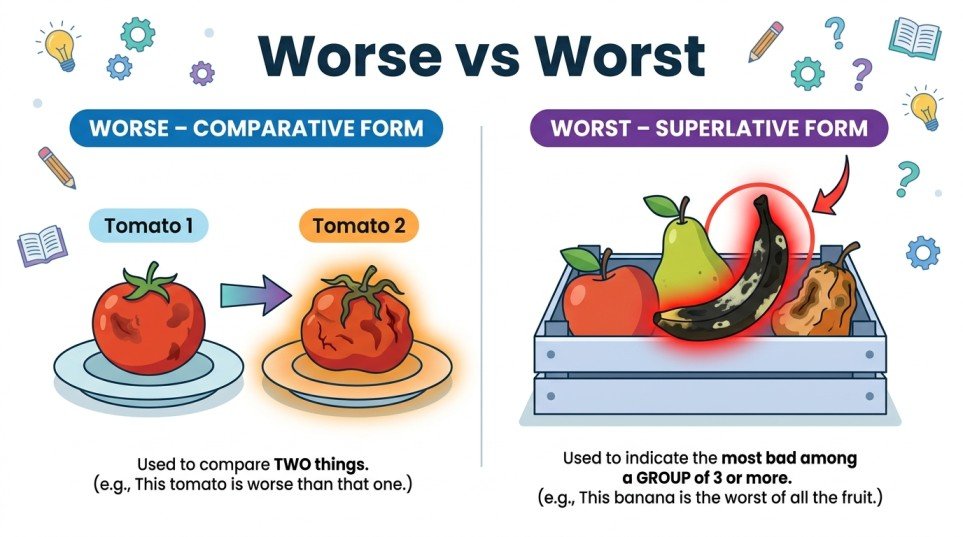
Quick Ans: The difference between worse or worst is simple. Worse is used when comparing two things, while worst is used when identifying the lowest quality or most negative option among three or more things. Understanding when to use each word helps improve grammar, writing, and everyday communication.
Many English learners struggle with worse or worst because the two words look very similar. Both come from the adjective bad. Both describe something negative. However, they are not interchangeable.
Using the wrong word can make a sentence sound awkward or grammatically incorrect. For example, saying “This is the worse movie I have ever seen” is incorrect. The correct word is “worst” because the speaker is referring to all movies they have seen.
Fortunately, the rule is easy to learn. One word compares two things. The other identifies the lowest point in a larger group.
Understanding worse or worst helps you write more clearly, speak more confidently, and avoid common grammar mistakes. Whether you are a student, professional, or English learner, mastering this distinction is important.
In this guide, you will learn definitions, examples, common mistakes, comparison tables, exercises, and practical tips. By the end, you will know exactly when to use worse and when to use worst.
Quick Answer: Worse or Worst
The easiest way to remember worse or worst is to think about comparison.
| Word | Usage | Example |
|---|---|---|
| Worse | Compare two things | Today is worse than yesterday. |
| Worst | Lowest quality in a group | This is the worst day of the year. |
A simple rule can help:
- Use worse when comparing two items.
- Use worst when referring to the lowest or most negative item in a group.
What Does Worse Mean?
Worse is the comparative form of bad.
It is used when comparing one thing with another.
Examples of Worse
- My headache is worse today than yesterday.
- The weather became worse during the afternoon.
- This restaurant is worse than the one we visited last week.
- Her second attempt was worse than her first attempt.
In each example, two situations, people, or things are being compared.
How Worse Functions in a Sentence
Worse often appears with words such as:
- Than
- Compared with
- Compared to
Examples:
- This laptop is worse than my old laptop.
- Traffic today is worse than usual.
- The sequel was worse than the original movie.
Whenever you compare two options, worse is usually the correct choice.
What Does Worst Mean?
Worst is the superlative form of bad.
It identifies the lowest quality, poorest condition, or most negative option within a group.
Examples of Worst
- This is the worst meal I have ever eaten.
- That was the worst storm of the decade.
- He had the worst score in the class.
- It became the worst day of my life.
Unlike worse, worst does not compare only two items. Instead, it highlights the most negative item among multiple possibilities.
How Worst Functions in a Sentence
Worst often appears with phrases such as:
- The worst
- My worst
- Their worst
- The worst of all
Examples:
- This is the worst hotel in the city.
- It was her worst performance.
- That was the worst mistake he ever made.
Because worst refers to an entire group, it indicates the lowest position.
Key Differences Between Worse or Worst
Type of Comparison
The biggest difference between worse or worst involves the type of comparison being made.
Worse compares two things.
Worst identifies the lowest item among several things.
Grammar Role
| Form | Word |
|---|---|
| Positive | Bad |
| Comparative | Worse |
| Superlative | Worst |
Examples
Comparative:
- This coffee is worse than yesterday’s coffee.
- My cold feels worse today.
Superlative:
- This is the worst coffee I have ever tasted.
- Today is the worst day of the month.
Easy Memory Trick
Think about the endings:
- Worse compares.
- Worst ranks.
If you are choosing the lowest item in a group, use worst.
If you are comparing two things, use worse.
Advantages of Understanding Worse or Worst
Learning the difference provides several benefits.
Better Grammar
Correct word choice improves sentence accuracy.
More Professional Writing
Business emails and reports sound more polished when grammar is correct.
Improved Communication
Listeners and readers understand your meaning more easily.
Better Academic Performance
Students often encounter grammar questions involving worse and worst.
Strong understanding helps on tests and assignments.
Real World Examples
At Work
Incorrect:
- This is the worse report in the department.
Correct:
- This is the worst report in the department.
The sentence refers to all reports, so worst is required.
At School
Incorrect:
- My math grade is worst than last semester.
Correct:
- My math grade is worse than last semester.
Only two grades are being compared.
In Everyday Conversation
Incorrect:
- Yesterday was the worse day of my life.
Correct:
- Yesterday was the worst day of my life.
The speaker is comparing all days in their life.
Regional and Global Usage
American English
American English follows the standard grammar rule:
- Worse for comparisons
- Worst for superlatives
British English
British English follows the same rule.
International English Learning
English learners around the world often confuse these terms because both originate from the adjective bad.
Nevertheless, grammar textbooks consistently teach the same distinction.
As a result, understanding worse or worst improves communication in any English-speaking environment.
Related Concepts and Comparisons
Better vs Best
The relationship mirrors worse and worst.
| Positive | Comparative | Superlative |
|---|---|---|
| Good | Better | Best |
Examples:
- This book is better than that book.
- This is the best book in the series.
Less vs Least
Another similar pattern exists.
| Positive | Comparative | Superlative |
|---|---|---|
| Little | Less | Least |
Examples:
- I have less money than you.
- She spent the least money of everyone.
Worse vs Bad
Bad is the basic adjective.
Examples:
- The weather is bad.
Worse is comparative.
Examples:
- The weather is worse today.
Worst is superlative.
Examples:
- This is the worst weather all year.
Common Mistakes About Worse or Worst
Using Worst Instead of Worse
Incorrect:
- My condition is worst today.
Correct:
- My condition is worse today.
The sentence compares today with another day.
Using Worse Instead of Worst
Incorrect:
- This is the worse movie ever made.
Correct:
- This is the worst movie ever made.
The sentence refers to all movies.
Forgetting the Comparison Rule
Many learners focus only on the negative meaning.
Instead, focus on the number of things being compared.
Two items usually require worse.
Three or more items usually require worst.
Mixing Up Comparative and Superlative Forms
Remember this sequence:
Bad → Worse → Worst
Keeping the order in mind helps avoid mistakes.
Beginner to Advanced Learning Tips
Beginner Level
Memorize the pattern:
Bad → Worse → Worst
This simple rule solves most grammar questions.
Intermediate Level
Practice writing comparison sentences.
Examples:
- Today is worse than yesterday.
- This is the worst week of the year.
Advanced Level
Read books, articles, and professional writing.
Notice how native speakers use comparative and superlative forms.
Consistent exposure improves accuracy naturally.
Step By Step Usage Scenario
Imagine a student receives three test scores:
- Test A: 90
- Test B: 80
- Test C: 70
Comparing Test B with Test A:
- Test B is worse than Test A.
Looking at all three scores:
- Test C is the worst score.
This example clearly demonstrates the difference between worse and worst.
Exercises With Answers
Exercise 1
Choose the correct word:
This movie is ______ than the first one.
Answer: Worse
Exercise 2
Choose the correct word:
This is the ______ movie I have ever seen.
Answer: Worst
Exercise 3
Choose the correct word:
The weather became ______ after lunch.
Answer: Worse
Exercise 4
Choose the correct word:
That was the ______ performance of the evening.
Answer: Worst
Exercise 5
True or False:
Worst is used when comparing only two things.
Answer: False
When Should You Use Worse or Worst?
Use worse when:
- Comparing two situations
- Comparing two people
- Comparing two objects
- Using the word “than”
Examples:
- This route is worse than the other route.
- My cold is worse today.
Use worst when:
- Referring to an entire group
- Identifying the lowest quality item
- Discussing the most negative outcome
Examples:
- This is the worst option available.
- It was the worst mistake of my career.
FAQs About Worse or Worst
What is the difference between worse or worst?
Worse compares two things, while worst identifies the lowest or most negative item in a group.
Is worse a comparative adjective?
Yes. Worse is the comparative form of the adjective bad.
Is worst a superlative adjective?
Yes. Worst is the superlative form of bad.
Do I use worse with than?
Usually yes. Worse often appears in comparisons using the word than.
Can worst compare two things?
Generally no. Worst is used for the lowest item within a group, not for simple two item comparisons.
Which is correct: worse than or worst than?
Worse than is correct. Worst than is grammatically incorrect.
What comes after bad in grammar comparison?
The sequence is bad, worse, and worst.
Why do people confuse worse and worst?
Both words come from bad and have similar meanings, making them easy to mix up.
Is this sentence correct: This is the worst day ever?
Yes. The sentence refers to all possible days and identifies the most negative one.
How can I remember worse or worst easily?
Remember that worse compares, while worst ranks. Comparing two items requires worse. Choosing the lowest item in a group requires worst.
Conclusion
Understanding worse or worst is an important part of English grammar. Although the words look similar, they perform different functions.
Worse is the comparative form of bad. It compares two people, situations, or things. Worst is the superlative form of bad. It identifies the lowest quality or most negative option within a group.
A simple rule can prevent most mistakes. If you are comparing two items, choose worse. If you are selecting the lowest item from three or more possibilities, choose worst.
Regular practice makes the distinction easier. Reading, writing, and speaking with these words helps reinforce correct usage over time.
By mastering the difference between worse or worst, you can improve grammar, communicate more clearly, and write with greater confidence in both academic and professional settings.
Discover More:-
- Start or Sit: Complete Fantasy Football Decision Making Guide
- Forty or Fourty: Which Spelling Is Correct and Why?

Lisa Thompson is a USA-based content writer and language specialist focused on grammar, writing improvement and digital publishing.
She holds a degree in English Language and Communication and has professional experience in educational and web content creation.
As the author of Gramtivo.Com, she aims to help readers improve their writing skills through clear and practical guidance.