
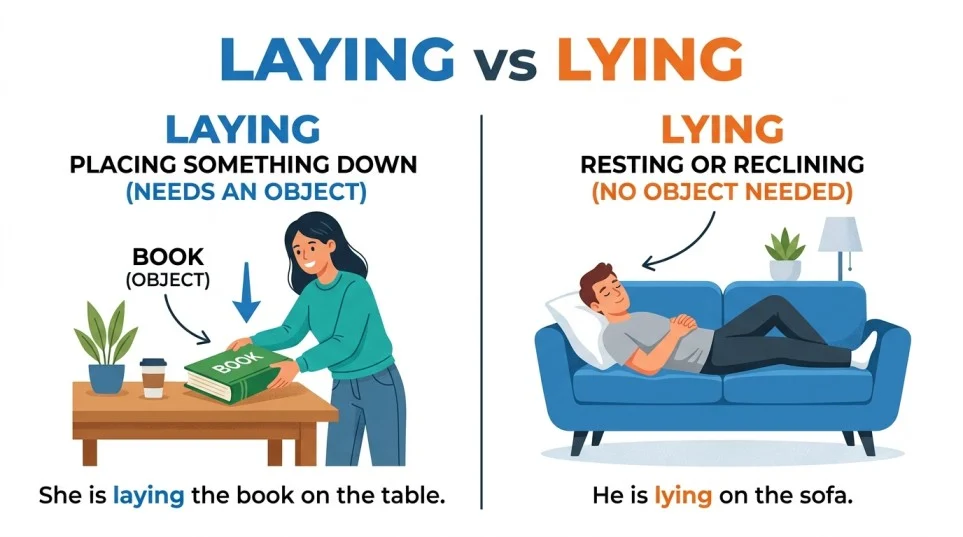
Quick Ans: The difference between laying or lying comes down to whether there is an object involved. Laying means placing something down and requires a direct object, while lying means resting or reclining and does not require an object. Understanding this distinction helps avoid one of the most common grammar mistakes in English.
Many English learners and native speakers struggle with laying or lying. The two words look similar. They sound related. Their verb forms also create confusion.
However, the meanings are different.
One word involves putting something somewhere. The other refers to a person or thing resting in a flat position. Because the past tense forms are also similar, many people use the wrong word without realizing it.
For example, someone might say, “I am laying on the couch.” Although this phrase is common in everyday conversation, it is grammatically incorrect unless the speaker is placing something on the couch.
As a result, understanding laying or lying is important for clear communication. Whether you are writing emails, academic papers, blog posts, or social media updates, using the correct word makes your writing more professional.
This guide explains the difference in simple language. You will learn definitions, grammar rules, examples, common mistakes, exercises, and practical tips for mastering these confusing verbs.
Quick Answer: Laying or Lying
The easiest way to understand laying or lying is to check whether an object receives the action.
| Word | Meaning | Needs an Object? |
|---|---|---|
| Laying | Putting something down | Yes |
| Lying | Resting or reclining | No |
Consider these examples:
- She is laying the book on the table.
- He is lying on the sofa.
In the first sentence, the book receives the action. In the second sentence, no object is involved.
Therefore, if you can answer the question “laying what?” you probably need laying. If there is no object, lying is usually correct.
What Does Laying Mean?
Laying comes from the verb lay, which means to place or put something down.
The key rule is simple:
Lay always requires an object.
In other words, something must receive the action.
Examples of Laying
- She is laying the blanket on the bed.
- The worker is laying bricks.
- They are laying the foundation for a new house.
- He is laying the papers on the desk.
Notice that each sentence includes an object:
- Blanket
- Bricks
- Foundation
- Papers
Without an object, the sentence becomes incorrect.
Common Uses of Laying
The verb lay appears in many situations:
- Laying a book on a table
- Laying tiles on a floor
- Laying cards during a game
- Laying a plan for the future
Because an object is always present, identifying it helps determine whether laying is correct.
What Does Lying Mean?
Lying comes from the verb lie, which means to rest, recline, or remain in a flat position.
Unlike lay, the verb lie does not require an object.
Examples of Lying
- The dog is lying on the floor.
- She is lying in bed.
- The keys are lying on the counter.
- He spent the afternoon lying in a hammock.
In each example, nobody is placing an object somewhere. Instead, the subject is resting or remaining in position.
Common Uses of Lying
People commonly use lying when discussing:
- Sleeping
- Relaxing
- Resting
- Reclining
- Remaining in a location
Because no object receives the action, lying is the correct choice.
Key Differences Between Laying or Lying
Presence of an Object
The biggest difference between laying or lying is whether an object exists.
Laying requires an object.
Lying does not require an object.
Action Type
Laying involves placing something somewhere.
Lying involves resting or reclining.
Sentence Structure
Compare these examples:
- She is laying the phone on the desk.
- She is lying on the couch.
The first sentence contains an object: phone.
The second sentence contains no object.
Memory Trick
A simple memory trick helps many learners:
Lay = Place
Both words contain four letters.
If you can replace the verb with place, then lay is probably correct.
Example:
- She is laying the book down.
- She is placing the book down.
The sentence still makes sense.
Verb Forms of Lay and Lie
One reason laying or lying causes confusion is the unusual verb forms.
Verb Forms of Lay
| Tense | Form |
|---|---|
| Base Verb | Lay |
| Present Participle | Laying |
| Past Tense | Laid |
| Past Participle | Laid |
Examples:
- I lay the keys on the table.
- Yesterday, I laid the keys there.
- I have laid the keys there before.
Verb Forms of Lie
| Tense | Form |
|---|---|
| Base Verb | Lie |
| Present Participle | Lying |
| Past Tense | Lay |
| Past Participle | Lain |
Examples:
- I lie on the couch.
- Yesterday, I lay on the couch.
- I have lain there all afternoon.
Notice something important.
The past tense of lie is lay, which creates much of the confusion.
Advantages and Disadvantages of Learning the Difference
Advantages
Understanding laying or lying helps you:
- Write more professionally
- Improve grammar accuracy
- Communicate clearly
- Avoid common mistakes
- Perform better in exams
Disadvantages
Learning these verb forms can be challenging because:
- The words look similar
- Their meanings overlap slightly
- The past tense forms are confusing
- Everyday speech often uses them incorrectly
Despite these challenges, mastering the distinction becomes easier with practice.
Real World Examples
At Work
Correct:
- The employee is laying documents on the conference table.
Incorrect:
- The employee is lying documents on the conference table.
At Home
Correct:
- The cat is lying on the rug.
Incorrect:
- The cat is laying on the rug.
In School Writing
Correct:
- The student is laying the notebook on the desk.
Correct:
- The student is lying on the grass during lunch.
These examples demonstrate how context determines the correct choice.
Regional and Global Usage
Everyday Conversation
Many English speakers incorrectly use laying when lying is needed.
For example:
- I am laying on the couch.
This phrase is common in casual speech.
Formal Writing
Professional writing typically follows standard grammar rules.
Therefore, editors and teachers often correct mistakes involving laying or lying.
International English Learning
Students learning English as a second language frequently struggle with these verbs because many languages do not make the same distinction.
Consequently, grammar lessons often emphasize this topic.
Related Concepts and Comparisons
Laying vs Sitting
Sitting refers to being upright.
Lying refers to being flat or reclined.
Laying vs Placing
In many situations, laying and placing have similar meanings.
Examples:
- She is laying the book down.
- She is placing the book down.
Lying vs Sleeping
Lying does not necessarily mean sleeping.
Someone can lie on a couch while reading a book.
Laying or Lying vs Raising or Rising
Another common grammar comparison involves:
- Raise and rise
- Lay and lie
Both pairs follow a similar pattern because one verb takes an object while the other does not.
Common Mistakes About Laying or Lying
Saying “I Am Laying on the Bed”
This is one of the most common mistakes.
Correct:
- I am lying on the bed.
No object is receiving the action.
Forgetting the Object Rule
Many people focus only on the action.
Instead, ask:
“What is being laid?”
If no answer exists, lying may be correct.
Mixing Up Past Tenses
Remember:
- Past tense of lay = laid
- Past tense of lie = lay
This distinction often causes confusion.
Using Casual Speech as a Grammar Guide
Everyday conversations frequently contain grammar mistakes.
Formal writing should follow standard grammar rules instead.
Beginner to Advanced Learning Tips
Beginner Level
Learn the object rule first.
Ask:
“Is something being placed somewhere?”
If yes, use laying.
Intermediate Level
Memorize the main verb forms:
- Lay, laid, laid
- Lie, lay, lain
Regular review improves recall.
Advanced Level
Practice identifying objects quickly in sentences.
You can also edit written passages and correct incorrect uses of laying and lying.
Consistent practice builds confidence.
Step By Step Grammar Scenario
Imagine a person holding a book.
Situation One
The person puts the book on a table.
Sentence:
- She is laying the book on the table.
An object receives the action.
Situation Two
The person relaxes on a sofa.
Sentence:
- She is lying on the sofa.
No object receives the action.
This simple comparison makes the difference much easier to remember.
Exercises With Answers
Exercise 1
Choose the correct word:
She is _____ the dishes on the counter.
Answer: Laying.
Exercise 2
Choose the correct word:
The dog is _____ in the sun.
Answer: Lying.
Exercise 3
Choose the correct word:
They are _____ carpet in the living room.
Answer: Laying.
Exercise 4
Choose the correct word:
The children are _____ on the grass.
Answer: Lying.
Exercise 5
True or False:
Laying requires an object.
Answer: True.
When Should You Use Laying or Lying?
Use laying when:
- Placing something down
- Moving an object
- Setting something in position
- Arranging materials
Use lying when:
- Resting
- Reclining
- Remaining flat
- Relaxing
Whenever you feel uncertain, identify the object first. This method works in most situations.
FAQs About Laying or Lying
What is the main difference between laying or lying?
Laying requires an object, while lying does not. Laying means placing something down, whereas lying means resting.
Is it correct to say I am laying on the couch?
No. The grammatically correct phrase is “I am lying on the couch” because no object receives the action.
Why is laying or lying so confusing?
The verbs have similar spellings, related meanings, and unusual past tense forms.
Does laying always require an object?
Yes. Something must receive the action when using laying.
Can lying refer to objects?
Yes. Objects can be lying somewhere. For example, “The keys are lying on the table.”
What is the past tense of lie?
The past tense of lie is lay.
What is the past tense of lay?
The past tense of lay is laid.
How can I remember laying or lying?
Ask whether an object receives the action. If yes, use laying. If not, use lying.
Is lying only used for people?
No. People, animals, and objects can all be lying somewhere.
Do native speakers make mistakes with laying or lying?
Yes. Many native speakers use these verbs incorrectly in everyday conversation.
Conclusion
Understanding laying or lying becomes much easier once you learn the object rule. Although the words appear similar, they perform different grammatical functions.
Laying means placing something down and always requires an object. Lying means resting or reclining and does not require an object. This simple distinction helps you choose the correct word in most situations.
The confusion often comes from the unusual verb forms. In particular, the past tense of lie is lay, while the past tense of lay is laid. Fortunately, regular practice makes these forms easier to remember.
When writing or speaking, pause and identify the object. If something receives the action, use laying. If the subject is simply resting, use lying.
By applying this rule consistently, you can avoid one of the most common grammar mistakes in English and communicate with greater confidence.
Discover More:-
- Women or Woman: Difference, Meaning, Grammar Rules, and Examples
- Ax or Axe: Which Spelling Is Correct? Complete Usage Guide

Robert Mitchell is a U.S.-based writer at Gramtivo.Com who focuses on grammar, writing improvement, and language-related content. He holds a degree in English and Linguistics from a U.S. university. His work aims to help readers enhance their writing skills with clear and practical guidance.