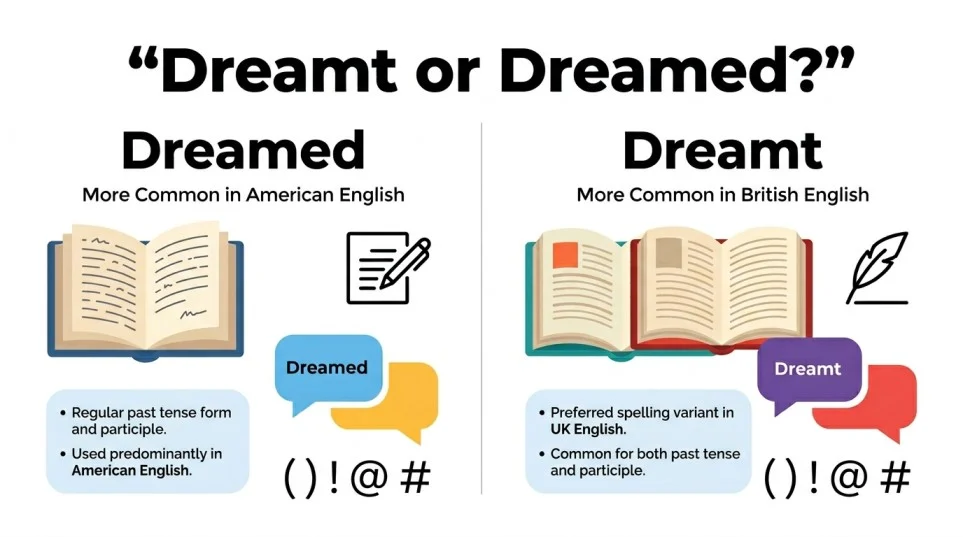
Quick Ans: The difference between dreamt or dreamed is mainly regional preference, not meaning. Both words are correct past tense forms of the verb dream. Generally, dreamed is more common in American English, while dreamt is used more often in British English.
Many English learners and native speakers wonder whether they should write dreamt or dreamed. The confusion is understandable because both words appear in books, articles, conversations, and online content.
At first glance, it may seem that one version is correct and the other is wrong. However, that is not the case. Both forms are accepted by major dictionaries and grammar guides.
The real difference comes from usage patterns. American English tends to favor dreamed. Meanwhile, British English often prefers dreamt. Despite this variation, the meaning remains exactly the same.
Understanding the distinction between dreamt or dreamed helps improve writing, communication, and grammar accuracy. It is especially useful for students, writers, bloggers, teachers, and professionals who want to use English correctly.
This guide explains everything you need to know. You will learn definitions, grammar rules, regional differences, examples, common mistakes, exercises, and practical usage tips.
Quick Answer: Dreamt or Dreamed
If you need a quick answer, here it is:
- Dreamed is more common in American English.
- Dreamt is more common in British English.
- Both words are grammatically correct.
- Both have the same meaning.
Quick Comparison Table
| Feature | Dreamed | Dreamt |
|---|---|---|
| Meaning | Past tense of dream | Past tense of dream |
| Correct Grammar | Yes | Yes |
| American English | More common | Less common |
| British English | Common | More common |
| Formal Writing | Accepted | Accepted |
| Everyday Use | Very common | Common |
In most situations, you can safely use either word.
What Does “Dreamed” Mean?
Dreamed is the regular past tense and past participle form of the verb dream.
Examples:
- I dreamed about flying last night.
- She dreamed of becoming a doctor.
- We dreamed of traveling around the world.
The word follows the common English pattern of adding -ed to create the past tense.
Because many English verbs follow this structure, some people find dreamed easier and more natural.
Why Is Dreamed Popular?
Several reasons explain its popularity:
- It follows regular verb rules.
- It is widely used in American English.
- Many style guides prefer regular verb forms.
- It sounds natural to many modern speakers.
As a result, dreamed appears frequently in newspapers, websites, academic writing, and business communication.
What Does “Dreamt” Mean?
Dreamt has the same meaning as dreamed. It is simply an alternative past tense and past participle form of dream.
Examples:
- I dreamt about a beautiful beach.
- He dreamt of becoming famous.
- They dreamt about their future success.
The meaning does not change at all.
Why Is Dreamt Still Used?
Many people continue using dreamt because:
- It has a traditional sound.
- It is common in British English.
- It appears frequently in literature.
- Some writers prefer its style and rhythm.
Therefore, seeing dreamt in books, novels, and British publications is completely normal.
Key Differences Between Dreamt or Dreamed
Meaning
There is no difference in meaning.
Both words describe:
- Having dreams while sleeping
- Imagining future goals
- Thinking about possibilities
Grammar
Both forms are grammatically correct.
For example:
- I dreamed about the ocean.
- I dreamt about the ocean.
Each sentence is correct.
Regional Usage
Regional preference creates the biggest distinction.
American English generally favors dreamed.
British English often prefers dreamt.
Writing Style
Some writers choose dreamt because it sounds more literary. Others choose dreamed because it follows regular grammar patterns.
The choice often depends on audience and style.
Historical Background of Dreamt or Dreamed
The verb dream has existed for centuries.
In older forms of English, irregular verb endings were more common. Consequently, forms such as dreamt developed naturally.
Over time, English gradually moved toward regular verb patterns. Because of this shift, dreamed became increasingly popular.
Today, both forms remain accepted.
This situation is similar to other verb pairs such as:
| Regular Form | Alternative Form |
|---|---|
| Learned | Learnt |
| Burned | Burnt |
| Spoiled | Spoilt |
| Smelled | Smelt |
English speakers continue using both versions depending on region and preference.
Advantages and Disadvantages
Advantages of Using Dreamed
- More common in American English
- Follows regular grammar patterns
- Widely accepted in professional writing
- Familiar to international audiences
Disadvantages of Using Dreamed
- May sound less traditional to some readers
- Less common in certain British publications
Advantages of Using Dreamt
- Common in British English
- Often sounds more literary
- Frequently appears in novels and poetry
- Adds stylistic variety
Disadvantages of Using Dreamt
- Less familiar to some American readers
- Can seem old fashioned in certain contexts
Neither choice is wrong. The best option depends on audience and writing style.
Real World Examples
Example in American English
An American news article might say:
“I dreamed about starting my own business.”
Most American readers find this version natural.
Example in British English
A British magazine might write:
“I dreamt of visiting Scotland.”
British readers often encounter this form regularly.
Example in Literature
Authors sometimes choose words based on rhythm.
For instance:
- She dreamed of freedom.
- She dreamt of freedom.
Although both sentences mean the same thing, the second version may sound slightly more poetic.
Regional Usage Around the World
United States
American English strongly favors dreamed.
Most newspapers, schools, and businesses use this version.
United Kingdom
British English uses both forms. However, dreamt appears more frequently.
Canada
Canadian English often accepts both versions.
Writers may choose based on personal preference or publication guidelines.
Australia and New Zealand
Both forms are common. Nevertheless, dreamt tends to appear more often than in the United States.
As a result, understanding your audience can help determine which form to use.
Related Concepts and Comparisons
Dreamt vs Dreamed vs Dreaming
| Word | Grammar Role |
|---|---|
| Dream | Base verb |
| Dreaming | Present participle |
| Dreamed | Past tense |
| Dreamt | Past tense |
Examples:
- I dream every night.
- I am dreaming right now.
- I dreamed about school.
- I dreamt about school.
Learnt vs Learned
The relationship between dreamt and dreamed is similar to:
- Learnt vs Learned
- Burnt vs Burned
- Spoilt vs Spoiled
In each case, both versions are considered correct.
Common Mistakes About Dreamt or Dreamed
Thinking One Is Incorrect
Many people assume one version must be wrong.
In reality, both forms are accepted in standard English.
Mixing Regional Styles
Switching between American and British spelling styles within the same document can create inconsistency.
Choose one style and maintain it throughout your writing.
Using the Wrong Verb Form
Some writers mistakenly use:
- Dreameded
- Dreamted
These forms are incorrect.
Only dreamed and dreamt are valid.
Assuming Meaning Changes
The meaning stays exactly the same.
The difference involves preference and regional usage rather than definition.
Beginner to Advanced Writing Tips
Beginner Level
Use dreamed if you are unsure.
It is widely understood around the world.
Intermediate Level
Match your audience.
For American readers, choose dreamed.
For British readers, either option works, although dreamt may feel more natural.
Advanced Level
Consider tone and rhythm.
Poetry, fiction, and creative writing sometimes benefit from dreamt because of its distinctive sound.
Business and academic writing often favor dreamed.
Step By Step Usage Scenario
Imagine you are writing a sentence about last night’s sleep.
If your audience is American:
- Write your sentence.
- Use dreamed as the past tense.
- Check for consistency.
Example:
“I dreamed about winning a race.”
If your audience is British:
- Write the sentence.
- Choose either form.
- Maintain the same style throughout the document.
Example:
“I dreamt about winning a race.”
Both sentences are correct.
Exercises With Answers
Exercise 1
Which word is more common in American English?
Answer: Dreamed.
Exercise 2
Which word is more common in British English?
Answer: Dreamt.
Exercise 3
True or False: Dreamt is grammatically incorrect.
Answer: False.
Exercise 4
Fill in the blank:
“I _____ about becoming an astronaut.”
Answer: Dreamed or Dreamt.
Exercise 5
Do dreamt and dreamed have different meanings?
Answer: No.
When Should You Use Dreamt or Dreamed?
Use dreamed when:
- Writing for American audiences
- Creating business documents
- Following regular grammar patterns
- Writing academic content
Use dreamt when:
- Writing for British audiences
- Creating literary content
- Following British style conventions
- Seeking a traditional tone
Consistency matters more than the specific choice.
FAQs About Dreamt or Dreamed
Which is correct, dreamt or dreamed?
Both are correct past tense forms of the verb dream.
Is dreamt old fashioned?
Not necessarily. Dreamt remains common in British English and literary writing.
Do dreamt and dreamed mean the same thing?
Yes. The meaning is identical.
Which is more common in American English?
Dreamed is much more common in American English.
Which is more common in British English?
Dreamt is often preferred in British English, although dreamed is also correct.
Can I use dreamt in academic writing?
Yes. However, many academic style guides favor dreamed because it follows regular verb patterns.
Is dreamed grammatically correct?
Absolutely. Dreamed is a fully accepted past tense form.
Why are there two versions?
English retains both regular and irregular verb forms from its historical development.
Should I use dreamt or dreamed in fiction?
Either works. Many fiction writers choose based on tone and rhythm.
Do dictionaries accept both dreamt and dreamed?
Yes. Major dictionaries list both forms as correct.
Conclusion
The debate over dreamt or dreamed is simpler than many people think. Both words are correct. Both express the past tense of dream. Neither changes the meaning of a sentence.
The main difference comes from regional preference. American English strongly favors dreamed, while British English often uses dreamt. Because both forms are widely accepted, choosing the right one depends mostly on audience and style.
For professional, academic, and international writing, dreamed is often the safest option. Meanwhile, dreamt remains a perfectly valid choice for British English, literature, and creative writing.
Most importantly, stay consistent throughout your document. Switching repeatedly between the two forms can make writing look inconsistent.
Once you understand the distinction between dreamt or dreamed, you can write with greater confidence and accuracy in any situation.
Discover More:-
- Stretcher vs Gurney: Key Differences, Uses, and Medical Comparison Guide
- Balcony vs Patio: Differences, Uses, and Outdoor Space Guide

Robert Mitchell is a U.S.-based writer at Gramtivo.Com who focuses on grammar, writing improvement, and language-related content. He holds a degree in English and Linguistics from a U.S. university. His work aims to help readers enhance their writing skills with clear and practical guidance.