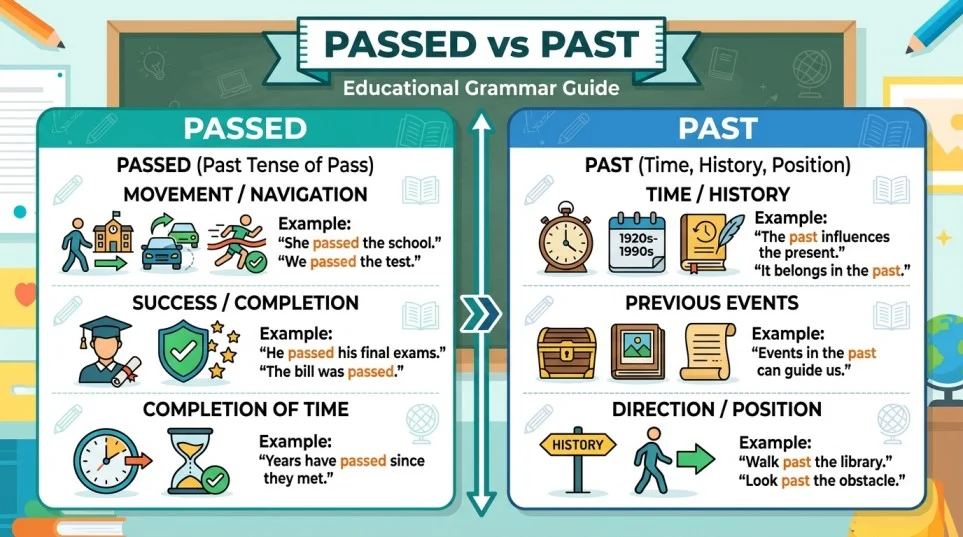
Quick Ans: The difference between passed or past is simple but important. Passed is usually the past tense of the verb pass, while past is commonly used as a noun, adjective, adverb, or preposition that refers to time, position, or something that has already happened. Although the words sound alike, they serve different grammatical purposes.
Many English learners struggle with passed or past because the two words sound exactly the same. They are examples of homophones, which means they have the same pronunciation but different meanings and uses.
At first glance, the difference may seem confusing. Both words appear in everyday conversations, emails, books, and professional writing. As a result, many people accidentally use one when they mean the other.
For example, someone might write, “I walked passed the store,” when the correct word is actually past. Likewise, another person may write, “The exam is past,” when they really mean passed.
Fortunately, understanding the difference is easier than it seems. Once you learn the role each word plays in a sentence, choosing the correct option becomes much simpler.
In this guide, you will learn the meanings, grammar rules, examples, common mistakes, exercises, and practical tips for using passed or past correctly in both writing and speech.
Quick Answer: Passed or Past
The easiest way to understand passed or past is to remember this rule:
- Passed is usually a verb.
- Past is usually not a verb.
Consider the following examples:
- She passed the driving test.
- We walked past the library.
In the first sentence, passed shows an action. In the second sentence, past shows direction or position.
Quick Comparison Table
| Feature | Passed | Past |
|---|---|---|
| Part of Speech | Usually a verb | Noun, adjective, adverb, or preposition |
| Meaning | Completed an action of passing | Refers to time, position, or previous events |
| Example | He passed the exam. | The past year was difficult. |
| Action Word | Yes | No |
| Common Use | Movement, success, transfer | Time, location, history |
Therefore, if the sentence needs an action, passed is often the correct choice.
What Does Passed Mean?
Passed is the past tense and past participle form of the verb pass.
The word describes an action that has already happened.
Common Meanings of Passed
Passed can mean:
- Moved by something
- Succeeded in a test
- Handed something to someone
- Approved officially
- Reached a point
- Died (a polite expression)
Examples of Passed
Here are some examples:
- She passed the school on her way home.
- The student passed the exam.
- He passed me the salt.
- The government passed a new law.
- Our car passed the truck.
- Her grandfather passed away last year.
In every example, the word describes an action.
How to Identify Passed
Ask yourself:
Can I replace the word with “completed an action of passing”?
If the answer is yes, then passed is likely correct.
For instance:
- He passed the ball.
- She passed the interview.
Both sentences contain actions.
What Does Past Mean?
Past refers to a previous time, a position beyond something, or events that already happened.
Unlike passed, it is usually not used as a verb.
Past as a Noun
When used as a noun, past refers to a time that has already happened.
Examples:
- We should learn from the past.
- Her past shaped her future.
Past as an Adjective
As an adjective, it describes something that already happened.
Examples:
- During the past week, sales increased.
- The past year was challenging.
Past as an Adverb
As an adverb, it describes movement beyond a point.
Examples:
- The car drove past.
- We ran past quickly.
Past as a Preposition
As a preposition, it means beyond a place or point.
Examples:
- Walk past the bank.
- The store is just past the traffic light.
Because past has several grammatical functions, context determines its meaning.
Key Differences Between Passed or Past
Grammar Function
The biggest difference between passed or past involves grammar.
- Passed functions as a verb.
- Past functions as a noun, adjective, adverb, or preposition.
Action vs Description
Passed describes an action.
Past describes time, position, or circumstances.
Example Comparison
| Incorrect | Correct |
|---|---|
| I walked passed the store. | I walked past the store. |
| She past the exam. | She passed the exam. |
| We learned from our passed. | We learned from our past. |
| The bill past Congress. | The bill passed Congress. |
These examples show why understanding the distinction matters.
Advantages and Disadvantages of Learning the Rule
Advantages
Understanding passed or past helps you:
- Write more accurately
- Improve grammar skills
- Avoid common mistakes
- Communicate professionally
- Score better on exams
Disadvantages
Some challenges include:
- Both words sound identical
- Autocorrect may not catch mistakes
- Context determines usage
- Beginners often confuse grammar roles
However, regular practice quickly improves accuracy.
Real World Examples
In School Writing
A student might write:
- Incorrect: I past the test.
- Correct: I passed the test.
The corrected sentence shows the action of completing the exam successfully.
In Directions
Someone giving directions may say:
- Walk past the supermarket.
- Continue past the bridge.
Here, past describes location.
In Business Communication
Professional emails often include:
- The proposal passed review.
- We discussed past performance.
Notice how each word serves a different purpose.
In Daily Conversation
People commonly say:
- Time has passed quickly.
- The past cannot be changed.
Although the words sound identical, their meanings differ.
Regional and Global Usage
American English
American English uses passed and past according to the same grammar rules taught worldwide.
British English
British English follows the same distinction.
Examples include:
- The train passed the station.
- We walked past the station.
International English Learning
Students across the world often confuse these words because pronunciation provides no clues. Consequently, grammar becomes the key to choosing correctly.
Related Concepts and Comparisons
Passed vs Pass
- Pass = present tense
- Passed = past tense
Examples:
- I pass the building every day.
- Yesterday, I passed the building.
Past vs Previous
Both words can refer to earlier time periods.
Examples:
- The past year
- The previous year
However, past often feels broader and more general.
Passed vs Passed Away
Passed away is a polite phrase meaning someone died.
Examples:
- Her grandfather passed away peacefully.
- The community remembered those who had passed away.
Passed or Past vs Then or Than
Many learners confuse these pairs because they sound similar. Nevertheless, their meanings and grammar functions are completely different.
Common Mistakes About Passed or Past
Using Passed for Location
Incorrect:
- We drove passed the museum.
Correct:
- We drove past the museum.
The sentence describes location, not action.
Using Past as a Verb
Incorrect:
- She past the exam.
Correct:
- She passed the exam.
The sentence requires a verb.
Confusing Time References
Incorrect:
- The passed year was difficult.
Correct:
- The past year was difficult.
The phrase describes a previous year.
Ignoring Grammar Roles
Many writers focus only on pronunciation. Instead, pay attention to the word’s grammatical function.
Doing so reduces errors significantly.
Beginner to Advanced Learning Tips
Beginner Level
Remember a simple rule:
Passed = action.
Past = time or place.
Intermediate Level
Identify the part of speech before choosing the word.
Ask:
- Do I need a verb?
- Do I need a noun, adjective, adverb, or preposition?
Advanced Level
Analyze sentence structure carefully.
Professional editors often check whether the word expresses movement, completion, direction, or time reference.
This habit improves writing quality.
Step By Step Usage Scenario
Imagine you are writing a sentence.
First, determine whether an action is happening.
Example:
- She _____ the final exam.
The sentence needs a verb.
Therefore:
- She passed the final exam.
Now consider another sentence:
- Walk _____ the restaurant.
This sentence describes direction.
Therefore:
- Walk past the restaurant.
Following these steps makes the choice much easier.
Exercises With Answers
Exercise 1
Choose the correct word:
She _____ the interview.
Answer: Passed.
Exercise 2
Choose the correct word:
We walked _____ the library.
Answer: Past.
Exercise 3
Choose the correct word:
The _____ month was very busy.
Answer: Past.
Exercise 4
Choose the correct word:
The law _____ last year.
Answer: Passed.
Exercise 5
True or False:
Past is usually a verb.
Answer: False.
When Should You Use Passed or Past?
Use passed when:
- Describing an action
- Talking about success in a test
- Referring to movement
- Mentioning approval or transfer
Use past when:
- Referring to earlier time
- Describing location
- Talking about history
- Indicating movement beyond a point
Following this guideline helps avoid most mistakes.
FAQs About Passed or Past
What is the difference between passed or past?
Passed is usually a verb showing action, while past refers to time, position, or previous events.
Is passed a verb?
Yes. Passed is the past tense of the verb pass.
Is past a verb?
Generally, no. Past functions as a noun, adjective, adverb, or preposition.
Do I say passed the store or past the store?
Use past the store because the phrase describes location.
Do I say passed the test or past the test?
Use passed the test because passing a test is an action.
Why do people confuse passed or past?
The words sound exactly the same, making them common homophones.
Can past refer to time?
Yes. Past often refers to previous events or earlier periods.
What does passed away mean?
Passed away is a polite expression meaning someone died.
How can I remember passed or past?
Remember that passed is usually an action, while past usually refers to time or place.
Are passed and past interchangeable?
No. Each word has a different grammatical role and meaning.
Conclusion
Understanding passed or past is essential for clear and accurate English writing. Although the two words sound identical, they serve different purposes in a sentence.
Passed is usually a verb that describes an action. Whether someone passed a test, passed a law, or passed a building, the word shows something happened.
Past, by contrast, usually refers to time, position, or previous events. It can function as a noun, adjective, adverb, or preposition depending on the context.
The easiest way to choose correctly is to identify the role the word plays in the sentence. If you need an action, use passed. If you are discussing time, location, or history, use past.
With regular practice and careful proofreading, distinguishing between passed or past becomes second nature. As a result, your writing will appear more professional, polished, and grammatically correct.
Discover More:-
- Women or Woman: Difference, Meaning, Grammar Rules, and Examples
- Ax or Axe: Which Spelling Is Correct? Complete Usage Guide

Lisa Thompson is a USA-based content writer and language specialist focused on grammar, writing improvement and digital publishing.
She holds a degree in English Language and Communication and has professional experience in educational and web content creation.
As the author of Gramtivo.Com, she aims to help readers improve their writing skills through clear and practical guidance.