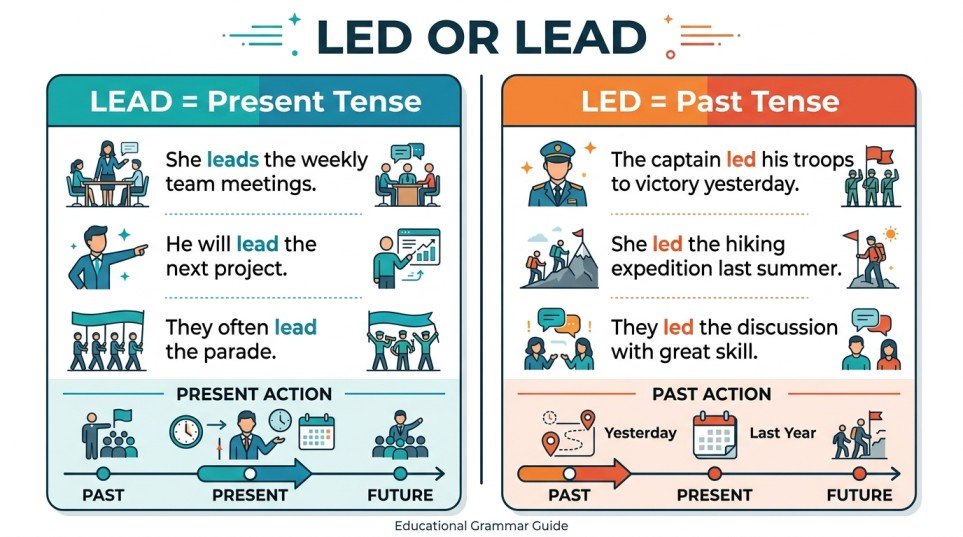
Quick Ans: The difference between led or lead comes down to tense and meaning. Lead is usually the present tense of the verb meaning to guide or direct, while led is the past tense and past participle of that same verb. Although the words look similar, using the wrong one can create grammar mistakes and confusion.
Many English learners and native speakers struggle with led or lead. The confusion is understandable because the two words are closely related. In fact, they come from the same verb.
However, their usage is different.
The word lead usually refers to something happening now or in the future. Meanwhile, led refers to something that already happened in the past. Because the spelling of lead resembles the past tense pattern of many verbs, people often assume it works differently than it actually does.
The confusion increases because lead can also be a noun. For example, it can refer to a position of leadership or even a type of metal. As a result, writers frequently pause to decide whether they should use led or lead in a sentence.
Understanding the distinction between led or lead is important for academic writing, business communication, emails, reports, and everyday conversations. This guide explains the difference clearly with examples, comparisons, common mistakes, and practical exercises.
Quick Answer: Led or Lead
The easiest way to understand led or lead is to remember the tense.
| Word | Part of Speech | Meaning | Example |
|---|---|---|---|
| Lead | Present tense verb | To guide or direct | I lead the team. |
| Led | Past tense verb | Guided or directed | I led the team yesterday. |
Simple Rule
- Use lead for present or future actions.
- Use led for past actions.
For example:
✅ I lead the project today.
✅ I led the project last year.
❌ I lead the project last year.
❌ I led the project tomorrow.
What Does Lead Mean?
The word lead is most commonly used as a verb meaning to guide, direct, influence, or show the way.
Examples of Lead as a Verb
- I lead the marketing department.
- They lead the discussion every week.
- She will lead the meeting tomorrow.
- Good teachers lead students toward success.
In each example, the action happens now or in the future.
Lead as a Noun
The word lead can also function as a noun.
Examples include:
- He has the lead in the race.
- She plays the lead in the movie.
- The detective followed a promising lead.
In these cases, lead does not mean guiding someone. Instead, it refers to an advantage, main role, or clue.
Lead as a Metal
Another meaning of lead refers to a heavy metallic element.
Examples:
- Lead pipes are no longer commonly used.
- The old paint contained lead.
Interestingly, the metal is pronounced differently from the verb.
What Does Led Mean?
The word led is the past tense and past participle of the verb lead.
Whenever the action already happened, led is usually the correct choice.
Examples of Led
- She led the team to victory.
- They led the project successfully.
- Our guide led us through the museum.
- The manager led the meeting yesterday.
Each sentence describes an action completed in the past.
Past Participle Usage
The word led also appears with helping verbs.
Examples:
- She has led many successful projects.
- They had led the company for years.
- He was led to the correct location.
Because these actions connect to past events, led remains the correct form.
Key Differences Between Led or Lead
Verb Tense
The biggest difference involves tense.
- Lead = present or future
- Led = past
Time Reference
Ask yourself when the action happened.
If it happens now, use lead.
If it happened before now, use led.
Grammar Function
Both words come from the same verb. However, they perform different grammatical roles based on time.
Comparison Table
| Situation | Correct Word |
|---|---|
| Action happening today | Lead |
| Action happening tomorrow | Lead |
| Action happened yesterday | Led |
| Action happened last year | Led |
| Present leadership role | Lead |
| Completed leadership action | Led |
Therefore, identifying the timeframe usually solves the problem.
Advantages and Disadvantages of Understanding Led or Lead
Advantages
Learning the difference provides several benefits:
- Improves grammar accuracy
- Creates professional writing
- Reduces confusion
- Enhances communication skills
- Builds confidence in English
Disadvantages of Misusing Them
Using the wrong word can:
- Create grammatical errors
- Confuse readers
- Weaken professional documents
- Lower writing quality
Consequently, mastering led or lead is valuable for every writer.
Real World Examples
Business Communication
Present tense:
- I lead the sales department.
Past tense:
- I led the sales department for five years.
Academic Writing
Present tense:
- The researcher leads the study.
Past tense:
- The researcher led the study in 2024.
Sports
Present tense:
- The captain leads the team.
Past tense:
- The captain led the team to victory.
These examples show how a simple tense change affects word choice.
Regional and Global Usage
American English
American English follows the standard distinction:
- Lead = present tense
- Led = past tense
British English
British English follows the same grammatical rule.
International English
Whether you are writing in Canada, Australia, India, or another English speaking region, the distinction remains consistent.
As a result, understanding led or lead benefits English users worldwide.
Related Concepts and Comparisons
Lead vs Led vs Lead (Metal)
This comparison often confuses learners.
| Word | Meaning | Pronunciation |
|---|---|---|
| Lead | Guide or direct | LEED |
| Led | Guided in the past | LED |
| Lead | Metal element | LED |
Notice that the metal lead and the word led sound the same but have different meanings.
Lead vs Guide
Both words can indicate direction or leadership.
Examples:
- Teachers lead students.
- Teachers guide students.
However, lead often implies taking charge, while guide may suggest providing assistance.
Lead vs Manage
A manager may lead a team, but leadership and management are not always identical.
Leadership focuses on vision and direction. Management often focuses on organization and execution.
Common Mistakes About Led or Lead
Using Lead for Past Events
Incorrect:
❌ She lead the project last year.
Correct:
✅ She led the project last year.
Using Led for Present Events
Incorrect:
❌ He led the department today.
Correct:
✅ He leads the department today.
Confusing Lead With the Metal
Incorrect understanding often occurs because the metal lead is pronounced like led.
Remember:
- Lead (verb) = LEED
- Lead (metal) = LED
Forgetting Time Clues
Words such as yesterday, last week, and last year usually require led.
Words such as today, now, and currently often require lead.
Beginner to Advanced Learning Tips
Beginner Level
Memorize this simple phrase:
Today I lead. Yesterday I led.
Intermediate Level
Practice identifying time markers in sentences before choosing a word.
Advanced Level
Study how led functions as both past tense and past participle.
Examples:
- She led the discussion.
- She has led the discussion before.
Developing this awareness improves advanced writing accuracy.
Step By Step Decision Process
When deciding between led or lead, follow these steps:
Step 1
Identify the action.
Step 2
Determine when it happened.
Step 3
If it happens now, use lead.
Step 4
If it already happened, use led.
Example
Sentence:
“She _____ the company for ten years before retiring.”
The action happened in the past.
Correct answer:
Led
Exercises With Answers
Exercise 1
Choose the correct word:
I _____ the team today.
Answer: Lead
Exercise 2
Choose the correct word:
She _____ the group yesterday.
Answer: Led
Exercise 3
Choose the correct word:
They have _____ several successful projects.
Answer: Led
Exercise 4
Choose the correct word:
Our manager will _____ the meeting tomorrow.
Answer: Lead
Exercise 5
True or False:
“Led” is the present tense of “lead.”
Answer: False
When Should You Use Led or Lead?
Use lead when:
- Discussing current actions
- Referring to future actions
- Describing ongoing leadership
Use led when:
- Referring to completed actions
- Writing about history
- Discussing past leadership
Checking the time reference is the easiest way to choose correctly.
FAQs About Led or Lead
What is the difference between led or lead?
Lead is the present tense of the verb, while led is the past tense and past participle.
Is it led or lead a team yesterday?
The correct phrase is led a team yesterday because the action happened in the past.
Why do people confuse led or lead?
Many people assume lead follows a regular past tense pattern. Additionally, lead is also a noun and a metal.
Is lead present tense?
Yes. Lead is generally the present tense form of the verb meaning to guide or direct.
Is led a real word?
Yes. Led is the correct past tense and past participle of lead.
Do British and American English use led differently?
No. Both varieties use lead for present tense and led for past tense.
What is the past tense of lead?
The past tense of lead is led.
Can lead be a noun?
Yes. It can mean a clue, an advantage, or a starring role.
How do I remember led or lead?
Use the phrase: “Today I lead. Yesterday I led.”
Is it has led or has lead?
The correct form is has led because led is the past participle.
Conclusion
Understanding led or lead is essential for clear and professional English writing. Although the words are closely related, they serve different grammatical purposes.
Lead is generally used for present and future actions. It describes guiding, directing, or being in charge right now. Led, by contrast, refers to actions that happened in the past. It also functions as the past participle of lead.
Many grammar mistakes occur because writers overlook time references. Fortunately, the solution is simple. Check when the action takes place before choosing a word.
If the action is happening today, use lead. If the action already happened, use led.
Practicing with real examples, reviewing common mistakes, and paying attention to sentence context will help you master the distinction. Once you understand the rule, choosing between led or lead becomes quick and easy in everyday writing.
Discover More:-
- Medicaid vs Obamacare: Key Differences, Eligibility, Costs, and Benefits
- Grizzly vs Gorilla: Size, Strength, Fight Analysis, and Key Differences

Robert Mitchell is a U.S.-based writer at Gramtivo.Com who focuses on grammar, writing improvement, and language-related content. He holds a degree in English and Linguistics from a U.S. university. His work aims to help readers enhance their writing skills with clear and practical guidance.