
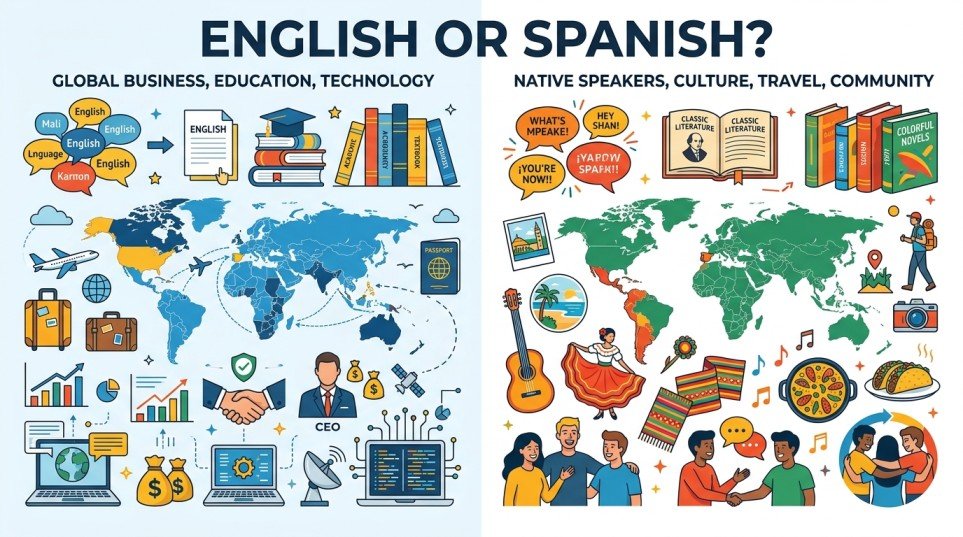
Quick Ans: When comparing English or Spanish, the best choice depends on your goals, location, and career plans. English is the most widely used international language for business, technology, and higher education, while Spanish is one of the most spoken native languages in the world and is valuable across many countries and industries.
Many language learners ask the question: English or Spanish? It is one of the most common language learning decisions people face today.
Both languages are extremely popular. Each one opens doors to new opportunities. Moreover, both can improve communication, travel experiences, and career prospects.
The challenge is deciding which language offers the greatest benefit for your situation. Some people need a language for work. Others want to travel more easily. Meanwhile, many learners simply enjoy connecting with different cultures.
Although English and Spanish share some similarities, they serve different purposes around the world. English dominates international business, science, and technology. Spanish, however, connects people across large parts of Europe, Latin America, and North America.
Understanding the strengths and limitations of each language can help you make the right choice. This guide explores the differences between English or Spanish, including global usage, difficulty levels, career benefits, real world examples, common mistakes, and practical learning exercises.
By the end, you will know which language better matches your goals.
Quick Answer: English or Spanish
The answer depends on what you want to achieve.
| Factor | English | Spanish |
|---|---|---|
| Global Reach | Extremely high | Very high |
| Business Use | Excellent | Good |
| Travel Benefits | Worldwide | Strong in Spanish speaking regions |
| Learning Difficulty | Moderate | Generally easier for pronunciation |
| Online Content | Largest amount | Large and growing |
| Native Speakers | Fewer than Spanish | More than English |
If your goal is international communication, English often provides broader opportunities. If your goal is connecting with Spanish speaking communities, Spanish may be the better choice.
What Is English?
English is a Germanic language that originated in England. Over time, it spread across the world through trade, colonization, media, and globalization.
Today, English serves as a global language in many industries.
Common areas where English is widely used include:
- International business
- Technology
- Science
- Aviation
- Tourism
- Higher education
Millions of people learn English as a second language because it helps them communicate internationally.
Why English Is Important
English plays a major role in global communication.
Many multinational companies use English as their primary working language. In addition, a large percentage of internet content is published in English.
As a result, learning English often provides access to more educational and professional resources.
Common Uses of English
English is frequently used for:
- Business meetings
- Academic research
- International travel
- Online learning
- Entertainment media
Because of its widespread use, English often becomes the default language between people from different countries.
What Is Spanish?
Spanish is a Romance language that originated on the Iberian Peninsula. Today, it is spoken throughout Spain, much of Latin America, and many communities worldwide.
Spanish ranks among the most spoken native languages globally.
Major Spanish speaking regions include:
- Spain
- Mexico
- Argentina
- Colombia
- Peru
- Chile
Large Spanish speaking populations also live in the United States.
Why Spanish Is Important
Spanish connects learners with hundreds of millions of native speakers.
Furthermore, it is one of the fastest growing languages in international communication.
Many industries value Spanish skills because they help businesses serve diverse customers and markets.
Common Uses of Spanish
Spanish is widely used in:
- Tourism
- Healthcare
- Customer service
- Education
- International trade
Therefore, Spanish can create valuable opportunities in many professions.
Key Differences Between English or Spanish
Global Usage
English functions as an international language across nearly every continent.
Spanish, meanwhile, dominates many countries in Latin America and Spain.
Number of Native Speakers
Spanish has more native speakers than English.
However, English has more total speakers when second language learners are included.
Pronunciation
Spanish pronunciation tends to be more consistent.
English pronunciation contains many irregular words and spelling patterns.
Grammar
English grammar is generally simpler in some areas.
Spanish grammar includes gendered nouns and more verb conjugations.
Career Applications
English is often required for international careers.
Spanish provides an advantage in regions with large Spanish speaking populations.
Advantages and Disadvantages
English Advantages
English offers many benefits:
- Global communication opportunities
- Strong business value
- Extensive educational resources
- Access to international media
English Disadvantages
Learners may face challenges such as:
- Irregular spelling
- Complex pronunciation rules
- Numerous exceptions
Spanish Advantages
Spanish provides several strengths:
- Consistent pronunciation
- Large native speaker population
- Useful across many countries
- Strong cultural influence
Spanish Disadvantages
Some learners find these aspects challenging:
- Verb conjugations
- Gendered nouns
- Regional vocabulary differences
Consequently, the choice between English or Spanish depends on personal goals and learning preferences.
Language Learning Difficulty Comparison
Many learners wonder which language is easier.
Pronunciation
Spanish words are often pronounced as they are written.
English pronunciation can vary significantly from spelling.
For this reason, beginners sometimes find Spanish pronunciation easier.
Vocabulary
English contains vocabulary from many language families.
Spanish vocabulary follows more predictable patterns.
Nevertheless, English learners often encounter more English content online, which can speed up learning.
Grammar
English uses simpler verb systems in many situations.
Spanish requires learners to memorize additional verb forms.
Therefore, grammar difficulty depends on which aspect you find easier.
Real World Examples
International Business Professional
A manager working with teams across multiple countries benefits greatly from English skills.
Healthcare Worker
A healthcare professional serving Spanish speaking patients may gain significant advantages from Spanish.
Frequent Traveler
Someone traveling worldwide often finds English useful in airports, hotels, and tourist destinations.
Community Services Employee
Workers serving multicultural communities frequently benefit from Spanish communication skills.
These examples show how English or Spanish choices vary based on individual circumstances.
Regional and Global Usage
North America
English dominates business and education.
Spanish remains extremely important because of large Spanish speaking populations.
Europe
English serves as a common second language in many countries.
Spanish is widely spoken in Spain and increasingly learned elsewhere.
Latin America
Spanish dominates most countries.
English remains valuable for tourism and international business.
Asia
English plays a major role in education and commerce.
Spanish is less common but continues growing among language learners.
As globalization increases, both languages remain highly valuable.
Related Concepts and Comparisons
English vs French
English generally offers broader global business opportunities.
French remains influential in diplomacy and parts of Africa.
Spanish vs Portuguese
These languages share similarities due to their Latin roots.
However, pronunciation and vocabulary differ considerably.
English vs Spanish vs French
| Feature | English | Spanish | French |
|---|---|---|---|
| Global Reach | Very High | High | High |
| Business Use | Excellent | Good | Good |
| Native Speakers | High | Very High | Moderate |
| Pronunciation Difficulty | Moderate | Easier | Moderate |
Understanding related language comparisons helps place the English or Spanish debate in context.
Common Mistakes About English or Spanish
Assuming One Language Is Always Better
The best language depends on your goals, not on popularity alone.
Ignoring Local Needs
Some learners choose a language without considering their community or workplace requirements.
Focusing Only on Difficulty
Ease of learning matters. However, usefulness should also influence your decision.
Expecting Instant Fluency
Language learning requires time and consistent practice.
Avoiding these mistakes helps create a more effective learning strategy.
Beginner to Advanced Learning Tips
Beginner Level
Start with:
- Basic greetings
- Common vocabulary
- Everyday phrases
Consistency matters more than speed.
Intermediate Level
Focus on:
- Listening practice
- Reading articles
- Watching videos
Regular exposure improves comprehension.
Advanced Level
Work on:
- Professional vocabulary
- Public speaking
- Academic writing
- Native level conversations
At this stage, immersion becomes especially valuable.
Step By Step Decision Scenario
Imagine you want to learn a new language.
If your goal is international business:
- Research job requirements
- Evaluate global opportunities
- Study English first
- Develop professional communication skills
If your goal is serving Spanish speaking communities:
- Identify local demand
- Learn practical vocabulary
- Practice daily conversations
- Build cultural understanding
The right choice depends on your personal objectives.
Exercises With Answers
Exercise 1
Which language is commonly used as an international business language?
Answer: English.
Exercise 2
Which language has more native speakers?
Answer: Spanish.
Exercise 3
Which language generally has more consistent pronunciation?
Answer: Spanish.
Exercise 4
Which language dominates most of Latin America?
Answer: Spanish.
Exercise 5
True or False: English and Spanish are spoken in only one country each.
Answer: False.
When Should You Choose English or Spanish?
Choose English if you:
- Need international communication skills
- Work in technology or global business
- Want access to extensive educational resources
Choose Spanish if you:
- Serve Spanish speaking communities
- Travel frequently in Latin America or Spain
- Want to communicate with a large native speaker population
In some cases, learning both languages may provide the greatest benefit.
FAQs About English or Spanish
What is the main difference between English or Spanish?
English serves as the dominant international language, while Spanish has a larger native speaker population and strong regional influence.
Is English harder than Spanish?
Difficulty depends on your background. Many learners find Spanish pronunciation easier, but English grammar can feel simpler in some situations.
Which language is better for jobs?
English often provides broader international career opportunities. Spanish can offer advantages in healthcare, education, tourism, and customer service.
Should I learn English or Spanish first?
Your goals should guide the decision. International careers often favor English, while community focused roles may benefit more from Spanish.
Which language has more speakers?
Spanish has more native speakers. However, English has more total speakers when second language users are included.
Is Spanish useful in the United States?
Yes. Spanish is highly valuable in many communities and industries throughout the country.
Can learning Spanish help with other languages?
Yes. Spanish can make it easier to learn other Romance languages such as French, Italian, and Portuguese.
Why is English considered a global language?
English is widely used in business, science, technology, aviation, and international communication.
Can I learn both English and Spanish?
Absolutely. Many people successfully learn both languages and gain benefits from each.
Which language grows faster globally?
Both continue to grow. English remains dominant internationally, while Spanish continues expanding due to demographic growth.
Conclusion
The debate over English or Spanish does not have a single correct answer. Each language offers unique advantages depending on your goals, career plans, and personal interests.
English provides unmatched access to international business, higher education, technology, and global communication. For many professionals, it remains the most practical choice.
Spanish, meanwhile, connects learners with a vast native speaking population across multiple continents. It is particularly valuable in tourism, healthcare, customer service, and cultural exchange.
Rather than asking which language is universally better, consider which language aligns with your objectives. A traveler, healthcare worker, business executive, and student may each reach a different conclusion.
If possible, learning both languages creates even greater opportunities. The combination of English and Spanish can improve communication, expand career options, and deepen cultural understanding.
Ultimately, the best language is the one that helps you achieve your goals and enriches your life.
Discover More:-
- Medicaid vs Obamacare: Key Differences, Eligibility, Costs, and Benefits
- Grizzly vs Gorilla: Size, Strength, Fight Analysis, and Key Differences

Robert Mitchell is a U.S.-based writer at Gramtivo.Com who focuses on grammar, writing improvement, and language-related content. He holds a degree in English and Linguistics from a U.S. university. His work aims to help readers enhance their writing skills with clear and practical guidance.