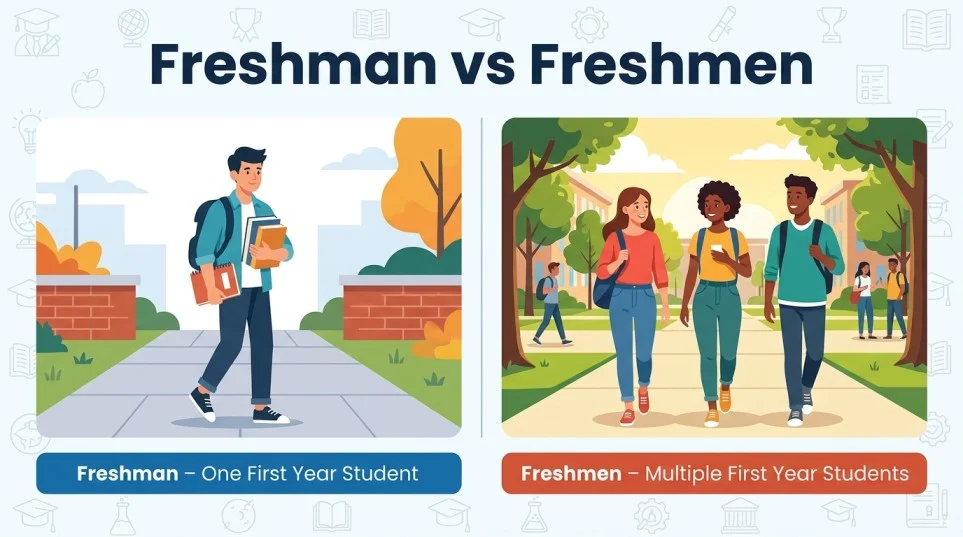
Quick Ans: The difference between freshman or freshmen is simple: freshman refers to one first year student, while freshmen refers to two or more first year students. Although the words look similar, using the correct form is important for proper grammar, academic writing, and professional communication.
Many students, teachers, writers, and English learners wonder about freshman or freshmen. The two words are closely related, and they often appear in school, college, and university settings. Because they differ by only a few letters, many people accidentally use the wrong one.
The confusion usually happens when discussing groups of students. Someone may write “three freshman attended the event” when the correct word should be “freshmen.” Likewise, a person might mistakenly use “freshmen” when referring to only one student.
Fortunately, the rule is straightforward. One word is singular. The other is plural.
Understanding the difference between freshman or freshmen helps improve grammar, writing accuracy, and communication skills. It is especially useful for students preparing essays, teachers reviewing assignments, and professionals creating educational content.
This guide explains everything you need to know. You will learn definitions, usage rules, examples, common mistakes, grammar tips, exercises, and frequently asked questions.
Quick Answer: Freshman or Freshmen
The easiest way to remember freshman or freshmen is to focus on the number of students being discussed.
| Word | Meaning | Number |
|---|---|---|
| Freshman | One first year student | Singular |
| Freshmen | Two or more first year students | Plural |
Examples:
- Sarah is a freshman at the university.
- The freshmen attended orientation week.
In short:
- Freshman = one student
- Freshmen = multiple students
What Does Freshman Mean?
A freshman is a student in the first year of high school, college, or university.
The term traditionally refers to someone who has recently entered a new educational institution.
Examples of Freshman
Consider these sentences:
- James is a freshman at college.
- The freshman joined the debate club.
- My sister is a freshman this year.
Each example refers to one student. Therefore, the singular form is correct.
Common Uses of Freshman
The word often appears in:
- School enrollment documents
- College brochures
- Academic reports
- Student orientation materials
- Sports teams
Because it refers to a single individual, it should never describe a group.
What Does Freshmen Mean?
Freshmen is the plural form of freshman. It refers to more than one first year student.
Whenever multiple students are being discussed, freshmen is the correct choice.
Examples of Freshmen
Look at these examples:
- The freshmen attended orientation.
- Several freshmen joined the soccer team.
- Freshmen often need help adjusting to campus life.
In each sentence, more than one student is involved.
Common Uses of Freshmen
The plural form frequently appears in:
- University announcements
- Orientation programs
- Academic statistics
- Student organizations
- Campus events
As a result, freshmen is common in educational communication.
Key Differences Between Freshman or Freshmen
Number of Students
The most important difference involves quantity.
- Freshman refers to one student.
- Freshmen refers to multiple students.
Grammar Function
Freshman functions as a singular noun.
Freshmen functions as a plural noun.
Sentence Structure
Correct usage depends on subject agreement.
Examples:
- The freshman is attending class.
- The freshmen are attending class.
Notice how the verb changes according to the noun.
Freshman or Freshmen Comparison Table
| Feature | Freshman | Freshmen |
|---|---|---|
| Type | Singular noun | Plural noun |
| Number | One student | More than one student |
| Verb Agreement | Singular verb | Plural verb |
| Example | The freshman studies hard. | The freshmen study hard. |
This table makes the distinction easy to remember.
Why Do People Confuse Freshman or Freshmen?
Several factors contribute to confusion.
Similar Spelling
The words differ by only two letters. Consequently, people often overlook the change.
Fast Writing
When writing quickly, many individuals focus on the sentence meaning rather than checking singular and plural forms.
English Learning Challenges
Non native speakers sometimes struggle with irregular plural forms. Since many English nouns simply add “s,” freshman and freshmen can seem unusual.
Informal Communication
Text messages and social media posts frequently contain grammar mistakes. Therefore, incorrect usage spreads easily.
Advantages of Using the Correct Word
Improved Grammar
Proper usage demonstrates strong language skills.
Better Academic Writing
Teachers and professors notice grammatical accuracy.
Professional Communication
Correct word choice creates a polished impression.
Clearer Meaning
Readers immediately understand whether you mean one student or several students.
Therefore, learning the difference between freshman or freshmen improves overall communication.
Disadvantages of Using the Wrong Word
Grammar Errors
Incorrect usage can reduce writing quality.
Reader Confusion
The audience may misunderstand how many students are being discussed.
Lower Academic Scores
Grammar mistakes can affect grades in formal assignments.
Reduced Professionalism
Business and educational documents should always use correct grammar.
For these reasons, choosing the proper form matters.
Real World Examples
College Orientation
Correct:
- Every freshman received a welcome packet.
Correct:
- All freshmen attended the orientation session.
Sports Team
Correct:
- The freshman earned a place on the team.
Correct:
- Several freshmen made the varsity roster.
Classroom Setting
Correct:
- One freshman asked a question.
Correct:
- Many freshmen participated in the discussion.
These examples show how the correct form depends entirely on quantity.
Regional and Global Usage
United States
The terms freshman and freshmen are widely used in American schools and universities.
Canada
Many educational institutions also use these words, although some prefer more inclusive alternatives.
United Kingdom
British schools rarely use freshman. Instead, terms such as “first year student” are more common.
Global Education
International universities often use freshman in American style programs. However, local terminology may differ.
As educational systems vary worldwide, usage can change depending on the region.
Gender Neutral Alternatives
Some institutions now prefer gender neutral language.
Common alternatives include:
- First year student
- First year learner
- New student
- Incoming student
Examples:
- She is a first year student.
- The first year students attended orientation.
Although freshman and freshmen remain widely accepted, these alternatives are increasingly popular.
Related Concepts and Comparisons
Freshman vs Sophomore
A freshman is in the first year.
A sophomore is in the second year.
Freshman vs Junior
A freshman begins academic studies.
A junior is usually in the third year.
Freshman vs Senior
A freshman is a new student.
A senior is typically in the final year of study.
Student Classification Table
| Classification | Academic Year |
|---|---|
| Freshman | First year |
| Sophomore | Second year |
| Junior | Third year |
| Senior | Fourth year or final year |
Understanding these classifications helps place freshman and freshmen in context.
Common Mistakes About Freshman or Freshmen
Using Freshman for Multiple Students
Incorrect:
- Three freshman joined the club.
Correct:
- Three freshmen joined the club.
Using Freshmen for One Student
Incorrect:
- The freshmen won the scholarship.
Correct:
- The freshman won the scholarship.
Ignoring Subject Verb Agreement
Incorrect:
- The freshmen is excited.
Correct:
- The freshmen are excited.
Not Checking Quantity
Always determine whether one or multiple students are involved before choosing the word.
Beginner to Advanced Grammar Tips
Beginner Level
Remember a simple rule:
- One = freshman
- More than one = freshmen
Intermediate Level
Check nearby verbs for agreement.
Examples:
- Freshman is
- Freshmen are
Advanced Level
Review sentence structure carefully in academic writing. Plural nouns require plural verbs and pronouns.
Following these tips reduces grammar mistakes.
Step By Step Usage Scenario
Imagine you are writing about students attending orientation.
Step 1: Count the students.
2: Determine whether the noun is singular or plural.
3: Select the correct word.
Examples:
One student attended orientation.
- The freshman attended orientation.
Several students attended orientation.
- The freshmen attended orientation.
This simple process helps ensure accuracy.
Exercises With Answers
Exercise 1
Choose the correct word:
The _____ attended orientation.
Answer: Freshmen.
Exercise 2
Choose the correct word:
Emily is a _____ at the university.
Answer: Freshman.
Exercise 3
True or False:
Freshmen is the singular form.
Answer: False.
Exercise 4
Fill in the blank:
Several _____ joined the science club.
Answer: Freshmen.
Exercise 5
Fill in the blank:
The _____ won the writing competition.
Answer: Freshman.
When Should You Use Freshman or Freshmen?
Use freshman when:
- Referring to one student
- Describing a single first year learner
- Writing about an individual
Use freshmen when:
- Referring to multiple students
- Discussing groups of first year learners
- Reporting enrollment numbers
The key is identifying whether the noun should be singular or plural.
FAQs About Freshman or Freshmen
What is the difference between freshman or freshmen?
Freshman is singular and refers to one first year student. Freshmen is plural and refers to multiple first year students.
Is freshman singular or plural?
Freshman is singular and should only describe one student.
Is freshmen singular or plural?
Freshmen is plural and should describe two or more students.
Can I say two freshman?
No. The correct phrase is “two freshmen.”
Can freshman refer to a girl?
Yes. Traditionally, freshman can refer to any first year student regardless of gender.
What is a gender neutral alternative to freshman?
Many institutions use “first year student” as a gender neutral alternative.
Do colleges still use the term freshman?
Yes. Many colleges continue to use it, although some prefer inclusive alternatives.
What comes after freshman?
The next classification is sophomore.
Why is freshmen not spelled freshmens?
Freshmen follows an irregular plural pattern similar to man and men.
How can I remember freshman or freshmen?
Think of man and men. Freshman follows the same pattern, while freshmen is the plural form.
Conclusion
Understanding freshman or freshmen is essential for accurate grammar and effective communication. Although the words look nearly identical, they serve different purposes.
Freshman refers to one first year student. Freshmen refers to two or more first year students. The distinction may seem small, but it plays an important role in academic writing, professional communication, and everyday English.
Many grammar mistakes occur because writers fail to consider whether the noun is singular or plural. Fortunately, the rule is easy to remember. If you are talking about one student, use freshman. If you are discussing a group, use freshmen.
Before submitting essays, emails, or reports, take a moment to check the number of students being referenced. Doing so will improve clarity, accuracy, and professionalism.
With consistent practice, choosing between freshman or freshmen becomes automatic and helps strengthen your overall writing skills.
Discover More:-
- iOS or Android: Full Comparison Guide for Features, Security, and Performance
- Greatful or Grateful: Which Spelling Is Correct and Why?

Robert Mitchell is a U.S.-based writer at Gramtivo.Com who focuses on grammar, writing improvement, and language-related content. He holds a degree in English and Linguistics from a U.S. university. His work aims to help readers enhance their writing skills with clear and practical guidance.