
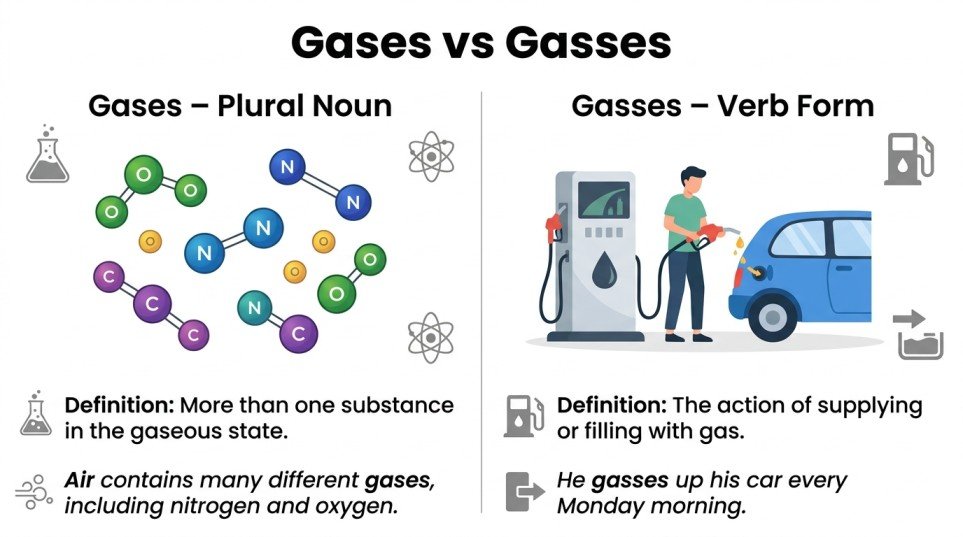
Quick Ans: The correct plural form of gas is usually gases. The word gasses is generally used as a verb, meaning to expose someone to gas or to talk excessively. Understanding the difference between gases or gasses helps improve writing accuracy in both academic and everyday English.
Many writers become confused when choosing between gases or gasses. At first glance, both words look correct. They differ by only one letter, which makes the mistake easy to make.
However, these words usually serve different grammatical purposes.
In most situations, gases is the correct plural noun. For example, scientists talk about gases in the atmosphere. Chemistry students study gases such as oxygen and nitrogen. Medical professionals discuss gases used during treatment.
The word gasses, on the other hand, is commonly a verb. It can mean poisoning someone with gas, filling something with gas, or talking excessively in informal English.
Because both spellings exist in dictionaries, many people assume they are interchangeable. That assumption often leads to grammar errors.
This guide explains the difference between gases or gasses, including meanings, usage rules, examples, common mistakes, and practical exercises. By the end, you will know exactly when to use each spelling.
Quick Answer: Gases or Gasses
The easiest way to remember the difference is to identify the word’s role in the sentence.
| Word | Part of Speech | Meaning |
|---|---|---|
| Gases | Noun (plural) | More than one gas |
| Gasses | Verb | Exposes to gas, fills with gas, or talks excessively |
Examples
Correct:
- The laboratory stores several gases.
- Greenhouse gases affect climate change.
Correct:
- The mechanic gasses the vehicle.
- The army gasses the chamber.
In most writing situations, gases is the word people need.
What Does “Gases” Mean?
Gases is the plural form of the noun gas.
A gas is a state of matter that expands to fill available space. Unlike solids and liquids, gases do not have a fixed shape or volume.
Common Examples of Gases
Examples include:
- Oxygen
- Nitrogen
- Helium
- Carbon dioxide
- Hydrogen
Scientists frequently use the word gases when discussing chemistry, physics, medicine, and environmental science.
Example Sentences
- Several gases make up Earth’s atmosphere.
- Industrial gases are used in manufacturing.
- The experiment compared different gases.
In each example, gases refers to multiple gas substances.
What Does “Gasses” Mean?
Gasses is generally the third person singular form of the verb to gas.
The meaning depends on context.
Meaning One: To Expose Someone to Gas
Examples:
- The chemical weapon gasses the target area.
- The machine accidentally gasses the room.
Meaning Two: To Fill With Gas
Examples:
- The worker gasses the tank before testing.
- The technician gasses the container.
Meaning Three: To Talk Excessively
In informal English, someone who talks too much may be described as “gassing.”
Examples:
- He gasses everyone at the party with long stories.
- She gasses her friends about her vacation.
Although this informal use exists, it is less common in formal writing.
Key Differences Between Gases or Gasses
Grammatical Function
The biggest difference between gases or gasses is grammar.
Gases functions as a noun.
Gasses functions as a verb.
Usage Frequency
Most writers use gases far more often.
The verb gasses appears in specific contexts such as science, military discussions, engineering, or informal conversation.
Meaning
Gases refers to substances.
Gasses refers to an action.
Quick Comparison Table
| Feature | Gases | Gasses |
|---|---|---|
| Word Type | Noun | Verb |
| Meaning | Multiple gases | Action involving gas |
| Common Usage | Very common | Less common |
| Academic Writing | Frequent | Limited |
| Scientific Context | Common | Occasional |
Why People Confuse Gases and Gasses
Several factors contribute to confusion.
Both Spellings Are Valid
Many spelling mistakes happen because both words are correct English words.
As a result, spell checkers may not catch the error.
Similar Appearance
Only one extra “s” separates the two spellings.
Consequently, writers often overlook the difference.
Pronunciation Similarities
In everyday speech, the words sound very similar.
Therefore, people frequently choose the wrong spelling when writing.
Lack of Grammar Awareness
Some writers focus only on pronunciation rather than sentence structure.
Understanding whether the word acts as a noun or verb solves most problems.
Real World Examples
Science Class
Correct:
- Different gases react under pressure.
Incorrect:
- Different gasses react under pressure.
Because the sentence discusses multiple substances, gases is correct.
Automotive Industry
Correct:
- The mechanic gasses the vehicle before testing.
Here, gasses describes an action.
Environmental Discussions
Correct:
- Greenhouse gases contribute to global warming.
This sentence refers to multiple atmospheric substances.
Medical Applications
Correct:
- Hospitals use several gases during procedures.
Again, the word functions as a plural noun.
Regional and Global Usage
American English
American English strongly prefers gases as the plural noun.
The verb form gasses remains standard when describing actions involving gas.
British English
British English follows the same distinction.
Writers use gases for the plural noun and gasses for the verb form.
Academic Publishing
Scientific journals consistently use gases when discussing chemical substances.
Professional writing rarely substitutes gasses for the plural noun.
Therefore, academic standards remain consistent across regions.
Related Grammar Concepts
Nouns and Verbs
The difference between gases or gasses resembles many noun and verb distinctions in English.
Examples include:
| Noun | Verb |
|---|---|
| Practice (UK noun) | Practise (UK verb) |
| Advice | Advise |
| Device | Devise |
Recognizing grammatical roles helps avoid spelling errors.
Plural Formation Rules
Most nouns ending in “s” add “es” to form plurals.
Examples:
- Bus → Buses
- Class → Classes
- Gas → Gases
This pattern explains why gases is the standard plural form.
Common Mistakes About Gases or Gasses
Using Gasses as a Plural Noun
Incorrect:
- The laboratory studies many gasses.
Correct:
- The laboratory studies many gases.
Using Gases as a Verb
Incorrect:
- The technician gases the chamber.
Correct:
- The technician gasses the chamber.
Ignoring Sentence Function
Some writers choose a spelling based solely on appearance.
Instead, identify whether the word represents a thing or an action.
Relying Only on Spell Check
Spell check software may not detect misuse because both spellings exist.
Always review grammar as well as spelling.
Beginner to Advanced Writing Tips
Beginner Level
Ask yourself a simple question:
“Am I talking about substances or an action?”
If substances, use gases.
If an action, use gasses.
Intermediate Level
Look at the surrounding words.
Articles and adjectives often signal nouns.
Verbs usually follow subjects and describe actions.
Advanced Level
Analyze sentence structure before proofreading.
Professional editors often verify grammatical roles before checking spelling choices.
This method dramatically reduces mistakes involving gases or gasses.
Step By Step Usage Scenario
Imagine you are writing a science report.
Sentence:
“The atmosphere contains oxygen, nitrogen, and other _____.”
Step 1: Identify the meaning.
You are discussing substances.
Step 2: Determine the word type.
The sentence needs a plural noun.
Step 3: Choose the correct spelling.
Answer: gases
Now consider this sentence:
“The technician _____ the storage tank.”
Step 1: Identify the meaning.
The sentence describes an action.
Step 2: Determine the word type.
The sentence needs a verb.
Step 3: Choose the correct spelling.
Answer: gasses
Exercises With Answers
Exercise 1
Choose the correct word:
The laboratory stores several _____.
Answer: gases
Exercise 2
Choose the correct word:
The worker _____ the testing chamber.
Answer: gasses
Exercise 3
Which word is usually a plural noun?
Answer: gases
Exercise 4
Which word is commonly used as a verb?
Answer: gasses
Exercise 5
True or False: Gasses is the standard plural form of gas.
Answer: False.
When Should You Use Gases or Gasses?
Use gases when:
- Referring to multiple gases
- Writing scientific documents
- Discussing atmospheric substances
- Describing chemical compounds
Use gasses when:
- Describing an action involving gas
- Discussing gas exposure
- Talking about filling something with gas
- Using informal expressions about excessive talking
The context determines the correct spelling.
FAQs About Gases or Gasses
What is the correct plural form of gas?
The correct plural noun is gases.
Is gasses a real word?
Yes. Gasses is a legitimate verb form of the word gas.
Which is more common, gases or gasses?
Gases is far more common because it appears frequently in science, education, and everyday writing.
Why do people confuse gases and gasses?
Both spellings are correct words, and their pronunciation is very similar.
Do scientists use gases or gasses?
Scientists almost always use gases when referring to multiple gas substances.
Can gasses be used as a noun?
Modern standard English generally uses gases as the plural noun instead.
Is greenhouse gases correct?
Yes. The phrase greenhouse gases is grammatically correct.
How do I remember the difference between gases or gasses?
Remember that gases names things, while gasses describes actions.
Is gasses wrong in academic writing?
Not when used as a verb. However, it is usually incorrect if used as a plural noun.
Which spelling should students use most often?
Students will typically need gases because academic subjects frequently discuss gas substances.
Conclusion
The debate over gases or gasses becomes simple once you understand grammar. Although both spellings are valid English words, they usually serve different purposes.
Gases is the standard plural noun of gas. Scientists, teachers, students, and professional writers use it when discussing multiple gas substances. Examples include atmospheric gases, industrial gases, and greenhouse gases.
Gasses, by contrast, is typically a verb. It describes actions such as exposing something to gas, filling a container with gas, or talking excessively in informal speech.
The easiest way to choose the correct spelling is to identify the word’s role in the sentence. If you are naming substances, use gases. If you are describing an action, use gasses.
By applying this simple rule, you can avoid one of the most common spelling mistakes involving these closely related words.
Discover More:-
- Smash or Pass Meaning: Origins, Rules, Examples, and Social Media Impac
- Allergies or COVID: Symptoms, Differences, and How to Tell Them Apart

Jennifer Collins is a professional grammar expert and language educator at gramtivo.com, specializing in English grammar, writing skills, and language improvement. She holds a Master’s degree in English Language and Literature from a recognized university in the United States. With years of teaching and content development experience, she is dedicated to helping learners improve their communication skills with clear and practical guidance.