
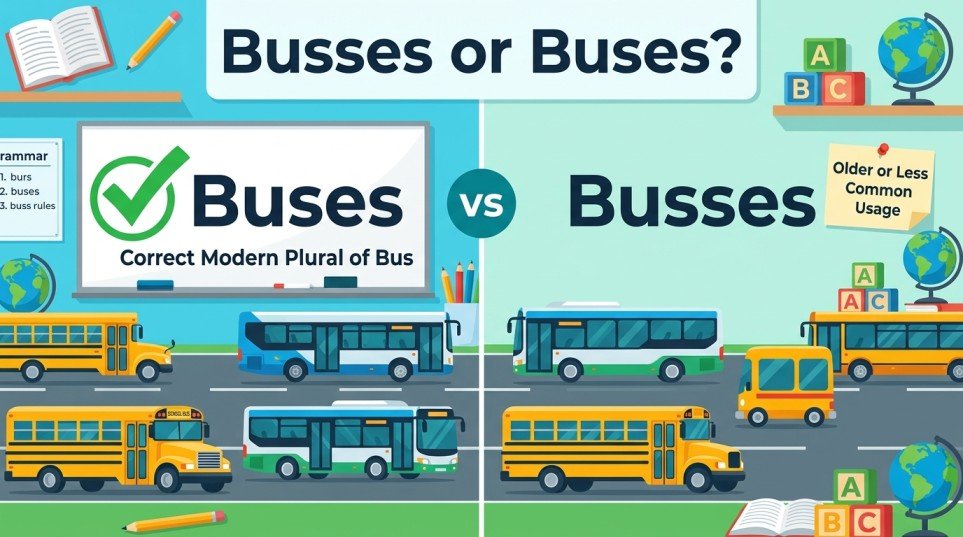
Quick Ans: The correct modern spelling is buses when referring to more than one bus. While busses is sometimes accepted in certain contexts, it is considered an older and less common spelling for the plural form of bus. In most writing, education, business, and professional communication, buses is the preferred spelling.
Many English learners and even native speakers wonder about busses or buses. The two words look almost identical. Both appear in dictionaries. Both have been used in books and publications. As a result, confusion is common.
The question becomes even more difficult because English spelling rules are not always consistent. Some words add -es to form a plural, while others follow different patterns. Consequently, many writers hesitate when choosing between busses or buses.
The good news is that the answer is fairly simple in modern English. Most style guides, dictionaries, schools, and professional editors recommend buses as the standard plural form of bus. Meanwhile, busses appears less frequently and often has a different meaning.
Understanding the difference helps improve grammar, writing accuracy, and professional communication. Whether you are writing an essay, email, blog post, or business document, knowing when to use buses and when busses might appear can prevent common mistakes.
This guide explains everything you need to know, from definitions and usage rules to examples, exercises, and frequently asked questions.
Quick Answer: Busses or Buses
If you are referring to more than one bus, the preferred spelling is buses.
| Word | Meaning | Common Usage |
|---|---|---|
| Buses | Plural of bus | Standard modern English |
| Busses | Older plural form or verb form | Less common |
Examples:
- The school owns five buses.
- Several city buses arrived at the station.
Although busses may appear in some dictionaries, buses is the spelling most writers should use.
What Does “Bus” Mean?
Before comparing busses or buses, it helps to understand the base word.
A bus is a large vehicle designed to transport multiple passengers.
Common types include:
- School buses
- City buses
- Tour buses
- Shuttle buses
- Public transportation buses
People use buses every day for commuting, travel, and transportation.
Examples of Bus in a Sentence
- The bus arrived on time.
- We took the bus to school.
- The city added a new bus route.
Once the noun becomes plural, the question of busses or buses appears.
What Does “Buses” Mean?
Buses is the standard plural form of the noun bus.
When referring to two or more buses, modern English almost always uses buses.
Examples
- Three buses were parked outside.
- The company operates twenty buses.
- School buses must follow safety regulations.
Most major dictionaries list buses as the preferred plural spelling.
Why “Buses” Is Preferred
English words ending in s often form plurals by adding es.
Examples include:
| Singular | Plural |
|---|---|
| Bus | Buses |
| Class | Classes |
| Box | Boxes |
| Dish | Dishes |
| Glass | Glasses |
Therefore, buses follows a familiar English grammar pattern.
What Does “Busses” Mean?
The word busses can function as a plural spelling, but it is much less common today.
In many modern contexts, busses appears as the verb form of buss, which means to kiss.
Examples of the Verb “Buss”
- She busses her child on the forehead.
- He busses his grandmother before leaving.
Because of this alternate meaning, using busses as the plural of bus can sometimes create confusion.
Historical Usage
Historically, some writers used busses as the plural of bus. However, language evolved over time. As a result, buses became the dominant spelling in modern English.
Today, most publications avoid busses when referring to vehicles.
Key Differences Between Busses or Buses
Modern Preference
The biggest difference is frequency of use.
Buses is the standard modern spelling.
Busses is uncommon and often considered outdated.
Meaning
In many cases:
- Buses = multiple vehicles
- Busses = kisses or the verb buss
Professional Writing
Editors, teachers, and style guides almost always recommend buses.
Reader Expectations
Most readers instantly recognize buses as the correct plural. Therefore, using it improves clarity.
Advantages and Disadvantages
Advantages of Using “Buses”
- Accepted worldwide
- Preferred by dictionaries
- Easy for readers to understand
- Standard in schools and businesses
Disadvantages of Using “Buses”
- Virtually none in modern English
Advantages of Using “Busses”
- Historically recognized
- Occasionally found in older texts
Disadvantages of Using “Busses”
- Less common
- May confuse readers
- Can resemble the verb form meaning “kisses”
For most situations, buses is clearly the safer choice.
Real World Examples
In Education
Schools typically write:
- School buses
- Bus schedules
- Bus routes
You rarely see school busses in modern educational materials.
In Transportation Companies
Transportation agencies consistently use buses.
Examples include:
- Electric buses
- Public buses
- Transit buses
In News Articles
Journalists overwhelmingly choose buses because it aligns with modern grammar standards.
Regional and Global Usage
American English
American English strongly favors buses.
British English
British English also prefers buses in most situations.
International English
Around the world, English language publications generally use buses.
Therefore, regardless of region, buses remains the dominant choice.
Related Concepts and Comparisons
Busses or Buses vs Classes
The plural of class is classes.
Similarly, the plural of bus is buses.
Busses or Buses vs Boxes
The plural of box becomes boxes.
Likewise, bus becomes buses.
Bus vs Buss
| Word | Meaning |
|---|---|
| Bus | Transportation vehicle |
| Buss | A kiss |
| Buses | Multiple buses |
| Busses | Verb form of buss or older plural spelling |
Understanding this distinction helps avoid grammar mistakes.
Common Mistakes About Busses or Buses
Using “Busses” in Formal Writing
Many people assume both spellings are equally common. However, modern editors generally prefer buses.
Thinking “Busses” Is Always Wrong
The word still exists. Nevertheless, it often functions as a verb rather than a plural noun.
Ignoring Context
Context matters. If the sentence discusses transportation, buses is usually correct.
Following Outdated Sources
Older books may use busses. Modern publications typically use buses instead.
Beginner to Advanced Grammar Tips
Beginner Level
Remember this simple rule:
One bus = bus
More than one bus = buses
Intermediate Level
Check modern dictionaries whenever you are uncertain about plural forms.
Advanced Level
Consider audience expectations. Professional readers expect buses in reports, articles, academic writing, and business documents.
Following current language standards improves credibility.
Step By Step Usage Scenario
Imagine you are writing about public transportation.
You want to describe ten vehicles arriving at a station.
Correct sentence:
- Ten buses arrived at the station.
Incorrect or less preferred sentence:
- Ten busses arrived at the station.
Now imagine you are discussing a kiss.
Correct sentence:
- She busses her child goodnight.
The meaning changes completely because the word functions as a verb.
Exercises With Answers
Exercise 1
Which spelling is the preferred plural form of bus?
Answer: Buses.
Exercise 2
Complete the sentence:
“The city purchased five new _____.”
Answer: Buses.
Exercise 3
True or False: Busses is the most common modern plural form of bus.
Answer: False.
Exercise 4
Which word is commonly associated with the verb meaning “to kiss”?
Answer: Busses.
Exercise 5
Choose the correct sentence:
A. Three buses stopped at the station.
B. Three busses stopped at the station.
Answer: A.
When Should You Use Busses or Buses?
Use buses when:
- Referring to multiple vehicles
- Writing professionally
- Creating academic content
- Following modern grammar rules
Use busses when:
- Referring to the verb buss
- Quoting older texts
- Preserving historical language usage
For nearly all modern writing situations, buses is the correct choice.
FAQs About Busses or Buses
Which is correct, busses or buses?
The preferred modern spelling is buses when referring to more than one bus.
Is busses a real word?
Yes. However, it is less common and often functions as the verb form of buss, meaning to kiss.
Why is buses more common than busses?
Modern dictionaries, editors, and style guides favor buses as the standard plural form.
Can I use busses in formal writing?
You can, but most professional writers and editors recommend buses instead.
What is the plural of bus in American English?
The standard plural form is buses.
What is the plural of bus in British English?
British English also commonly uses buses.
Do dictionaries recognize busses?
Some dictionaries do. Nevertheless, buses remains the preferred spelling.
Is buses grammatically correct?
Yes. It is the accepted modern plural form of bus.
Why do some older books use busses?
Older publications followed historical spelling conventions that were more common at the time.
Should students write buses or busses?
Students should generally use buses because it follows modern grammar standards.
Conclusion
The debate over busses or buses is much simpler than it first appears. Although both spellings exist, modern English strongly favors buses as the standard plural form of bus.
Schools, businesses, publishers, and major dictionaries all support this spelling. Consequently, writers who choose buses will align with current grammar expectations and reader preferences.
The word busses still has a place in English. However, it is less common and often appears as the verb form of buss, meaning a kiss. Because of this alternate meaning, using busses for transportation vehicles can sometimes create confusion.
For professional communication, academic writing, blog posts, reports, and everyday usage, buses is the safest and most widely accepted choice.
Whenever you need the plural of bus, remember the simple rule: one bus, two buses. Following this guideline will help ensure clear, accurate, and professional writing.
Discover More:-
- Swifty or Swiftie: Which Spelling Is Correct for Taylor Swift Fans?
- Smash or Pass Meaning: Origins, Rules, Examples, and Social Media Impac

Lisa Thompson is a USA-based content writer and language specialist focused on grammar, writing improvement and digital publishing.
She holds a degree in English Language and Communication and has professional experience in educational and web content creation.
As the author of Gramtivo.Com, she aims to help readers improve their writing skills through clear and practical guidance.