
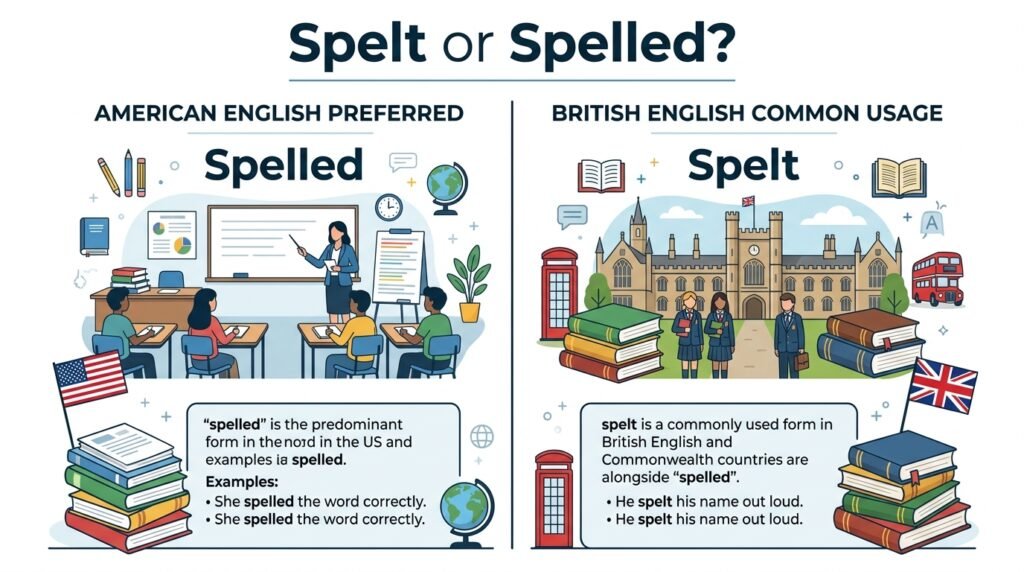
Quick Ans: The difference between spelt or spelled is mainly regional usage. Both are correct past tense and past participle forms of the verb spell. Spelled is more common in American English, while spelt is frequently used in British English and other Commonwealth countries.
Many English learners and native speakers wonder about spelt or spelled. Both words appear in books, articles, emails, and everyday conversations. As a result, people often ask which version is correct.
The simple answer is that both forms are accepted. However, the preferred choice depends on where you are writing and who will read your work.
American English strongly favors spelled. Meanwhile, British English commonly uses both spelled and spelt. Because English varies across regions, seeing different forms can sometimes create confusion.
For example, an American teacher may write, “The word is spelled correctly.” A British writer might choose, “The word is spelt correctly.” Both sentences are grammatically correct.
Understanding the difference between spelt or spelled helps you write more naturally and communicate effectively with your audience. This guide explains definitions, usage rules, regional preferences, examples, common mistakes, exercises, and frequently asked questions.
Quick Answer: Spelt or Spelled
If you need a quick answer, here it is:
| Form | Status | Common Usage |
|---|---|---|
| Spelled | Correct | American English and international writing |
| Spelt | Correct | British English and Commonwealth English |
In most situations:
- Use spelled for American audiences.
- Use spelt or spelled for British audiences.
- Choose one style and stay consistent throughout your writing.
Therefore, the spelt or spelled debate is usually about style rather than grammar.
What Does “Spelled” Mean?
Spelled is the past tense and past participle of the verb spell.
Examples include:
- She spelled the word correctly.
- The student’s name was spelled wrong.
- We spelled every answer carefully.
In American English, spelled is the standard and preferred form in nearly all contexts.
Why Is “Spelled” So Common?
Regular English verbs often form the past tense by adding -ed.
Examples include:
- Walk → Walked
- Jump → Jumped
- Talk → Talked
- Spell → Spelled
Because it follows the regular pattern, many writers naturally prefer spelled.
Common Uses of “Spelled”
You will often see spelled in:
- Academic writing
- Business communication
- Newspapers
- Professional documents
- American publications
As a result, it is considered the safest option for international audiences.
What Does “Spelt” Mean?
Spelt has the same meaning as spelled when used as a verb. It functions as the past tense and past participle of spell.
Examples include:
- The word was spelt incorrectly.
- Her surname was spelt differently on the document.
- He spelt every answer correctly.
The meaning does not change. Only the preferred regional style differs.
Why Does “Spelt” Exist?
English contains many verbs with irregular past tense forms.
Examples include:
- Dream → Dreamt
- Burn → Burnt
- Learn → Learnt
- Spell → Spelt
British English often preserves these traditional forms. Consequently, spelt remains common in the United Kingdom, Australia, New Zealand, and several other English speaking countries.
Common Uses of “Spelt”
You may encounter spelt in:
- British newspapers
- UK educational materials
- Commonwealth publications
- British literature
Therefore, seeing spelt does not indicate a grammar mistake.
Key Differences Between Spelt or Spelled
Regional Preference
The most important difference involves geography.
American English prefers spelled.
British English accepts both forms but often uses spelt.
Formal Writing
International business and academic writing usually favor spelled because it is more universally recognized.
Meaning
There is no difference in meaning.
Both words describe the past action of spelling something.
Frequency of Use
Today, spelled appears more frequently worldwide.
However, spelt remains common in British English.
Spelt or Spelled in American English
American English almost always uses spelled.
Examples:
- The address was spelled incorrectly.
- She spelled the city name perfectly.
- His last name was spelled wrong on the form.
Although Americans understand spelt, it can sound old fashioned or unusual.
For this reason, writers targeting American readers should generally choose spelled.
Spelt or Spelled in British English
British English accepts both forms.
Examples:
- The surname was spelt incorrectly.
- The surname was spelled incorrectly.
Both sentences are correct.
Many British writers use spelt in everyday writing. Nevertheless, spelled is also common and widely accepted.
Therefore, British English provides more flexibility in the spelt or spelled choice.
Historical Background
The history of spelt or spelled reflects the evolution of English.
Older English often included irregular verb endings such as:
- Burnt
- Dreamt
- Learnt
- Spelt
Over time, American English moved toward regular -ed endings. Consequently, forms like spelled became dominant.
British English retained many traditional alternatives. As a result, both versions continue to exist today.
Language changes gradually, and the coexistence of spelt and spelled demonstrates this process.
Advantages and Disadvantages
Advantages of Using Spelled
- Preferred in American English
- Common worldwide
- Suitable for international audiences
- Fits regular grammar patterns
Disadvantages of Using Spelled
- May sound less traditional in some British contexts
Advantages of Using Spelt
- Widely accepted in British English
- Reflects traditional usage
- Common in UK publications
Disadvantages of Using Spelt
- Less familiar to American readers
- May appear unusual in international business writing
Choosing between spelt or spelled often depends on audience expectations.
Real World Examples
Academic Writing
Most international academic journals prefer spelled.
Example:
- The term was spelled incorrectly in the manuscript.
British Newspaper Example
A British publication may write:
- The player’s name was spelt incorrectly.
Business Communication
Companies serving global audiences usually choose spelled for consistency.
Educational Settings
Schools often follow regional standards. Consequently, students should use the form preferred by their curriculum.
Regional and Global Usage
United States
American English strongly favors spelled.
United Kingdom
British English uses both spelled and spelt.
Australia and New Zealand
Both forms appear regularly, though spelt is relatively common.
International English
Global businesses and multinational organizations often prefer spelled because it is recognized everywhere.
As a result, spelled dominates in international communication.
Related Concepts and Comparisons
Learned vs Learnt
Like spelt or spelled, both forms are correct.
- Learned is more common in American English.
- Learnt is common in British English.
Burned vs Burnt
Another similar pair includes:
- Burned
- Burnt
Regional preferences influence usage.
Dreamed vs Dreamt
The same pattern appears here.
- Dreamed is common in American English.
- Dreamt appears frequently in British English.
These examples show that spelt or spelled is part of a broader language pattern.
Common Mistakes About Spelt or Spelled
Thinking One Form Is Wrong
Many people assume one version must be incorrect.
In reality, both forms are accepted.
Mixing Styles
Some writers switch between spelt and spelled within the same document.
Consistency improves professionalism.
Ignoring Audience
A British audience may expect spelt in some contexts.
An American audience usually expects spelled.
Confusing Spelt With the Grain
The word spelt can also refer to a type of ancient grain.
Example:
- We baked bread using spelt flour.
Context usually makes the meaning clear.
Beginner to Advanced Usage Tips
Beginner Level
Use spelled if you are unsure.
It works well in nearly every situation.
Intermediate Level
Match your choice to the regional style guide you are following.
Advanced Level
Maintain consistency across all documents.
Editors often check carefully for style uniformity.
Following these practices helps avoid confusion.
Step By Step Decision Guide
When choosing between spelt or spelled, follow these steps:
- Identify your audience.
- Determine whether American or British English is required.
- Use spelled for American English.
- Use either form for British English.
- Stay consistent throughout the document.
This simple process eliminates most uncertainty.
Exercises With Answers
Exercise 1
Which form is preferred in American English?
Answer: Spelled.
Exercise 2
Which form is commonly used in British English?
Answer: Spelt and spelled.
Exercise 3
True or False: Spelt is grammatically incorrect.
Answer: False.
Exercise 4
Which sentence is correct?
A. The word was spelt correctly.
B. The word was spelled correctly.
Answer: Both are correct.
Exercise 5
Which form is usually safer for international audiences?
Answer: Spelled.
When Should You Choose Spelt or Spelled?
Choose spelled if you:
- Write for American readers
- Create international content
- Work in business communication
- Prefer modern standard usage
Choose spelt if you:
- Write in British English
- Follow UK style guides
- Prefer traditional British forms
The best choice depends on audience and style requirements.
FAQs About Spelt or Spelled
Is spelt or spelled correct?
Both are correct. The preferred choice depends on regional English usage.
Do Americans use spelt?
Rarely. American English almost always uses spelled.
Is spelt wrong in British English?
No. British English commonly accepts spelt.
Which is more formal, spelt or spelled?
Neither is inherently more formal. However, spelled is more common in international professional writing.
Can I use spelt in academic writing?
If you follow British English conventions, yes. Otherwise, many academic publications prefer spelled.
Why does British English use spelt?
British English retains several traditional verb forms, including spelt, learnt, and dreamt.
Is spelled better for global audiences?
Yes. International readers are generally more familiar with spelled.
Does spelt mean anything besides the past tense of spell?
Yes. Spelt is also a type of ancient grain used in baking.
Should I switch between spelt and spelled in one article?
No. Consistency is important. Choose one style and use it throughout.
Which should English learners use, spelt or spelled?
Most learners benefit from using spelled because it is more widely accepted worldwide.
Conclusion
The spelt or spelled question has a simple answer: both forms are correct. The real difference lies in regional preference rather than grammar.
American English strongly favors spelled, making it the standard choice in the United States and most international communication. British English accepts both forms and frequently uses spelt, especially in traditional and everyday writing.
Understanding your audience is the most important factor. If you write for American readers or global audiences, spelled is usually the safest choice. If you follow British English conventions, either form can work, though spelt remains widely accepted.
Consistency also matters. Once you choose a style, use it throughout your document. Doing so creates a more professional and polished result.
By understanding the difference between spelt or spelled, you can write confidently and adapt your language to different audiences and regions.
Discover More:-
- Leafs or Leaves: Which Word Is Correct and When to Use It
- Truely or Truly: Which Spelling Is Correct and Why?

Lisa Thompson is a USA-based content writer and language specialist focused on grammar, writing improvement and digital publishing.
She holds a degree in English Language and Communication and has professional experience in educational and web content creation.
As the author of Gramtivo.Com, she aims to help readers improve their writing skills through clear and practical guidance.