
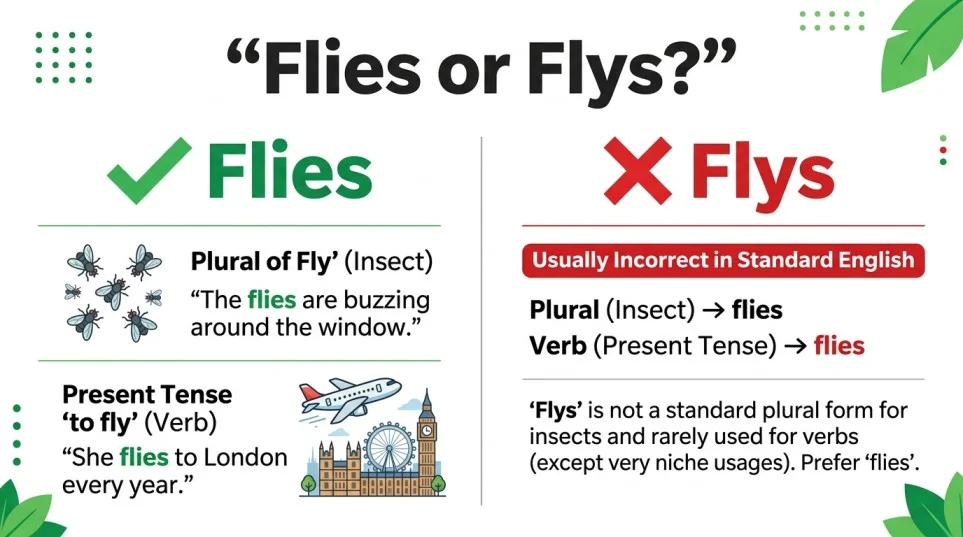
Quick Ans: The correct spelling is usually flies, not flys. The word flies is the standard plural form of fly and the third person singular form of the verb fly. Meanwhile, flys appears only in a few specialized contexts, making flies the correct choice in most everyday writing.
Many English learners and even native speakers get confused about flies or flys. The two words look similar. They sound exactly the same when spoken. As a result, people often wonder which spelling is correct.
The confusion becomes more common when writing emails, school assignments, blog posts, or social media content. Someone may write “The flys are annoying today” and wonder later whether the spelling is right.
Fortunately, the answer is simple.
In most situations, flies is the correct spelling. English grammar follows specific rules when forming plurals and changing verbs. Once you understand these rules, choosing between flies or flys becomes much easier.
This guide explains everything you need to know. You will learn definitions, grammar rules, examples, common mistakes, exceptions, exercises, and frequently asked questions. By the end, you will know exactly when to use flies and when flys might be acceptable.
Quick Answer: Flies or Flys
If you need a quick answer, use this table.
| Word | Correct Usage | Example |
|---|---|---|
| Flies | Standard plural noun | The flies are everywhere. |
| Flies | Third person singular verb | She flies to London often. |
| Flys | Rare specialized term | Found mainly in proper names or technical usage. |
For everyday writing, flies is almost always correct.
What Does “Flies” Mean?
The word flies has two common uses in English.
Flies as a Plural Noun
When talking about more than one fly insect, the correct plural is flies.
Examples:
- Flies are buzzing around the picnic.
- Several flies landed on the table.
- The flies disappeared after sunset.
English spelling rules change fly to flies because the word ends with a consonant followed by y.
Flies as a Verb
The word flies is also the third person singular form of the verb fly.
Examples:
- She flies to New York every month.
- The bird flies across the lake.
- The airplane flies above the clouds.
In these examples, flies functions as a verb rather than a noun.
What Does “Flys” Mean?
The word flys is much less common.
In standard English, flys is usually considered incorrect when you mean multiple insects or the action of flying.
However, there are a few exceptions.
Specialized Uses of Flys
You may occasionally see flys in:
- Proper names
- Brand names
- Historical references
- Certain technical or nautical terms
Because these uses are uncommon, most people rarely encounter them.
Why People Write Flys
Many writers assume that adding s creates a plural.
For example:
- Dog → Dogs
- Cat → Cats
- Book → Books
Applying the same pattern leads some people to write flys. However, English grammar treats words ending in consonant + y differently.
Therefore, flies becomes the correct spelling.
The Grammar Rule Behind Flies or Flys
Understanding one simple grammar rule solves the confusion.
Words Ending in Consonant + Y
When a word ends with a consonant followed by y, change the y to i and add es.
Examples:
| Singular | Plural |
|---|---|
| Fly | Flies |
| Baby | Babies |
| City | Cities |
| Lady | Ladies |
| Story | Stories |
Because fly follows this rule, its plural becomes flies.
Verb Form Rule
The same pattern applies to many third person singular verbs.
Examples:
| Base Verb | Third Person Singular |
|---|---|
| Fly | Flies |
| Cry | Cries |
| Try | Tries |
| Carry | Carries |
Consequently, “she flies” is correct, while “she flys” is generally incorrect.
Why “Flies” Is Usually Correct
The vast majority of English writing requires flies.
Consider these examples:
- The flies are annoying.
- The bird flies south for winter.
- Time flies when you’re having fun.
- The airplane flies at high altitude.
Each sentence follows standard English spelling conventions.
As a result, dictionaries, style guides, and grammar books recognize flies as the accepted spelling.
Advantages and Disadvantages of Using Each Form
Advantages of Using Flies
- Grammatically correct
- Accepted in formal writing
- Recognized by dictionaries
- Works for nouns and verbs
Disadvantages of Using Flies
- Few disadvantages exist
- Some learners may initially find the spelling rule confusing
Advantages of Using Flys
- May be appropriate in rare proper names
- Occasionally appears in specialized terminology
Disadvantages of Using Flys
- Usually considered incorrect
- Can reduce writing credibility
- Often flagged by spell checkers
Therefore, most writers should choose flies.
Real World Examples
In Everyday Conversation
Correct:
- The flies won’t leave us alone.
Incorrect:
- The flys won’t leave us alone.
In Business Writing
Correct:
- Our CEO flies internationally every month.
Incorrect:
- Our CEO flys internationally every month.
In Academic Writing
Correct:
- The bird flies during seasonal migration.
Incorrect:
- The bird flys during seasonal migration.
These examples show why flies dominates modern English usage.
Regional and Global Usage
American English
American English uses flies as the standard spelling.
British English
British English follows the same rule.
Canadian English
Canadian spelling conventions also prefer flies.
Australian English
Australian English uses flies for both plural nouns and verb forms.
Therefore, the debate about flies or flys has the same answer across major English-speaking regions.
Related Concepts and Comparisons
Flies vs Fly
| Word | Usage |
|---|---|
| Fly | Singular noun or base verb |
| Flies | Plural noun or third person singular verb |
Examples:
- One fly landed on the window.
- Several flies landed on the window.
Fly vs Flying
| Word | Function |
|---|---|
| Fly | Base verb |
| Flies | Third person singular verb |
| Flying | Present participle |
Examples:
- I fly often.
- She flies often.
- They are flying today.
Understanding these forms helps clarify the flies or flys question.
Common Mistakes About Flies or Flys
Adding Only “S”
Many people write:
- Fly → Flys
This is incorrect in standard English.
Correct form:
- Fly → Flies
Ignoring the Y Rule
Words ending in consonant + y follow a specific spelling rule.
Examples include:
- Baby → Babies
- City → Cities
- Fly → Flies
Confusing Nouns and Verbs
Some writers know the plural form but forget the verb form.
Correct:
- The bird flies.
Incorrect:
- The bird flys.
Relying Only on Pronunciation
Because both words sound identical, pronunciation cannot help determine the correct spelling.
Instead, writers must apply grammar rules.
Beginner to Advanced Learning Tips
Beginner Level
Memorize the simple rule:
Consonant + y = change y to i and add es.
Intermediate Level
Practice with similar words:
- Cry → Cries
- Try → Tries
- Carry → Carries
Advanced Level
Study exceptions involving proper names and specialized terminology.
Additionally, pay attention to context when proofreading professional writing.
Consistent practice makes the correct spelling automatic.
Step By Step Decision Guide
Suppose you want to write about several insects.
Step 1: Start with fly.
2: Check the ending.
3: Notice the consonant + y pattern.
4: Change y to i.
5: Add es.
Result:
Flies
Now suppose you want the verb form.
Example:
“She ___ to Paris every year.”
Apply the same rule.
Correct answer:
flies
Exercises With Answers
Exercise 1
Which spelling is correct?
“The ___ are buzzing around the room.”
Answer: flies
Exercise 2
Choose the correct verb.
“He ___ across the country every month.”
Answer: flies
Exercise 3
True or False:
“Flys” is the standard plural of fly.
Answer: False.
Exercise 4
Complete the sentence.
“Time ___ when you’re having fun.”
Answer: flies
Exercise 5
Which follows English spelling rules?
A. Flys
B. Flies
Answer: B. Flies
When Should You Use Flies or Flys?
Use flies when:
- Referring to multiple insects
- Writing standard English
- Using the third person singular verb
- Creating formal documents
- Writing academic content
Use flys only when:
- Referring to a specific proper name
- Following a specialized technical usage
- Reproducing an official title or brand name
For nearly all situations, flies is the correct choice.
FAQs About Flies or Flys
Which is correct, flies or flys?
In standard English, flies is the correct spelling for both the plural noun and the third person singular verb.
Why is flies correct instead of flys?
Words ending in a consonant plus y usually change the y to i and add es.
Is flys ever a real word?
Yes, but only in rare specialized contexts, proper names, or technical references.
How do you spell the plural of fly?
The plural of fly is flies.
How do you spell the verb form in “she flies”?
The correct spelling is flies.
Do British and American English use different spellings?
No. Both varieties use flies as the standard form.
Is flys accepted in formal writing?
Generally no. Formal writing almost always requires flies.
Why do people confuse flies or flys?
Many people simply add s to form a plural and forget the consonant + y spelling rule.
What is the correct sentence: The flies are annoying or The flys are annoying?
“The flies are annoying” is correct.
How can I remember the difference between flies or flys?
Remember that words ending in consonant + y usually change to ies, just like baby becomes babies and city becomes cities.
Conclusion
Understanding flies or flys is easier once you know the basic spelling rule. In standard English, flies is the correct form for both the plural noun and the third person singular verb. Whether you are talking about insects, birds, airplanes, or common expressions like “time flies,” the spelling remains the same.
The confusion usually happens because many English words form plurals by adding s. However, words ending in a consonant followed by y follow a different pattern. Instead of simply adding s, the y changes to i, and es is added.
As a result, flies is the correct choice in nearly every situation. Although flys exists in a few specialized contexts, most writers will rarely need it.
When in doubt, remember this simple rule: fly becomes flies, just as baby becomes babies and city becomes cities. Following this guideline will help you write more accurately and confidently.
Discover More:-
- Flyer or Flier: Which Spelling Is Correct and When to Use Each
- There or Their: Difference, Meaning, Examples, and Grammar Guide

Robert Mitchell is a U.S.-based writer at Gramtivo.Com who focuses on grammar, writing improvement, and language-related content. He holds a degree in English and Linguistics from a U.S. university. His work aims to help readers enhance their writing skills with clear and practical guidance.