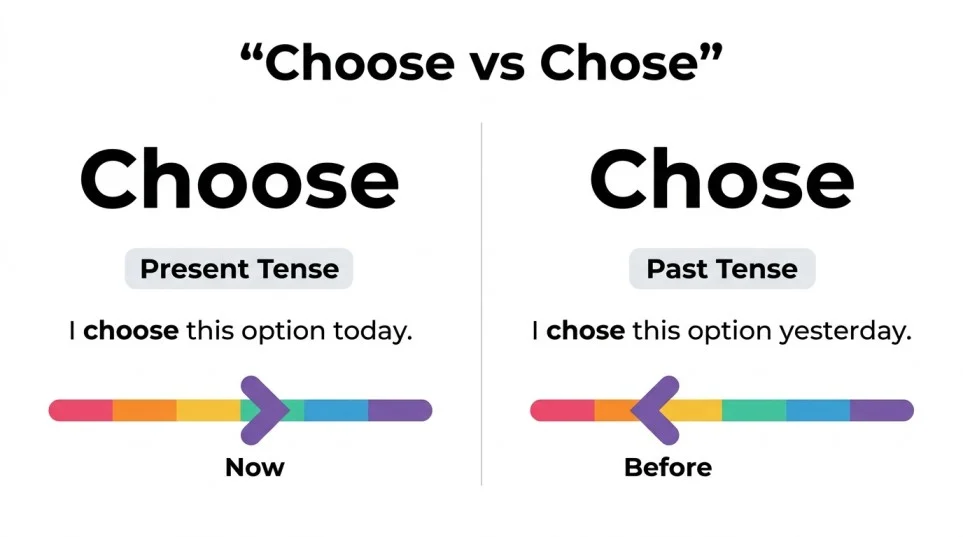
Quick Ans: The difference between choose or chose is tense. Choose is the present tense form of the verb, while chose is the simple past tense form. If the action is happening now or in the future, use choose. If the action already happened, use chose.
Many English learners struggle with choose or chose because the words look almost identical. The only visible difference is one letter. However, that small spelling change creates a completely different meaning.
Grammar mistakes involving these words are common in emails, school assignments, social media posts, and professional writing. Someone might write, “Yesterday I choose a new laptop,” when the correct word should be “chose.” Likewise, another person may write, “I chose this option every time,” when “choose” is the correct choice.
Understanding the distinction between choose or chose is important because verb tense helps readers understand when an action happens. Using the wrong tense can make sentences sound confusing or grammatically incorrect.
Fortunately, the rule is simple. One form refers to present or future actions, while the other refers to actions that already happened.
This guide explains everything you need to know about choose or chose, including definitions, examples, grammar rules, common mistakes, exercises, and practical usage tips.
Quick Answer: Choose or Chose
The easiest way to remember choose or chose is to focus on time.
| Word | Tense | Meaning |
|---|---|---|
| Choose | Present tense | To select something now or in the future |
| Chose | Past tense | Selected something in the past |
Examples:
- I choose healthy food every day.
- Yesterday, I chose healthy food.
In short, use choose for present actions and chose for past actions.
What Does Choose Mean?
Choose is the present tense form of the verb “to choose.” It means to select, pick, decide on, or prefer something.
People use choose when talking about actions happening now, regularly, or in the future.
Examples of Choose
- I choose water instead of soda.
- They choose their classes carefully.
- You can choose any seat.
- We choose quality over price.
Each sentence refers to a present or future decision.
Common Situations Using Choose
You may use choose when:
- Making decisions
- Picking products
- Selecting options
- Expressing preferences
- Giving choices
Because the action is current or ongoing, choose remains the correct form.
How Choose Functions in a Sentence
The verb can appear in several structures:
- I choose this option.
- We choose carefully.
- They choose to participate.
- You can choose either answer.
As a result, choose appears frequently in everyday English.
What Does Chose Mean?
Chose is the simple past tense of choose. It describes a decision or selection that happened previously.
Whenever the action is completed in the past, chose is usually the correct word.
Examples of Chose
- I chose the blue shirt yesterday.
- She chose a new apartment last month.
- They chose the winning design.
- We chose a different route.
Each example refers to a decision that already happened.
Common Situations Using Chose
Writers use chose when discussing:
- Past decisions
- Historical events
- Previous selections
- Completed actions
Since the action is finished, the past tense form is required.
How Chose Functions in a Sentence
Common sentence structures include:
- I chose that option.
- They chose wisely.
- She chose to leave.
- We chose another solution.
Therefore, chose helps readers understand that the decision occurred earlier.
Key Differences Between Choose or Chose
Tense
The biggest difference between choose or chose is verb tense.
- Choose = Present tense
- Chose = Past tense
Time Reference
Choose refers to actions happening now or later.
Chose refers to actions that already happened.
Usage in Sentences
Present:
- I choose this book.
Past:
- I chose this book yesterday.
Grammar Function
Both words are forms of the same verb. The difference comes from when the action occurs.
Understanding time markers often makes the choice easy.
Choose vs Chose Comparison Table
| Feature | Choose | Chose |
|---|---|---|
| Verb Form | Present tense | Past tense |
| Action Time | Now or future | Completed in the past |
| Example | I choose this option. | I chose this option yesterday. |
| Common Signal Words | Today, now, usually | Yesterday, last week, earlier |
This table provides a quick reference whenever you are unsure.
Advantages and Disadvantages of Learning the Difference
Advantages
Understanding choose or chose offers several benefits:
- Improves grammar accuracy
- Strengthens writing skills
- Enhances professional communication
- Reduces common English mistakes
- Builds confidence in speaking
Disadvantages of Confusing Them
Using the wrong form may:
- Create grammatical errors
- Confuse readers
- Reduce writing quality
- Affect academic work
- Make communication less clear
Consequently, mastering this rule improves overall language skills.
Real World Examples
Workplace Email
Correct:
- I chose the marketing proposal yesterday.
Incorrect:
- I choose the marketing proposal yesterday.
The word “yesterday” requires the past tense.
School Assignment
Correct:
- Students choose a topic before beginning research.
The action occurs in the present.
Online Shopping
Correct:
- Last week, I chose a new smartphone.
The decision already happened.
Everyday Conversation
Correct:
- I usually choose coffee in the morning.
The action is habitual and present.
These examples show how context determines the correct word.
Regional and Global Usage
American English
American English follows the standard distinction:
- Choose = Present
- Chose = Past
British English
British English follows exactly the same rule.
International English Learning
Students worldwide often confuse these words because the pronunciation is similar. Nevertheless, English grammar remains consistent regardless of region.
As a result, the same tense rules apply everywhere.
Related Concepts and Comparisons
Choose vs Chosen
Many learners confuse choose or chose with chosen.
Examples:
- Choose = Present
- Chose = Past
- Chosen = Past participle
Examples in sentences:
- I choose carefully.
- I chose carefully.
- I have chosen carefully.
Choose vs Pick
Both words often mean the same thing.
Examples:
- Choose a book.
- Pick a book.
However, choose sometimes sounds slightly more formal.
Choose vs Select
Select is often used in professional or technical contexts.
Examples:
- Please select an option.
- Please choose an option.
The meanings are similar, but select can sound more precise.
Common Mistakes About Choose or Chose
Using Choose With Past Time Expressions
Incorrect:
- Yesterday I choose a new car.
Correct:
- Yesterday I chose a new car.
Using Chose for Present Actions
Incorrect:
- I chose healthy meals every day.
Correct:
- I choose healthy meals every day.
Forgetting Time Clues
Words such as these often indicate the correct tense:
Present clues:
- Usually
- Always
- Often
- Today
Past clues:
- Yesterday
- Last week
- Earlier
- Previously
Looking for these signals helps prevent mistakes.
Confusing Chose With Chosen
Incorrect:
- I have chose the winner.
Correct:
- I have chosen the winner.
The phrase “have chosen” requires the past participle.
Beginner to Advanced Learning Tips
Beginner Level
Focus on one simple rule:
- Choose = Present
- Chose = Past
Intermediate Level
Pay attention to time expressions in sentences.
Examples:
- Today → choose
- Yesterday → chose
Advanced Level
Practice using all three forms:
- Choose
- Chose
- Chosen
Mastering the complete verb family improves grammar accuracy.
Step By Step Usage Scenario
Imagine you are selecting a laptop.
If the decision is happening now:
- I choose this laptop.
If the decision happened yesterday:
- I chose this laptop yesterday.
If you are describing a completed action using a helping verb:
- I have chosen this laptop.
This simple progression helps clarify the relationship between the forms.
Exercises With Answers
Exercise 1
Which word is correct?
I _____ this option every time.
Answer: Choose.
Exercise 2
Which word is correct?
Yesterday, she _____ the blue dress.
Answer: Chose.
Exercise 3
Which sentence is correct?
A. I choose that book last week.
B. I chose that book last week.
Answer: B.
Exercise 4
Fill in the blank:
Students _____ their projects today.
Answer: Choose.
Exercise 5
True or False: Chose is the present tense form.
Answer: False.
When Should You Use Choose or Chose?
Use choose when:
- The action happens now
- The action is habitual
- The action will happen in the future
- You are giving options
Use chose when:
- The action already happened
- A past time expression appears
- The decision is completed
Checking the time frame usually reveals the correct answer.
FAQs About Choose or Chose
What is the difference between choose or chose?
Choose is the present tense form, while chose is the past tense form of the verb.
When should I use choose?
Use choose when discussing present actions, habits, or future decisions.
When should I use chose?
Use chose when referring to a decision or selection made in the past.
Is chose the past tense of choose?
Yes. Chose is the simple past tense form of choose.
Can I say “Yesterday I choose”?
No. The correct sentence is “Yesterday I chose.”
What is the difference between chose and chosen?
Chose is the simple past tense, whereas chosen is the past participle.
Is choose present tense?
Yes. Choose is the present tense form.
Why do people confuse choose or chose?
The words look and sound similar, making them easy to mix up.
Which is correct: I have chose or I have chosen?
The correct phrase is “I have chosen.”
How can I remember choose or chose easily?
Think about time. Present actions use choose, while past actions use chose.
Conclusion
Understanding choose or chose is one of the simplest yet most important grammar rules in English. Although the words differ by only one letter, they represent different points in time.
Choose is used for present and future actions. Chose is used for actions that happened in the past. By identifying when the action occurs, you can quickly determine the correct form.
Paying attention to time expressions such as “today,” “usually,” “yesterday,” and “last week” makes the decision much easier. Furthermore, practicing with real examples helps reinforce the rule.
Whether you are writing emails, completing assignments, creating content, or improving spoken English, using the correct tense strengthens communication and credibility.
The next time you face the choose or chose question, simply ask yourself one thing: Did the action happen now or in the past? The answer will guide you to the correct word.
Discover More:-
- Flyer or Flier: Which Spelling Is Correct and When to Use Each
- There or Their: Difference, Meaning, Examples, and Grammar Guide

Lisa Thompson is a USA-based content writer and language specialist focused on grammar, writing improvement and digital publishing.
She holds a degree in English Language and Communication and has professional experience in educational and web content creation.
As the author of Gramtivo.Com, she aims to help readers improve their writing skills through clear and practical guidance.