
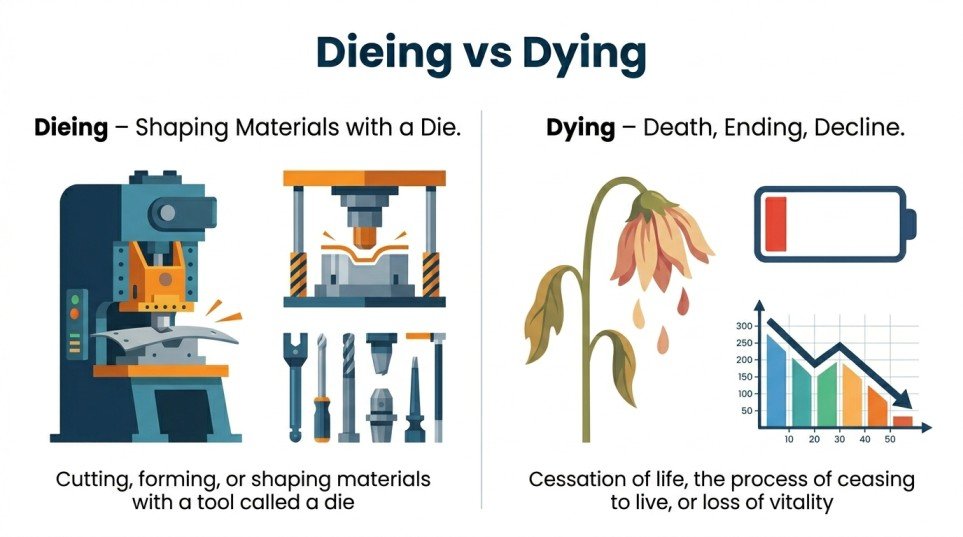
Quick Ans: The correct spelling in most situations is dying, which refers to death or the process of coming to an end. The word dieing is a rare term used in manufacturing and engineering to describe the process of cutting, shaping, or stamping materials with a die. Understanding dieing or dying helps you avoid one of the most common English spelling mistakes.
Many people get confused about dieing or dying because both words look similar. At first glance, they seem like alternate spellings of the same term. However, they have completely different meanings.
In everyday English, dying is almost always the correct choice. It refers to death, fading away, ending, or declining. You may see it in sentences about people, animals, plants, businesses, traditions, or even technology.
The word dieing, on the other hand, exists but is rarely used. It belongs mainly to manufacturing and industrial settings where a “die” is a specialized tool used to cut or shape materials.
Because the two words differ by only one letter, writers often make mistakes. Spell checkers may not always catch the error because both spellings are legitimate words.
Learning the difference between dieing or dying improves writing accuracy and helps you communicate more clearly. This guide explains definitions, usage rules, examples, common mistakes, exercises, and practical tips for remembering the correct spelling.
Quick Answer: Dieing or Dying
When deciding between dieing or dying, the correct choice depends on meaning.
| Word | Meaning | Common Usage |
|---|---|---|
| Dying | Approaching death, ending, fading | Very common |
| Dieing | Using a die to cut, stamp, or shape material | Rare |
In most everyday situations, dying is the correct spelling.
For example:
✅ The flowers are dying because they need water.
✅ The old tradition is slowly dying out.
✅ The battery is dying.
The word dieing would only appear in technical or manufacturing contexts.
What Does Dying Mean?
Dying is the present participle of the verb die.
It refers to:
- Approaching death
- Gradually ending
- Losing strength
- Fading away
- Stopping operation
Because the term appears frequently in daily communication, it is one of the most commonly used English words related to decline or death.
Common Examples of Dying
Consider these examples:
- The patient is dying.
- The plant is dying from lack of sunlight.
- The battery is dying.
- The company is dying financially.
- The tradition is slowly dying out.
In each sentence, dying means ending, weakening, or moving toward death.
Why Die Becomes Dying
English spelling rules sometimes change words when adding -ing.
For the verb die, the final ie changes to y before adding -ing.
Therefore:
- Die + ing = Dying
This spelling follows standard English grammar rules.
What Does Dieing Mean?
Dieing is a real word, but its meaning is completely different.
It comes from the noun die, which is a specialized tool used to:
- Cut materials
- Shape metal
- Stamp products
- Form industrial parts
In manufacturing, workers may refer to the process of dieing materials.
Examples of Dieing
Here are some technical examples:
- The factory is dieing aluminum sheets.
- Dieing operations require precision equipment.
- The metal component entered the dieing machine.
These sentences relate to industrial production rather than death or decline.
Why Dieing Is Rare
Most people never encounter industrial dieing processes in daily life.
As a result, dying appears far more frequently than dieing.
When writers accidentally use dieing instead of dying, readers often notice the mistake immediately.
Key Differences Between Dieing or Dying
Meaning
The biggest difference between dieing or dying involves meaning.
Dying relates to death, decline, or ending.
Dieing refers to shaping materials with industrial dies.
Frequency of Use
Dying appears in books, news articles, conversations, and everyday writing.
Dieing mainly appears in manufacturing documents.
Context
Context makes the correct spelling easy to identify.
If the sentence involves people, animals, plants, businesses, or fading conditions, use dying.
If the sentence discusses industrial cutting or stamping tools, use dieing.
Comparison Table: Dieing vs Dying
| Feature | Dying | Dieing |
|---|---|---|
| Part of Speech | Present participle | Present participle |
| Root Word | Die (death) | Die (tool) |
| Meaning | Approaching death or ending | Using a die tool |
| Frequency | Very common | Very rare |
| Everyday Use | Yes | No |
| Technical Use | Sometimes | Primarily |
This comparison highlights why most people need dying rather than dieing.
Advantages and Disadvantages of Each Word
Advantages of Using Dying Correctly
- Improves writing accuracy
- Prevents confusion
- Matches standard English usage
- Appears natural to readers
Disadvantages of Misusing Dying
- Creates grammatical errors
- Reduces credibility
- Confuses readers
Advantages of Using Dieing Correctly
- Ensures technical precision
- Communicates manufacturing processes accurately
- Uses proper industry terminology
Disadvantages of Misusing Dieing
- Makes writing appear incorrect
- Changes sentence meaning
- Distracts readers
Therefore, understanding dieing or dying is important for professional communication.
Real World Examples
Everyday Conversation
Correct:
- My phone battery is dying.
Incorrect:
- My phone battery is dieing.
The sentence refers to losing power, so dying is correct.
Health Context
Correct:
- The patient is dying peacefully.
Incorrect:
- The patient is dieing peacefully.
The topic involves death, making dying the only correct choice.
Manufacturing Context
Correct:
- The company specializes in dieing metal components.
Here the word refers to industrial tooling processes.
Business Context
Correct:
- The small business is dying because sales are declining.
The company is weakening, not being shaped by machinery.
Regional and Global Usage
American English
American English overwhelmingly uses dying in everyday writing.
British English
British English follows the same rule.
Technical Industries Worldwide
Manufacturing industries around the world may use dieing when discussing tooling operations.
Despite this specialized use, dying remains far more common globally.
Related Concepts and Comparisons
Die vs Dying
- Die = base verb
- Dying = present participle
Example:
- Plants die without water.
- The plants are dying.
Dying vs Dead
Dying means the process is happening.
Dead means the process has already finished.
Examples:
- The tree is dying.
- The tree is dead.
Dying vs Declining
Declining means becoming weaker.
Dying suggests a stronger movement toward an end.
Examples:
- Sales are declining.
- The company is dying.
Common Mistakes About Dieing or Dying
Assuming Both Spellings Mean Death
This is the most common mistake.
Only dying refers to death or decline.
Trusting Autocorrect Completely
Because dieing is a legitimate word, spell checkers may not flag it.
Always review context carefully.
Forgetting the Spelling Rule
Many writers assume:
- Die + ing = Dieing
However, English changes ie to y.
Therefore:
- Die + ing = Dying
Ignoring Context
Context usually provides the answer.
If the sentence involves death, fading, ending, or decline, use dying.
Beginner to Advanced Grammar Tips
Beginner Level
Remember this simple phrase:
People are dying, factories are dieing.
This trick helps separate the meanings.
Intermediate Level
Check whether the sentence involves:
- Death
- Ending
- Weakening
- Decline
If so, choose dying.
Advanced Level
Study English spelling transformations.
Many verbs ending in ie change before adding -ing.
Examples include:
- Lie → Lying
- Tie → Tying
- Die → Dying
Understanding the pattern improves spelling accuracy.
Step By Step Method to Choose the Correct Word
When deciding between dieing or dying, follow these steps:
- Identify the sentence topic.
- Ask whether it relates to death or decline.
- If yes, use dying.
- If it involves industrial tooling, use dieing.
- Review the sentence for context.
Using this process prevents most spelling mistakes.
Exercises With Answers
Exercise 1
Choose the correct word:
The flowers are ___ because they have not been watered.
Answer: Dying
Exercise 2
Choose the correct word:
The factory specializes in ___ metal sheets.
Answer: Dieing
Exercise 3
Choose the correct word:
My laptop battery is ___.
Answer: Dying
Exercise 4
Choose the correct word:
The company is ___ due to financial losses.
Answer: Dying
Exercise 5
True or False:
Dieing is commonly used when discussing death.
Answer: False
When Should You Use Dying?
Use dying when discussing:
- Death
- Illness
- Fading traditions
- Weak businesses
- Low batteries
- Declining trends
This covers nearly all everyday situations.
When Should You Use Dieing?
Use dieing when discussing:
- Metal stamping
- Manufacturing tools
- Industrial shaping processes
- Cutting operations
- Production equipment
Outside technical industries, you will rarely need this word.
FAQs About Dieing or Dying
Which is correct: dieing or dying?
In most situations, dying is correct because it refers to death, ending, or decline.
Is dieing a real word?
Yes. Dieing is a legitimate technical term used in manufacturing and industrial processes.
Why is dying spelled with a Y?
English changes the ending ie to y before adding -ing, creating the spelling dying.
When should I use dieing?
Use dieing only when referring to shaping, cutting, or stamping materials with a die.
Is dying the present tense of die?
No. Dying is the present participle form of the verb die.
What is the most common mistake with dieing or dying?
Many writers incorrectly use dieing when they mean dying.
Do spell checkers catch this mistake?
Not always. Both words are legitimate, so context matters.
Is dying used in business writing?
Yes. Writers often describe failing industries or companies as dying.
Can dying refer to objects?
Yes. Batteries, devices, traditions, and technologies can all be described as dying.
How can I remember dieing or dying easily?
Remember this rule: if it involves death or decline, use dying. If it involves factory tooling, use dieing.
Conclusion
Understanding dieing or dying is easier once you know the difference in meaning. Although the words look nearly identical, they belong to different contexts.
Dying refers to death, decline, fading, or coming to an end. It appears in everyday conversation, professional writing, literature, and news reporting. As a result, it is the spelling most people need.
Dieing is a specialized manufacturing term connected to industrial dies used for cutting, stamping, and shaping materials. Outside technical industries, it rarely appears.
When in doubt, think about the sentence context. If the subject involves a person, plant, battery, business, tradition, or anything fading away, choose dying. If the topic involves factory equipment and material shaping, choose dieing.
Following this simple rule will help you avoid one of the most common English spelling mistakes and improve the accuracy of your writing.
Discover More:-
- TheraBreath vs Listerine: Differences, Ingredients, Benefits, and Best Mouthwash Guide
- Beemer or Beamer: Meaning, Differences, and Correct BMW Nicknames

Lisa Thompson is a USA-based content writer and language specialist focused on grammar, writing improvement and digital publishing.
She holds a degree in English Language and Communication and has professional experience in educational and web content creation.
As the author of Gramtivo.Com, she aims to help readers improve their writing skills through clear and practical guidance.