Quick Ans: The main difference between whom or who is their role in a sentence. Who is used as the subject performing an action, while whom is used as the object receiving an action. Understanding when to use whom or who helps improve grammar, writing clarity, and professional communication.
Many English learners struggle with whom or who because the two words seem very similar. Both refer to people. Both appear in formal and everyday English.
However, they serve different grammatical purposes.
The confusion often happens because modern spoken English uses who much more frequently. As a result, many people avoid using whom altogether. Although this may sound natural in casual conversation, it can create grammar mistakes in formal writing.
Understanding the difference between whom or who helps you write more confidently. It also improves emails, academic papers, business communication, and professional content.
Fortunately, the rule is easier than many people think. Once you learn how subjects and objects work, choosing the correct word becomes much simpler.
In this guide, you will learn definitions, grammar rules, examples, common mistakes, exercises, and practical tips. By the end, you will know exactly when to use whom or who.
Quick Answer: Whom or Who
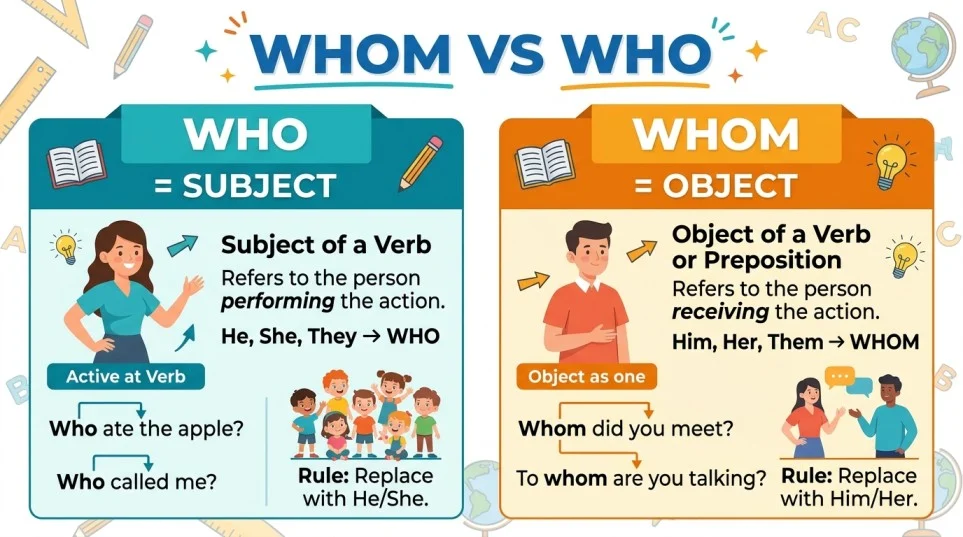
The easiest way to understand whom or who is to identify whether the person is performing the action or receiving it.
| Word | Function | Example |
|---|---|---|
| Who | Subject | Who called you? |
| Whom | Object | Whom did you call? |
A simple rule:
- Use who when the person does the action.
- Use whom when the person receives the action.
For example:
- Who wrote the report?
- Whom did you invite?
What Is Who?
Who is a subject pronoun. It refers to the person performing an action in a sentence.
Think of who as working like:
- He
- Her
- They
If the answer can be replaced by “he” or “her,” use who.
Examples of Who
- Who is coming to the meeting?
- Who wrote this book?
- Who called last night?
- Who wants pizza?
In each sentence, the person is performing the action.
How Who Functions
Consider this sentence:
Who opened the door?
The person opened the door. Therefore, the person performs the action.
Since the person acts as the subject, who is correct.
What Is Whom?
Whom is an object pronoun. It refers to the person receiving an action.
Think of whom as working like:
- Him
- Her
- Them
If the answer can be replaced by “him” or “her,” use whom.
Examples of Whom
- Whom did you call?
- Whom should we invite?
- Whom are they looking for?
- To whom was the letter addressed?
In these examples, the person receives the action rather than performs it.
How Whom Functions
Consider this sentence:
Whom did you call?
You performed the action of calling. The other person received that action.
Because the person functions as the object, whom is correct.
Key Differences Between Whom or Who
Grammatical Role
The biggest difference between whom or who involves sentence structure.
- Who = Subject
- Whom = Object
Subject vs Object
Subjects perform actions.
Objects receive actions.
Examples:
- Who sent the email?
- Whom did you email?
Pronoun Test
One of the easiest ways to choose between whom or who is the pronoun test.
Replace the word with:
- He or her = Who
- Him or her = Whom
Example:
Who called?
Answer: He called.
Therefore, use who.
Example:
Whom did you call?
Answer: I called him.
Therefore, use whom.
Advantages and Disadvantages
Advantages of Using Who Correctly
- Improves grammar accuracy
- Sounds natural in conversation
- Easy to understand
- Common in modern English
Disadvantages of Incorrect Who Usage
- Can create grammar mistakes
- May reduce professionalism in formal writing
Advantages of Using Whom Correctly
- Demonstrates strong grammar skills
- Useful in academic writing
- Appropriate for formal communication
- Improves sentence precision
Disadvantages of Incorrect Whom Usage
- Can sound awkward
- May confuse readers
- Often appears overly formal when misused
Therefore, understanding whom or who helps balance correctness and readability.
Real World Examples
In Business Emails
Correct:
- To whom should I send the invoice?
Incorrect:
- To who should I send the invoice?
In Job Interviews
Correct:
- Who interviewed you?
Correct:
- Whom did you interview?
Each sentence requires a different pronoun because the grammatical roles differ.
In Everyday Conversation
People often say:
- Who are you talking to?
Traditional grammar prefers:
- Whom are you talking to?
However, modern spoken English frequently uses who in both situations.
Regional and Global Usage
American English
In everyday American English, who often replaces whom.
For example:
- Who did you invite?
Many speakers consider this acceptable in casual conversation.
British English
British English tends to preserve whom more often in formal writing.
Academic Writing
Universities and professional publications generally expect correct usage of whom or who.
As a result, understanding the distinction remains valuable.
Related Concepts and Comparisons
Who vs Whose
Many learners confuse these words.
| Word | Meaning |
|---|---|
| Who | Refers to a person |
| Whose | Shows possession |
Examples:
- Who called?
- Whose book is this?
Who vs That
Both words can introduce clauses.
Examples:
- The teacher who helped me.
- The book that inspired me.
Whom vs Whoever
Whom functions as an object.
Whoever functions as a subject.
Examples:
- Give the prize to whomever you choose.
- Whoever wins gets the trophy.
Understanding these related concepts strengthens your grasp of whom or who.
Common Mistakes About Whom or Who
Using Who as an Object
Incorrect:
- Who did you invite?
Formal correction:
- Whom did you invite?
Using Whom as a Subject
Incorrect:
- Whom is coming to dinner?
Correct:
- Who is coming to dinner?
Ignoring the Pronoun Test
Many grammar mistakes occur because writers skip the he/him test.
Using this simple method often solves the problem immediately.
Overusing Whom
Some people insert whom everywhere because it sounds formal.
However, incorrect formality is still incorrect grammar.
Beginner to Advanced Grammar Tips
Beginner Level
Remember one simple rule:
- Who = He
- Whom = Him
Intermediate Level
Identify the subject and object before choosing a word.
Ask:
- Who performs the action?
- Who receives the action?
Advanced Level
Analyze clauses carefully.
Example:
- Whom do you believe will win?
Although whom may seem correct, who is actually correct because the word functions as the subject of “will win.”
Complex sentences require deeper analysis.
Step By Step Usage Scenario
Imagine you want to ask about a phone call.
Scenario 1:
A person made the call.
Question:
Who called?
The person performs the action.
Scenario 2:
You made the call.
Question:
Whom did you call?
The person receives the action.
Following this process makes choosing between whom or who much easier.
Exercises With Answers
Exercise 1
Choose the correct word:
___ sent this email?
Answer: Who.
Exercise 2
Choose the correct word:
To ___ should I address the letter?
Answer: Whom.
Exercise 3
Choose the correct word:
___ is speaking?
Answer: Who.
Exercise 4
Choose the correct word:
___ did you invite?
Answer: Whom.
Exercise 5
True or False:
Who is used as an object.
Answer: False.
When Should You Use Whom or Who?
Use who when:
- The person performs the action
- The word functions as a subject
- The answer could be he, her, or they
Use whom when:
- The person receives the action
- The word functions as an object
- The answer could be him, her, or them
Applying these guidelines will improve grammar accuracy immediately.
FAQs About Whom or Who
What is the main difference between whom or who?
Who functions as a subject, while whom functions as an object.
Is whom still used today?
Yes. Although less common in conversation, whom remains important in formal writing.
How do I know whether to use whom or who?
Use the he/him test. If he works, choose who. If him works, choose whom.
Is it wrong to use who instead of whom?
In casual conversation, many people do. However, formal grammar often requires whom.
Which is correct: Who did you call or Whom did you call?
Formal grammar considers “Whom did you call?” correct.
Why do people avoid using whom?
Many speakers find it formal and prefer simpler everyday language.
Can whom start a sentence?
Yes. For example: “Whom did you invite?”
Is whom used in business writing?
Yes. Formal business documents often use whom correctly.
What is the easiest way to remember whom or who?
Remember: who equals he, whom equals him.
Does modern English still require whom?
Formal writing and academic settings still value correct whom usage.
Conclusion
Understanding whom or who becomes much easier once you learn the difference between subjects and objects. Although the two words refer to people, they perform different grammatical jobs.
Use who when the person performs an action. Use whom when the person receives an action. The simple he/him test often provides the fastest answer.
Modern conversation frequently favors who, even in situations where traditional grammar suggests whom. Nevertheless, formal writing, academic work, and professional communication still benefit from correct usage.
Practicing with real examples helps build confidence. Over time, recognizing subjects and objects becomes automatic.
By mastering whom or who, you can improve your grammar, strengthen your writing skills, and communicate more professionally in any setting.
Discover More:-
- Stretcher vs Gurney: Key Differences, Uses, and Medical Comparison Guide
- Balcony vs Patio: Differences, Uses, and Outdoor Space Guide

Lisa Thompson is a USA-based content writer and language specialist focused on grammar, writing improvement and digital publishing.
She holds a degree in English Language and Communication and has professional experience in educational and web content creation.
As the author of Gramtivo.Com, she aims to help readers improve their writing skills through clear and practical guidance.