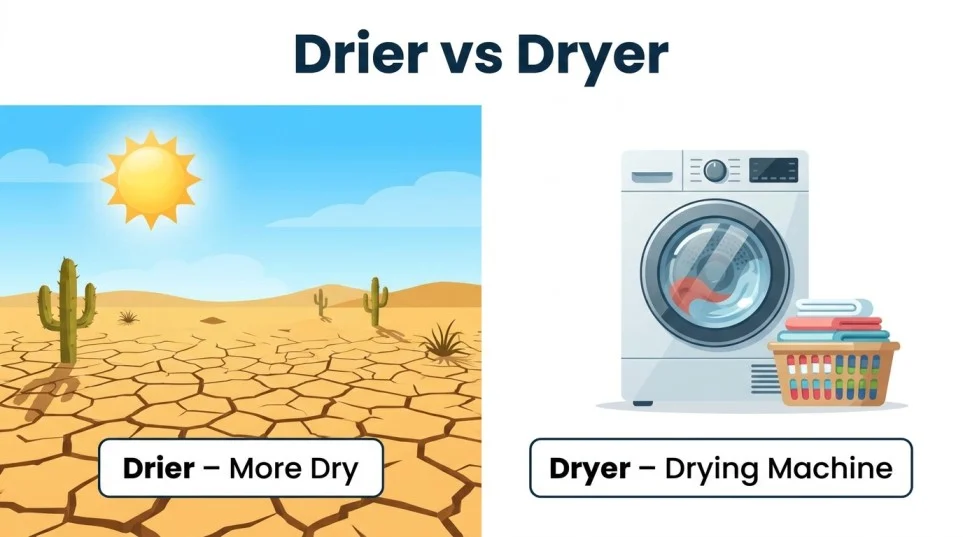
Quick Ans: The difference between drier or dryer comes down to grammar and meaning. Drier is usually the comparative form of the adjective dry, meaning “more dry.” Dryer most commonly refers to a machine that dries clothes, hair, or other items, although it can also be an alternative comparative spelling in some contexts.
Many English learners and native speakers get confused about drier or dryer. The two words look almost identical. Their pronunciation is often the same. Because of this, people frequently use one when they actually mean the other.
The confusion becomes even more common in writing. Someone might write “The weather is dryer today” when they mean “The weather is drier today.” Another person may write “Put the clothes in the drier” instead of “Put the clothes in the dryer.”
Although the difference seems small, choosing the correct spelling improves clarity and professionalism. In formal writing, academic work, and business communication, using the right word matters.
Understanding drier or dryer is not difficult once you learn the basic rule. One spelling usually refers to a machine, while the other commonly describes something with less moisture.
This guide explains everything you need to know. You will learn definitions, examples, grammar rules, common mistakes, comparisons, exercises, and practical usage tips.
Quick Answer: Drier or Dryer
When deciding between drier or dryer, use this simple rule:
| Word | Meaning | Example |
|---|---|---|
| Drier | More dry | This towel is drier than that one. |
| Dryer | A machine that dries things | Put the clothes in the dryer. |
In most situations:
- Drier = comparative adjective.
- Dryer = drying machine.
Therefore, if you are comparing moisture levels, choose drier. If you are talking about an appliance, choose dryer.
What Does Drier Mean?
Drier is the comparative form of the adjective dry.
It means something has less moisture than something else.
Examples of Drier
Consider these sentences:
- The desert air is drier than the coastal air.
- Today’s weather feels drier than yesterday’s.
- This paint is drier now than it was this morning.
- The towel became drier after sitting in the sun.
In each example, the word compares two levels of dryness.
Why Drier Is Used
English often forms comparatives by adding -er to adjectives.
Examples include:
- Tall → Taller
- Small → Smaller
- Dry → Drier
As a result, drier follows a common English grammar pattern.
Common Contexts for Drier
You may see drier in discussions about:
- Weather
- Climate
- Skin conditions
- Paint
- Soil
- Fabrics
Whenever you compare dryness levels, drier is usually the preferred spelling.
What Does Dryer Mean?
Dryer most commonly refers to a machine that removes moisture.
Many homes contain a clothes dryer. Hair salons use hair dryers. Industrial facilities may use large drying machines.
Examples of Dryer
Here are some common examples:
- Put the wet clothes in the dryer.
- The hair dryer stopped working.
- We bought a new dryer last week.
- This dryer uses less electricity.
In each case, dryer refers to equipment rather than a comparison.
Types of Dryers
Several kinds of dryers exist:
- Clothes dryer
- Hair dryer
- Industrial dryer
- Grain dryer
- Food dryer
Because these machines perform drying functions, the spelling dryer is standard.
Why Dryer Is Different
Although it looks similar to drier, the word developed as a noun referring to equipment.
Consequently, most modern English speakers immediately associate dryer with a machine.
Key Differences Between Drier or Dryer
Meaning
The biggest difference between drier or dryer involves meaning.
- Drier describes dryness.
- Dryer usually names a machine.
Part of Speech
Drier functions mainly as an adjective.
Example:
- This climate is drier.
Dryer functions mainly as a noun.
Example:
- The dryer is in the laundry room.
Usage Frequency
In everyday conversation, dryer appears frequently because people often discuss appliances.
Meanwhile, drier commonly appears in weather reports, scientific writing, and descriptive comparisons.
Context
Context usually makes the correct choice obvious.
Compare these examples:
- The soil became drier after two weeks without rain.
- The dryer finished the laundry in forty minutes.
The surrounding words clearly indicate the intended meaning.
Comparison Table: Drier vs Dryer
| Feature | Drier | Dryer |
|---|---|---|
| Part of Speech | Adjective | Noun |
| Main Meaning | More dry | Drying machine |
| Used for Comparisons | Yes | No |
| Common in Weather Discussions | Yes | Rarely |
| Common in Laundry Discussions | Rarely | Yes |
This comparison helps clarify the drier or dryer distinction.
Advantages and Disadvantages of Each Usage
Advantages of Using Drier Correctly
- Improves grammatical accuracy
- Enhances professional writing
- Avoids confusion
- Follows standard comparative rules
Disadvantages of Misusing Drier
- Can appear grammatically incorrect
- May confuse readers
- Reduces writing quality
Advantages of Using Dryer Correctly
- Clearly identifies a machine
- Matches common English usage
- Improves communication
Disadvantages of Misusing Dryer
- Creates confusion in comparisons
- Weakens formal writing
- May change sentence meaning
Therefore, choosing the correct spelling is important.
Real World Examples
Weather Reports
Meteorologists frequently use drier.
Examples include:
- Conditions will become drier this weekend.
- Northern regions are expected to remain drier than southern areas.
Home Appliances
Homeowners frequently use dryer.
Examples include:
- The dryer needs repair.
- The dryer finished the load.
Business Writing
Professional writers often need the correct word.
For instance:
- The region experienced drier conditions this year.
- The company installed a new industrial dryer.
These examples show how context determines the proper spelling.
Regional and Global Usage
American English
American English commonly uses:
- Drier for comparisons
- Dryer for machines
This distinction appears in schools, newspapers, and business writing.
British English
British English generally follows the same pattern.
However, some dictionaries recognize dryer as an alternative comparative spelling of dry.
Even so, drier remains more common in formal writing.
International English
English learners worldwide typically learn:
- Drier = comparative adjective
- Dryer = noun
As a result, this rule works well across most English-speaking regions.
Related Concepts and Comparisons
Dry vs Drier
Dry describes something without moisture.
Drier compares two levels of dryness.
Examples:
- The ground is dry.
- The ground is drier today.
Dry vs Dryer
Dry is an adjective.
Dryer is usually a noun.
Examples:
- The clothes are dry.
- The clothes are in the dryer.
Drier vs Dryest
Drier is comparative.
Dryest is superlative.
Examples:
- This month is drier than last month.
- July was the dryest month of the year.
Some style guides also accept driest, which is often considered the preferred modern spelling.
Common Mistakes About Drier or Dryer
Using Dryer for Weather Comparisons
Incorrect:
- The weather is dryer today.
Correct:
- The weather is drier today.
Using Drier for Appliances
Incorrect:
- Put the clothes in the drier.
Correct:
- Put the clothes in the dryer.
Ignoring Context
Some writers focus only on spelling without considering meaning.
Instead, ask yourself whether the sentence compares dryness or mentions a machine.
Assuming They Are Always Interchangeable
The words are not interchangeable in most situations.
Choosing the wrong spelling can change the meaning completely.
Beginner to Advanced Usage Tips
Beginner Level
Remember a simple rule:
- Drier = more dry
- Dryer = machine
Intermediate Level
Check the sentence context before writing.
If comparison words such as more, less, or than appear nearby, drier may be correct.
Advanced Level
Review style guide recommendations.
Many editors prefer drier for comparative usage because it avoids ambiguity.
Careful proofreading helps eliminate mistakes.
Step By Step Decision Process
When deciding between drier or dryer, follow these steps:
Step 1
Ask whether you are discussing a machine.
Step 2
If the answer is yes, use dryer.
Step 3
If the answer is no, determine whether you are comparing dryness.
Step 4
If comparison is involved, use drier.
Step 5
Read the sentence again to confirm the meaning.
This method works in nearly every situation.
Exercises With Answers
Exercise 1
Choose the correct word:
The climate became ______ after the rainy season.
Answer: Drier
Exercise 2
Choose the correct word:
Please move the clothes into the ______.
Answer: Dryer
Exercise 3
Choose the correct word:
My hair feels ______ today.
Answer: Drier
Exercise 4
Choose the correct word:
The new ______ uses less electricity.
Answer: Dryer
Exercise 5
True or False: Dryer usually refers to a machine.
Answer: True
When Should You Use Drier or Dryer?
Use drier when you:
- Compare moisture levels
- Describe weather conditions
- Discuss climate differences
- Compare fabrics, soil, or surfaces
Use dryer when you:
- Discuss laundry appliances
- Mention hair styling equipment
- Refer to industrial drying machines
- Talk about drying technology
The sentence context will usually guide your choice.
FAQs About Drier or Dryer
What is the difference between drier or dryer?
Drier usually means “more dry,” while dryer typically refers to a machine that removes moisture.
Is drier a real word?
Yes. Drier is the standard comparative form of the adjective dry.
Can dryer mean more dry?
Some dictionaries recognize dryer as an alternative comparative spelling, but drier is generally preferred in formal writing.
Which spelling is correct for weather conditions?
When discussing weather, drier is usually the correct choice.
Should I write drier or dryer for laundry equipment?
Use dryer because it refers to a machine.
Why do people confuse drier and dryer?
The words look similar and are often pronounced the same.
Is dryer a noun or adjective?
Dryer is most commonly used as a noun.
Is drier a comparative adjective?
Yes. Drier compares one level of dryness with another.
Which spelling should students use in academic writing?
Students should generally use drier for comparisons and dryer for machines.
How can I remember the difference between drier or dryer?
Think of the laundry appliance. If you mean the machine, use dryer. For comparisons of dryness, use drier.
Conclusion
Understanding drier or dryer becomes simple once you know the difference in meaning and usage. Although the words look nearly identical, they serve different grammatical purposes.
The word drier usually functions as a comparative adjective. It describes something with less moisture than another thing. Weather reports, climate discussions, and descriptive writing often use this spelling.
The word dryer, on the other hand, most commonly refers to a machine that removes moisture. Clothes dryers, hair dryers, and industrial dryers all use this form.
Context is the key to choosing correctly. If you are comparing dryness, use drier. If you are talking about equipment, use dryer.
By following these simple guidelines, you can avoid common spelling mistakes and improve the accuracy of your writing.
Discover More:-
- Flyer or Flier: Which Spelling Is Correct and When to Use Each
- There or Their: Difference, Meaning, Examples, and Grammar Guide

Robert Mitchell is a U.S.-based writer at Gramtivo.Com who focuses on grammar, writing improvement, and language-related content. He holds a degree in English and Linguistics from a U.S. university. His work aims to help readers enhance their writing skills with clear and practical guidance.