
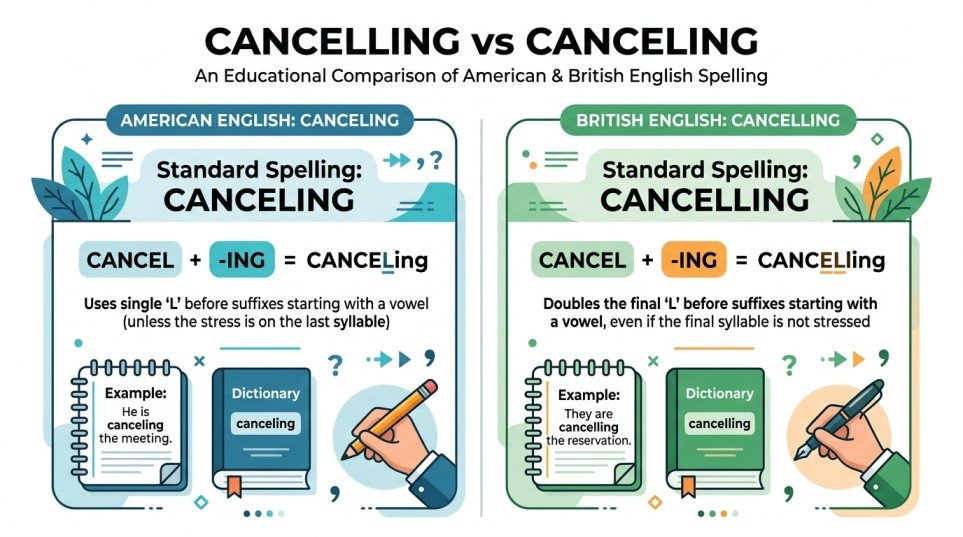
Quick Ans: The difference between cancelling or canceling comes down to regional spelling rules. Canceling is the preferred spelling in American English, while cancelling is the standard spelling in British English, Canadian English, Australian English, and many other forms of English. Both spellings are correct when used in the appropriate language variety.
Many writers wonder whether they should use cancelling or canceling. The words look almost identical. The meaning is exactly the same. Yet one version has a double “l” while the other uses only a single “l.”
This difference often creates confusion for students, professionals, bloggers, and business writers. A document may look inconsistent if both spellings appear together. Additionally, using the wrong regional spelling can make writing seem less professional.
The good news is that neither spelling is wrong. Instead, the correct choice depends on the version of English you are using.
American English follows one spelling rule. British English follows another. As a result, both forms have become widely accepted around the world.
Understanding cancelling or canceling helps improve grammar, maintain consistency, and ensure professional communication. This guide explains the differences, spelling rules, examples, common mistakes, and practical exercises so you can use the correct form with confidence.
Quick Answer: Cancelling or Canceling
The simplest answer is that both spellings are correct.
| Version of English | Preferred Spelling |
|---|---|
| American English | Canceling |
| British English | Cancelling |
| Canadian English | Cancelling |
| Australian English | Cancelling |
| New Zealand English | Cancelling |
Therefore:
- Use canceling for American audiences.
- Use cancelling for British and most international audiences.
The meaning remains exactly the same regardless of spelling.
What Does “Cancel” Mean?
The verb cancel means to stop, revoke, call off, or decide not to continue something.
Examples include:
- Cancel a meeting
- Cancel a subscription
- Cancel a flight
- Cancel an appointment
- Cancel an order
When the verb changes into its present participle form, writers must decide between cancelling or canceling depending on regional spelling conventions.
Simple Examples
American English:
- We are canceling tomorrow’s meeting.
- She is canceling her membership.
British English:
- We are cancelling tomorrow’s meeting.
- She is cancelling her membership.
Although the spelling differs, the meaning stays identical.
Why Are There Two Spellings?
The existence of cancelling or canceling comes from differences between American and British spelling systems.
British English often doubles the final consonant before adding endings such as:
- -ing
- -ed
American English sometimes simplifies these spellings.
Consider these examples:
| American English | British English |
|---|---|
| Traveling | Travelling |
| Modeled | Modelled |
| Fueling | Fuelling |
| Canceling | Cancelling |
As a result, both spelling traditions developed independently and remain accepted today.
The Rule Behind Canceling and Cancelling
Understanding the spelling rule makes the difference easier to remember.
British English Rule
British English usually doubles the final “l” before adding a suffix.
Examples:
- Cancel → Cancelling
- Travel → Travelling
- Signal → Signalling
Therefore, cancelling becomes the standard British spelling.
American English Rule
American English often keeps a single “l” when the final syllable is not stressed.
Examples:
- Cancel → Canceling
- Travel → Traveling
- Fuel → Fueling
Consequently, canceling is the preferred American spelling.
Cancelling or Canceling in Different Forms
The difference extends beyond the -ing form.
| Base Word | American English | British English |
|---|---|---|
| Cancel | Cancel | Cancel |
| Canceling/Cancelling | Canceling | Cancelling |
| Canceled/Cancelled | Canceled | Cancelled |
| Cancellation | Cancellation | Cancellation |
Notice that cancellation keeps the double “l” in both versions.
This detail surprises many writers.
Examples of Canceling in American English
American English publications generally prefer canceling.
Examples:
- The company is canceling the project.
- We are canceling our vacation plans.
- She considered canceling the subscription.
- They are canceling several flights due to weather.
In each sentence, only one “l” appears before the “-ing” ending.
Examples of Cancelling in British English
British English style guides generally recommend cancelling.
Examples:
- The company is cancelling the project.
- We are cancelling our holiday plans.
- She discussed cancelling the membership.
- Airlines are cancelling flights because of bad weather.
The extra “l” follows standard British spelling conventions.
Key Differences Between Cancelling or Canceling
Regional Preference
The biggest difference involves location.
American English prefers canceling.
British English prefers cancelling.
Meaning
No difference exists in meaning.
Both words describe stopping or calling off something.
Professional Writing
Professional writers should stay consistent.
Switching between spellings in the same document can appear careless.
Search and Online Content
Online audiences may use either spelling depending on their country.
Therefore, businesses often choose the version that matches their target market.
Advantages and Disadvantages
Using Canceling
Advantages:
- Standard in American English
- Preferred by many U.S. publishers
- Consistent with American spelling rules
Disadvantages:
- May appear incorrect to British readers
- Less common outside the United States
Using Cancelling
Advantages:
- Standard in British English
- Used across many English-speaking countries
- Familiar to international audiences
Disadvantages:
- May look unusual in American publications
- Can conflict with U.S. style guides
Because both spellings are valid, audience expectations should guide your choice.
Real World Examples
Business Emails
An American company might write:
“We are canceling tomorrow’s meeting.”
A British company would likely write:
“We are cancelling tomorrow’s meeting.”
Travel Industry
Airlines frequently announce flight changes.
American airline:
“We are canceling selected flights.”
British airline:
“We are cancelling selected flights.”
Academic Writing
Universities generally follow regional style guides. Therefore, spelling often depends on the institution’s location.
Regional and Global Usage
United States
American English strongly favors canceling.
Most newspapers, publishers, and businesses use the single “l” version.
United Kingdom
British English almost always uses cancelling.
The double “l” spelling appears in schools, media, and government documents.
Canada
Canadian English generally follows British conventions, making cancelling more common.
Australia and New Zealand
Writers typically use cancelling as well.
As a result, the double “l” spelling dominates much of the English-speaking world outside the United States.
Related Concepts and Comparisons
Canceled vs Cancelled
The same regional rule applies.
| American English | British English |
|---|---|
| Canceled | Cancelled |
Traveling vs Travelling
Another common example:
| American English | British English |
|---|---|
| Traveling | Travelling |
Fueling vs Fuelling
The pattern appears again.
| American English | British English |
|---|---|
| Fueling | Fuelling |
These examples help explain why cancelling or canceling follows different spelling conventions.
Common Mistakes About Cancelling or Canceling
Mixing Both Spellings
Many writers use both versions in one document.
Incorrect:
- The event is canceling today.
- Several speakers are cancelling their appearances.
Correct:
Choose one spelling style and use it consistently.
Assuming One Version Is Wrong
Both spellings are correct.
The appropriate choice depends on regional English.
Forgetting Your Audience
Business communication should match reader expectations.
American audiences usually expect canceling.
British audiences generally expect cancelling.
Confusing Cancellation
Many people expect American English to spell it as “cancelation.”
However, cancellation remains the preferred spelling in both major English varieties.
Beginner to Advanced Usage Tips
Beginner Level
Determine whether you are writing in American or British English.
Intermediate Level
Use the same spelling style throughout the entire document.
Advanced Level
Follow the style guide required by your organization, publication, or academic institution.
Consistency is often more important than personal preference.
Step By Step Decision Guide
Suppose you need to write the sentence:
“The company is ____ the event.”
Step 1: Identify your audience.
2: Determine the required English variety.
3: Apply the correct spelling.
For American English:
“The company is canceling the event.”
For British English:
“The company is cancelling the event.”
Following these steps helps eliminate uncertainty.
Exercises With Answers
Exercise 1
Which spelling is preferred in American English?
Answer: Canceling.
Exercise 2
Which spelling is preferred in British English?
Answer: Cancelling.
Exercise 3
True or False: Both spellings have the same meaning.
Answer: True.
Exercise 4
Which version would typically appear in a U.S. newspaper?
Answer: Canceling.
Exercise 5
Which version is more common in Australia?
Answer: Cancelling.
When Should You Use Cancelling or Canceling?
Use canceling when:
- Writing for American audiences
- Following U.S. style guides
- Producing American business content
Use cancelling when:
- Writing for British audiences
- Following UK spelling standards
- Creating content for many international readers
Choosing the correct version improves professionalism and consistency.
FAQs About Cancelling or Canceling
What is the difference between cancelling or canceling?
The difference is regional spelling. American English uses canceling, while British English uses cancelling.
Is canceling incorrect?
No. It is the standard American English spelling.
Is cancelling incorrect?
No. It is the standard British English spelling.
Which spelling should I use in the United States?
Use canceling for American audiences.
Which spelling should I use in the United Kingdom?
Use cancelling for British audiences.
Do cancelling and canceling mean the same thing?
Yes. Both forms mean stopping or calling off something.
Why does British English use two l’s?
British spelling rules often double the final “l” before adding suffixes like “-ing.”
Why does American English use one l?
American spelling tends to simplify certain words by using a single “l.”
Is cancellation spelled differently in American English?
No. Both American and British English generally use cancellation.
Can I use both spellings in one document?
It is best not to. Consistent spelling creates a more professional appearance.
Conclusion
The debate over cancelling or canceling is not about right versus wrong. Instead, it reflects the differences between American and British English spelling conventions.
American English prefers canceling with one “l.” British English, along with Canadian, Australian, and many international varieties, favors cancelling with two “l’s.” Despite the spelling difference, both words carry exactly the same meaning.
Writers should focus on audience and consistency. If your readers are primarily American, use canceling throughout your document. If your audience follows British English conventions, choose cancelling instead.
Professional communication becomes clearer when spelling remains consistent from beginning to end. By understanding the rules behind cancelling or canceling, you can write confidently and avoid common mistakes in business, academic, and everyday writing.
Discover More:-
- TheraBreath vs Listerine: Differences, Ingredients, Benefits, and Best Mouthwash Guide
- Stretcher vs Gurney: Key Differences, Uses, and Medical Comparison Guide

Jennifer Collins is a professional grammar expert and language educator at gramtivo.com, specializing in English grammar, writing skills, and language improvement. She holds a Master’s degree in English Language and Literature from a recognized university in the United States. With years of teaching and content development experience, she is dedicated to helping learners improve their communication skills with clear and practical guidance.