
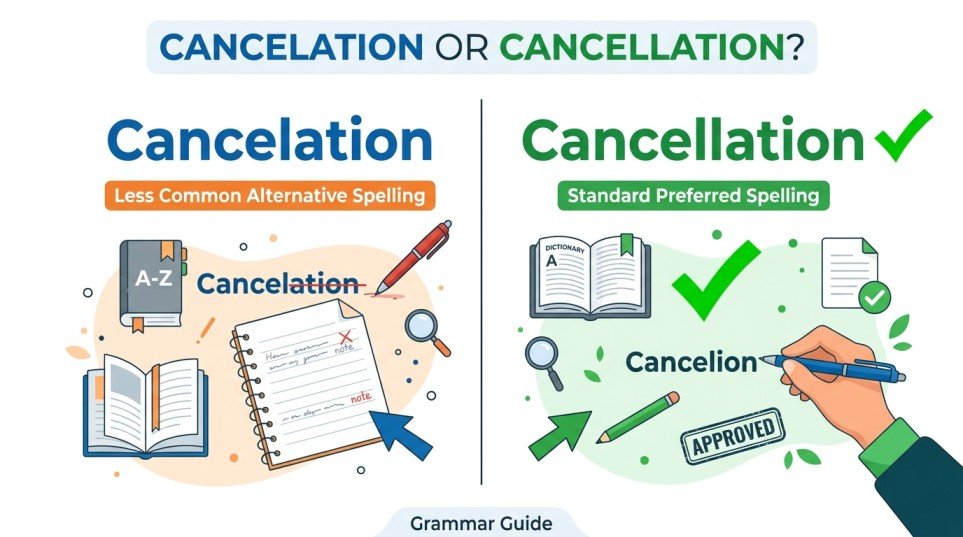
Quick Ans: The main difference between cancelation or cancellation is spelling preference and usage frequency. While both spellings are accepted in some dictionaries, cancellation with two “l” letters is the standard and far more common spelling in modern English. Most style guides, publishers, businesses, and educational institutions recommend using cancellation.
Many English learners and native speakers wonder whether they should write cancelation or cancellation. The words look almost identical. The meanings are exactly the same. However, one spelling appears much more often in books, websites, business documents, and professional writing.
The confusion comes from the verb cancel. Since the base word contains only one “l,” some people naturally assume the noun should become cancelation. Others use cancellation because they see it more frequently.
As a result, writers often stop and question which version is correct.
The good news is that the issue is easier than it seems. Although both spellings have appeared in dictionaries, one version has become the clear standard in modern English.
Understanding the difference between cancelation or cancellation helps improve writing accuracy, avoid spelling mistakes, and ensure your communication looks professional.
In this guide, you will learn definitions, spelling rules, examples, regional usage, common mistakes, exercises, and frequently asked questions.
Quick Answer: Cancelation or Cancellation
If you need a quick answer, use cancellation.
| Spelling | Status |
|---|---|
| Cancelation | Accepted but uncommon |
| Cancellation | Standard and preferred |
In most situations:
- Use cancellation in professional writing.
- Use cancellation in academic work.
- Use cancellation in business communication.
- Use cancellation in formal documents.
Therefore, when choosing between cancelation or cancellation, cancellation is usually the safest choice.
What Does Cancellation Mean?
Cancellation is a noun that refers to the act of canceling something.
It can describe:
- Ending an event
- Stopping a service
- Revoking an agreement
- Calling off a reservation
- Terminating a subscription
Examples of Cancellation
- The flight cancellation frustrated passengers.
- We received a cancellation notice from the hotel.
- The concert cancellation disappointed fans.
- Her subscription cancellation was processed quickly.
In every example, the word refers to something being officially canceled.
Why Is Cancellation So Common?
Modern English generally doubles the final consonant before adding certain suffixes. Because of this pattern, cancellation became the preferred spelling over time.
Consequently, most writers automatically choose this version.
What Does Cancelation Mean?
Cancelation has the same meaning as cancellation.
There is no difference in definition.
The distinction involves spelling rather than meaning.
Examples of Cancelation
You may occasionally see sentences such as:
- The event cancelation was announced yesterday.
- We received a cancelation email.
Although these sentences are understandable, many editors would change cancelation to cancellation.
Why Does Cancelation Exist?
The spelling developed because some writers followed the structure of the base verb cancel.
Since the verb ends with a single “l,” they formed the noun without doubling the consonant.
However, standard English usage eventually favored cancellation.
Key Differences Between Cancelation or Cancellation
Meaning
There is no difference in meaning.
Both words refer to the act of canceling something.
Popularity
Cancellation is dramatically more common.
Most books, websites, newspapers, and businesses use it.
Professional Acceptance
Editors generally prefer cancellation.
Academic institutions also favor this spelling.
Dictionary Treatment
Many dictionaries list both forms. However, cancellation is usually identified as the preferred version.
Why Cancellation Became the Standard
English spelling often follows patterns involving suffixes.
Consider these examples:
| Verb | Noun |
|---|---|
| Cancel | Cancellation |
| Admit | Admission |
| Permit | Permission |
| Commit | Commission |
| Submit | Submission |
In many cases, the final consonant doubles when certain endings are added.
As a result, cancellation aligns with common English spelling patterns.
Furthermore, publishers and style guides reinforced this preference over many decades.
Consequently, the double “l” spelling became dominant.
Advantages and Disadvantages
Advantages of Using Cancellation
- Recognized worldwide
- Preferred by editors
- Accepted in formal writing
- Common in academic work
- Seen as professional
Disadvantages of Using Cancellation
- Slightly longer spelling
- May confuse some learners initially
Advantages of Using Cancelation
- Shorter spelling
- Found in some dictionaries
Disadvantages of Using Cancelation
- Less common
- May appear incorrect to readers
- Often corrected by editors
- Not preferred in professional contexts
For these reasons, cancellation remains the better choice.
Real World Examples
Business Communication
Companies almost always use cancellation.
Examples include:
- Cancellation policy
- Cancellation fee
- Cancellation request
- Cancellation notice
Travel Industry
Airlines and hotels commonly use:
- Flight cancellation
- Reservation cancellation
- Booking cancellation
Customers rarely encounter the spelling cancelation.
Academic Writing
Universities and researchers overwhelmingly choose cancellation because it aligns with standard English conventions.
Regional and Global Usage
American English
American English overwhelmingly prefers cancellation.
Although some dictionaries acknowledge cancelation, it remains uncommon.
British English
British English strongly favors cancellation as well.
Most publications use the double “l” spelling.
International English
Across business, education, media, and government communication, cancellation is the dominant form.
Therefore, global audiences expect to see cancellation rather than cancelation.
Related Concepts and Comparisons
Cancel vs Cancellation
Cancel is a verb.
Example:
- We decided to cancel the meeting.
Cancellation is a noun.
Example:
- The cancellation was announced today.
Cancellation vs Postponement
A cancellation ends an event completely.
A postponement moves the event to a later date.
Cancellation vs Termination
Termination usually refers to ending agreements, contracts, or employment.
Cancellation often applies to reservations, subscriptions, events, and services.
Common Mistakes About Cancelation or Cancellation
Assuming Both Are Equally Common
Both spellings exist. However, cancellation appears much more frequently.
Using Cancelation in Formal Documents
Professional writing generally requires cancellation.
Mixing Spellings in One Document
Choose one spelling and remain consistent.
In most cases, that spelling should be cancellation.
Applying the Same Logic to Every Word
English spelling patterns vary. Therefore, not every noun follows the exact same formation rule.
Always verify unfamiliar spellings with a reliable dictionary.
Beginner to Advanced Writing Tips
Beginner Level
Memorize the standard spelling:
Cancellation = Correct choice for most situations
Intermediate Level
Review business documents and notice how frequently cancellation appears.
This exposure reinforces correct usage.
Advanced Level
Follow major style guides and publishing standards.
Professional editors expect cancellation, especially in formal writing.
Step By Step Usage Scenario
Imagine you are writing an email about a canceled hotel reservation.
Option 1:
- Reservation cancelation notice
Option 2:
- Reservation cancellation notice
Most businesses, hotels, and travel companies would choose Option 2.
Therefore, cancellation is the preferred spelling.
Exercises With Answers
Exercise 1
Which spelling is preferred in modern English?
Answer: Cancellation.
Exercise 2
Do cancelation and cancellation have different meanings?
Answer: No.
Exercise 3
Which spelling appears more often in professional writing?
Answer: Cancellation.
Exercise 4
Which spelling do most style guides recommend?
Answer: Cancellation.
Exercise 5
True or False: Cancellation is considered the standard spelling.
Answer: True.
When Should You Use Cancellation?
Use cancellation when writing:
- Business emails
- Academic papers
- Website content
- Contracts
- Travel documents
- Customer service messages
- Professional reports
In nearly every situation, cancellation is the safest choice.
FAQs About Cancelation or Cancellation
Which is correct: cancelation or cancellation?
Both spellings exist, but cancellation is the standard and preferred spelling in modern English.
Is cancelation a real word?
Yes. Some dictionaries recognize it, although it is much less common than cancellation.
Why is cancellation spelled with two l’s?
English spelling conventions often double the consonant before certain suffixes, leading to cancellation.
Do American English and British English use cancellation?
Yes. Both varieties strongly prefer cancellation.
Can I use cancelation in professional writing?
You can, but most editors recommend using cancellation instead.
Which spelling appears in business documents?
Businesses almost always use cancellation.
Is cancellation more formal than cancelation?
The meaning is the same, but cancellation appears more professional because it is the standard spelling.
Do dictionaries accept cancelation?
Some dictionaries list it as an alternative spelling. Nevertheless, cancellation remains the preferred form.
Should students use cancellation or cancelation?
Students should generally use cancellation in essays, assignments, and academic work.
What is the easiest way to remember the correct spelling?
Remember that professional writing almost always uses cancellation with two “l” letters.
Conclusion
The debate over cancelation or cancellation is largely about spelling preference rather than meaning. Both words refer to the act of canceling something. However, one version clearly dominates modern English.
Cancellation with two “l” letters is the standard spelling used by businesses, schools, publishers, government agencies, and professional writers. Although cancelation appears in some dictionaries, it is much less common and may look incorrect to many readers.
For everyday writing, academic assignments, business communication, and professional documents, choosing cancellation is the best practice. It aligns with current language standards and helps ensure your writing appears polished and credible.
Whenever you face the choice between cancelation or cancellation, remember a simple rule: if you want the spelling most readers expect, use cancellation.
Discover More:-
- Stretcher vs Gurney: Key Differences, Uses, and Medical Comparison Guide
- TheraBreath vs Listerine: Differences, Ingredients, Benefits, and Best Mouthwash Guide

Robert Mitchell is a U.S.-based writer at Gramtivo.Com who focuses on grammar, writing improvement, and language-related content. He holds a degree in English and Linguistics from a U.S. university. His work aims to help readers enhance their writing skills with clear and practical guidance.