
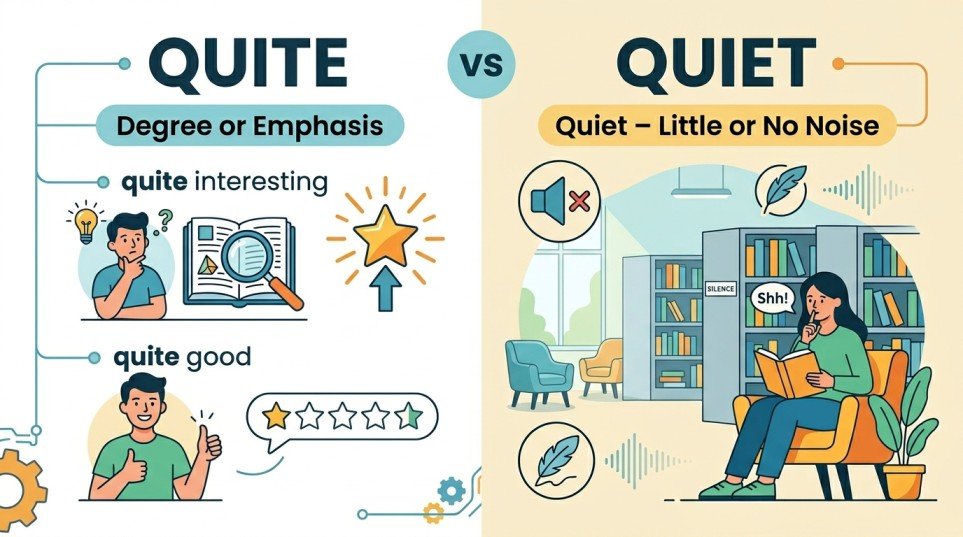
Quick Ans: The difference between quite or quiet is simple but important. Quite is an adverb that usually means “fairly,” “completely,” or “to a significant degree,” while quiet is an adjective or noun that refers to little or no noise. Although the words look similar, they have very different meanings and uses in English.
Many English learners struggle with quite or quiet because the words look almost identical. In fact, just one extra letter changes the spelling. As a result, people often confuse them in writing and conversation.
This mistake is common among students, professionals, and even native speakers. Someone might write “The library is quite” when they actually mean “The library is quiet.” Similarly, another person may use “quiet” when they want to emphasize something with “quite.”
Because these words appear frequently in everyday English, understanding the difference is essential. Correct usage improves writing, speaking, and overall communication. Moreover, using the wrong word can change the meaning of an entire sentence.
This guide explains quite or quiet in a clear and simple way. You will learn definitions, examples, grammar rules, common mistakes, comparisons, exercises, and practical tips. By the end, you will know exactly when to use each word.
Quick Answer: Quite or Quiet
Here is the simplest explanation:
| Word | Meaning | Part of Speech |
|---|---|---|
| Quite | Fairly, very, completely | Adverb |
| Quiet | Making little or no noise | Adjective, noun, or verb |
Examples:
- The movie was quite interesting.
- The room was quiet during the exam.
Therefore, quite describes degree or intensity, while quiet relates to silence or low noise.
What Does Quite Mean?
Quite is an adverb used to modify adjectives, verbs, or other adverbs. It usually means:
- Fairly
- Rather
- Very
- Completely
The exact meaning often depends on context.
Examples of Quite
Consider these examples:
- The test was quite difficult.
- She is quite happy with the results.
- The meal was quite delicious.
- We are quite certain about our decision.
In each sentence, quite increases or emphasizes the meaning of another word.
Common Uses of Quite
People frequently use quite when they want to:
- Add emphasis
- Express a moderate degree
- Show certainty
- Strengthen a statement
For example:
- That was quite a surprise.
- He runs quite fast.
- The project is quite important.
Because of its flexibility, quite appears often in both spoken and written English.
What Does Quiet Mean?
Quiet refers to little or no noise. Most commonly, it functions as an adjective.
Examples of Quiet
Look at these sentences:
- The classroom was quiet.
- We enjoyed a quiet evening at home.
- The neighborhood remains quiet at night.
- Please stay quiet during the presentation.
In each case, quiet describes silence or a lack of sound.
Quiet as a Noun
Sometimes quiet functions as a noun.
Examples:
- We enjoyed the quiet of the countryside.
- After the storm came complete quiet.
Quiet as a Verb
Less commonly, quiet can be a verb.
Examples:
- The teacher tried to quiet the students.
- Parents often quiet a crying child.
Therefore, quiet has several grammatical roles, but all relate to calmness or reduced noise.
Key Differences Between Quite or Quiet
Meaning
The biggest difference between quite or quiet is meaning.
- Quite relates to degree or emphasis.
- Quiet relates to silence or calmness.
Part of Speech
Another major difference involves grammar.
- Quite is usually an adverb.
- Quiet is usually an adjective but can also be a noun or verb.
Usage
Consider these examples:
- She is quite talented.
- She is quiet during meetings.
The first sentence discusses degree. The second describes behavior.
Pronunciation
The words sound different as well.
| Word | Pronunciation |
|---|---|
| Quite | kwyt |
| Quiet | kwy-uht |
Although similar, the extra syllable in quiet helps distinguish the two.
Advantages and Disadvantages of Learning the Difference
Advantages
Understanding quite or quiet helps you:
- Improve grammar accuracy
- Write more professionally
- Avoid misunderstandings
- Communicate clearly
- Perform better in exams
Disadvantages of Confusing Them
Using the wrong word can:
- Change sentence meaning
- Create confusion
- Reduce writing quality
- Cause mistakes in professional communication
Therefore, mastering this distinction is valuable for every English learner.
Comparison Table: Quite vs Quiet
| Feature | Quite | Quiet |
|---|---|---|
| Meaning | Fairly or very | Silent or calm |
| Part of Speech | Adverb | Adjective, noun, verb |
| Related To | Degree | Noise level |
| Example | Quite interesting | Quiet room |
| Common Mistake | Used instead of quiet | Used instead of quite |
This table provides a quick overview of quite or quiet.
Real World Examples
At School
Teacher: “The class was quite impressive today.”
Teacher: “The class was quiet today.”
The first sentence praises performance. The second describes noise level.
At Work
Manager: “The presentation was quite successful.”
Manager: “The office is quiet this morning.”
Again, the meanings are completely different.
At Home
- Dinner was quite enjoyable.
- The house became quiet after midnight.
These examples show how often both words appear in daily communication.
Regional and Global Usage
American English
American speakers frequently use quite to mean “very” or “fairly.”
Examples:
- Quite good
- Quite interesting
Meanwhile, quiet consistently refers to low noise.
British English
British English sometimes uses quite differently.
For example:
- Quite good may mean fairly good rather than very good.
However, quiet keeps the same meaning.
International English
English learners worldwide often confuse these words because of their similar spelling. Consequently, grammar teachers regularly include quite or quiet in vocabulary lessons.
Related Concepts and Comparisons
Quite vs Very
Both words add emphasis.
Examples:
- Quite interesting
- Very interesting
However, very usually expresses stronger intensity.
Quiet vs Silent
Both relate to little noise.
Examples:
- The room was quiet.
- The room was silent.
Generally, silent suggests complete absence of sound.
Quite vs Quiet vs Silent
| Word | Meaning |
|---|---|
| Quite | Fairly or very |
| Quiet | Little noise |
| Silent | No noise |
Understanding these related terms improves vocabulary and communication skills.
Common Mistakes About Quite or Quiet
Using Quiet Instead of Quite
Incorrect:
- The movie was quiet interesting.
Correct:
- The movie was quite interesting.
Using Quite Instead of Quiet
Incorrect:
- Please remain quite during the meeting.
Correct:
- Please remain quiet during the meeting.
Ignoring Context
Many learners focus only on spelling. However, meaning should guide your choice.
Ask yourself:
- Am I talking about degree? Use quite.
- Am I talking about noise? Use quiet.
Forgetting Pronunciation Differences
Listening carefully can also help prevent errors. The pronunciation of each word is slightly different.
Beginner to Advanced Learning Tips
Beginner Level
Memorize a simple rule:
- Quite = degree
- Quiet = silence
Intermediate Level
Practice writing sentences with both words.
Examples:
- The book was quite helpful.
- The library was quiet.
Advanced Level
Read newspapers, books, and articles. Notice how native speakers use both words in different contexts.
Regular exposure strengthens understanding over time.
Step By Step Usage Scenario
Imagine you are describing a restaurant.
If you want to talk about quality:
- The food was quite good.
- The service was quite excellent.
If you want to talk about noise:
- The restaurant was quiet.
- The dining area remained quiet throughout the evening.
The correct word depends entirely on the message you want to communicate.
Exercises With Answers
Exercise 1
Choose the correct word:
The library was very ______.
Answer: quiet
Exercise 2
Choose the correct word:
The lecture was ______ informative.
Answer: quite
Exercise 3
Choose the correct word:
Please remain ______ during the ceremony.
Answer: quiet
Exercise 4
Choose the correct word:
The movie was ______ entertaining.
Answer: quite
Exercise 5
True or False:
“Quite” means little or no noise.
Answer: False
When Should You Use Quite or Quiet?
Use quite when:
- Adding emphasis
- Expressing degree
- Modifying adjectives
- Modifying adverbs
Examples:
- Quite beautiful
- Quite difficult
- Quite quickly
Use quiet when:
- Talking about noise levels
- Describing calm environments
- Referring to silence
Examples:
- Quiet room
- Quiet street
- Quiet behavior
Remembering this distinction makes choosing between quite or quiet much easier.
FAQs About Quite or Quiet
What is the difference between quite or quiet?
Quite means fairly, very, or completely, while quiet refers to little or no noise.
Is quite the same as quiet?
No. Although the spellings are similar, the meanings are entirely different.
How do I remember quite or quiet?
Think of “quiet” as containing the word “quiet place,” which relates to silence. Use “quite” when discussing degree or emphasis.
Can quiet be a noun?
Yes. For example, “We enjoyed the quiet of the countryside.”
Is quite an adjective?
No. Quite is usually an adverb.
Why do people confuse quite or quiet?
The words have similar spellings and are only one letter apart.
Can quiet be a verb?
Yes. For example, “The teacher tried to quiet the students.”
Which word relates to noise?
Quiet relates to noise and silence.
Which word means fairly or very?
Quite means fairly, rather, or very depending on context.
Are quite and quiet pronounced the same way?
No. Quiet has two syllables, while quite has one.
Conclusion
Understanding quite or quiet is important for clear communication. Although the words look similar, their meanings are completely different.
Quite is an adverb that expresses degree, emphasis, or intensity. It often means fairly, rather, or very. Quiet, on the other hand, relates to silence, calmness, or low levels of noise. It commonly functions as an adjective, though it can also be a noun or verb.
Many learners confuse these words because their spellings differ by only one letter. Fortunately, remembering a simple rule can help. If you are talking about emphasis, use quite. If you are discussing noise or silence, use quiet.
Regular practice makes the distinction easier. Read examples, complete exercises, and pay attention to context whenever you encounter these words.
By mastering quite or quiet, you will improve your writing, speaking, and overall confidence in English.
Discover More:-
- Start or Sit: Complete Fantasy Football Decision Making Guide
- Forty or Fourty: Which Spelling Is Correct and Why?

Lisa Thompson is a USA-based content writer and language specialist focused on grammar, writing improvement and digital publishing.
She holds a degree in English Language and Communication and has professional experience in educational and web content creation.
As the author of Gramtivo.Com, she aims to help readers improve their writing skills through clear and practical guidance.