
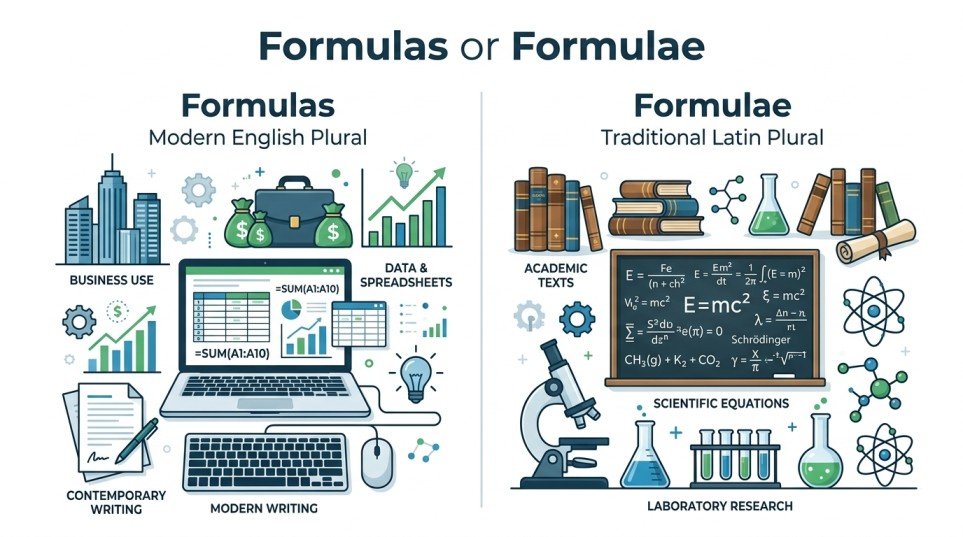
Quick Ans: The difference between formulas or formulae is mainly based on language style and usage. “Formulas” is the modern English plural of formula and is commonly used in everyday writing, mathematics, and science. “Formulae” is the traditional Latin plural and appears more often in academic, scientific, or formal contexts.
Many writers become confused about formulas or formulae because both words are technically correct. One appears modern and simple. The other sounds formal and traditional.
At first glance, the difference seems small. However, choosing the wrong form can make writing sound unnatural in certain situations.
For example, most business documents use “formulas.” Meanwhile, scientific papers may prefer “formulae.” Students, teachers, researchers, and content writers often wonder which version should appear in professional writing.
The confusion exists because the word “formula” comes from Latin. In Latin grammar, many nouns ending in “a” change to “ae” in plural form. English later adopted its own simpler plural version using “s.”
Understanding formulas or formulae helps improve grammar, academic writing, and communication clarity. It also helps you sound more natural depending on your audience.
This guide explains definitions, grammar rules, examples, common mistakes, comparisons, exercises, and usage tips from beginner to advanced level.
Quick Answer: Formulas or Formulae
The simplest answer is this:
| Word | Usage |
|---|---|
| Formulas | Modern English plural |
| Formulae | Traditional Latin plural |
In most situations, “formulas” is preferred in modern English. However, “formulae” still appears in scientific, mathematical, and academic writing.
Both forms are grammatically correct.
What Does “Formula” Mean?
A formula is a set rule, method, equation, or expression used to solve problems or explain something.
The word appears in several fields such as:
- Mathematics
- Chemistry
- Physics
- Business
- Writing
- Finance
Common Examples of Formula
Examples include:
- Math equations
- Scientific expressions
- Spreadsheet calculations
- Business strategies
For instance:
- The area formula for a rectangle is length × width.
- Scientists use chemical formulas in laboratories.
Because the word has many meanings, both plural forms became widely used.
What Is “Formulas”?
“Formulas” is the standard English plural form of formula.
Most modern English speakers use this version in:
- Everyday writing
- Schools
- Business communication
- Marketing
- Technology
Examples of “Formulas”
Here are common examples:
- Excel formulas help automate calculations.
- Teachers explained several math formulas.
- The company developed new marketing formulas.
In modern English, this version sounds more natural and conversational.
Why “Formulas” Became Popular
English grammar often simplifies foreign plural forms.
For example:
| Singular | Traditional Plural | Modern English Plural |
|---|---|---|
| Curriculum | Curricula | Curriculums |
| Stadium | Stadia | Stadiums |
| Formula | Formulae | Formulas |
As English evolved, regular “s” endings became more common.
What Is “Formulae”?
“Formulae” is the original Latin plural form of formula.
This version appears more often in:
- Academic journals
- Scientific writing
- Technical documents
- Formal mathematics discussions
Examples of “Formulae”
Consider these examples:
- The paper compared several chemical formulae.
- Ancient mathematical formulae influenced modern science.
- Researchers studied complex statistical formulae.
Although correct, “formulae” sounds more formal and specialized.
Why Some Professionals Prefer “Formulae”
Certain academic traditions preserve Latin plurals because they sound precise and scholarly.
As a result, researchers and scientists sometimes prefer “formulae” in professional publications.
Key Differences Between Formulas or Formulae
Language Style
The biggest difference between formulas or formulae is style.
“Formulas” sounds modern and natural. “Formulae” sounds formal and academic.
Audience
Audience matters greatly.
General readers usually expect “formulas.” Academic readers may encounter “formulae” more often.
Frequency of Usage
Modern English strongly favors “formulas.”
In contrast, “formulae” appears less frequently outside scientific fields.
Tone
“Formulas” creates a simple and approachable tone. Meanwhile, “formulae” creates a more scholarly tone.
Advantages and Disadvantages
Advantages of Using “Formulas”
- Easy to understand
- Common in modern English
- Suitable for general audiences
- Preferred in business writing
Disadvantages of Using “Formulas”
- May sound less formal in academic contexts
- Some scholars consider it less traditional
Advantages of Using “Formulae”
- Sounds academic and professional
- Matches traditional Latin grammar
- Common in scientific writing
Disadvantages of Using “Formulae”
- Can confuse general readers
- Sounds overly formal in casual writing
- Less common in everyday English
Therefore, context determines which version works best.
Real World Examples
In Schools
Teachers usually write “math formulas” on classroom boards because students understand the modern version more easily.
In Science Journals
Researchers may use “formulae” when discussing chemical equations or mathematical theories.
In Business Writing
Business professionals almost always use “formulas” because it sounds clearer and more modern.
In Software and Technology
Programs like Microsoft Excel use the word “formulas,” not “formulae.”
These examples show how audience and industry affect word choice.
Regional and Global Usage
American English
American English strongly prefers “formulas” in most situations.
British English
British English also commonly uses “formulas,” although “formulae” appears more frequently in academic writing.
Academic Communities
Universities and scientific institutions sometimes preserve Latin plurals like “formulae.”
Consequently, the formulas or formulae debate often depends on professional environment.
Related Concepts and Comparisons
Formula vs Equation
A formula shows relationships between values. An equation states that two expressions are equal.
Formula vs Function
A formula gives instructions or calculations. A function performs a specific operation in mathematics or programming.
Formulas vs Formulae Comparison Table
| Feature | Formulas | Formulae |
|---|---|---|
| Style | Modern English | Traditional Latin |
| Tone | Casual to professional | Formal and academic |
| Frequency | Very common | Less common |
| Best For | General writing | Scientific writing |
Understanding related grammar concepts makes the formulas or formulae distinction easier.
Common Mistakes About Formulas or Formulae
Assuming One Version Is Wrong
Many people think only one form is correct. In reality, both are grammatically acceptable.
Mixing Styles in One Document
Switching between “formulas” and “formulae” within the same article creates inconsistency.
Using “Formulae” in Casual Writing
Overly formal language can sound unnatural in blogs, emails, or marketing content.
Ignoring Audience Expectations
Academic readers may accept “formulae” comfortably. General readers often prefer “formulas.”
Avoiding these mistakes improves clarity and professionalism.
Beginner to Advanced Grammar Tips
Beginner Level
Use “formulas” in everyday writing because it sounds natural and widely accepted.
Intermediate Level
Learn audience expectations before choosing between formulas or formulae.
Advanced Level
Maintain consistent style throughout academic papers or professional publications.
Strong writers adapt word choice depending on context and tone.
Step By Step Usage Scenario
Imagine writing different documents.
If you are creating a school blog:
- Use simple language
- Choose “formulas”
- Keep tone conversational
If you are writing a scientific research paper:
- Follow academic style guide
- Consider using “formulae”
- Maintain formal consistency
The correct choice depends on audience and purpose.
Exercises With Answers
Exercise 1
Which plural form sounds more modern in everyday English?
Answer: Formulas.
Exercise 2
Which plural form comes from Latin grammar?
Answer: Formulae.
Exercise 3
Which version appears more often in scientific journals?
Answer: Formulae.
Exercise 4
Which form is common in business writing?
Answer: Formulas.
Exercise 5
True or False: Both “formulas” and “formulae” are grammatically correct.
Answer: True.
When Should You Use Formulas or Formulae?
Use “formulas” when:
- Writing for general readers
- Creating business content
- Writing blogs or websites
- Teaching beginners
Use “formulae” when:
- Writing academic papers
- Publishing scientific research
- Following formal style traditions
The audience and writing style should guide your decision.
FAQs About Formulas or Formulae
What is the difference between formulas or formulae?
The difference is mainly style. “Formulas” is the modern English plural, while “formulae” is the traditional Latin plural.
Is formulae grammatically correct?
Yes. “Formulae” is completely correct and commonly used in academic and scientific writing.
Which is more common, formulas or formulae?
“Formulas” is far more common in modern English.
Should I use formulas or formulae in business writing?
Business writing usually prefers “formulas” because it sounds more natural and accessible.
Why do scientists use formulae?
Scientists sometimes use “formulae” because academic traditions preserve Latin plural forms.
Can I use both formulas and formulae in the same document?
Consistency is important. Choose one style and use it throughout the document.
Does Microsoft Excel use formulas or formulae?
Microsoft Excel uses the term “formulas.”
Is formulae old fashioned?
Not exactly. However, it sounds more formal and traditional than “formulas.”
Do universities prefer formulae?
Some academic departments prefer “formulae,” especially in scientific fields.
Which version should students use?
Most students can safely use “formulas” unless a teacher or style guide requests otherwise.
Conclusion
Understanding formulas or formulae helps writers choose the right tone for different audiences. Both words are correct, but they serve different stylistic purposes.
“Formulas” is the modern English plural and appears most often in schools, business writing, websites, and everyday communication. Because it sounds natural and simple, it works well for general audiences.
“Formulae,” on the other hand, preserves the traditional Latin plural form. Academic writers, researchers, and scientists sometimes prefer it in formal contexts.
The best choice depends on audience expectations and writing style. For most situations, “formulas” is the safer and more widely accepted option. However, “formulae” remains appropriate in specialized academic environments.
By understanding the distinction between formulas or formulae, you can write more clearly, professionally, and confidently.
Discover More:-
- Mathew or Matthew: Correct Spelling, Meaning, and Key Differences
- Shiesty or Sheisty: Correct Spelling, Meaning, and Usage Explained

Robert Mitchell is a U.S.-based writer at Gramtivo.Com who focuses on grammar, writing improvement, and language-related content. He holds a degree in English and Linguistics from a U.S. university. His work aims to help readers enhance their writing skills with clear and practical guidance.