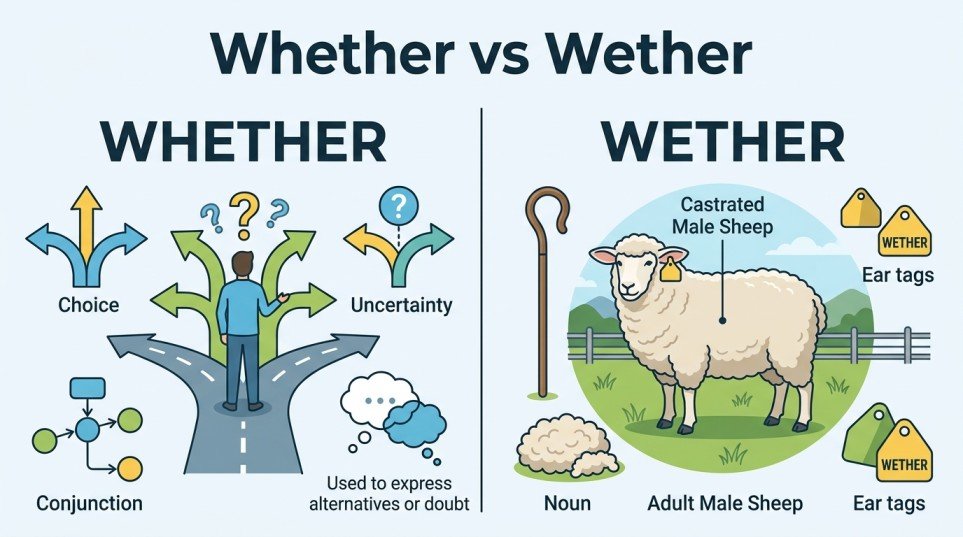
Quick Ans: The difference between whether or wether is simple but important. Whether is a common English conjunction used to express a choice, possibility, or uncertainty, while wether is a noun that refers to a castrated male sheep. Most people mean whether, but spelling mistakes often cause confusion.
Many English learners and native speakers search for whether or wether because the two words look almost identical. Their pronunciation is very similar. However, their meanings are completely different.
One word appears in everyday writing, conversations, emails, and academic work. The other belongs mainly to farming and livestock vocabulary.
Because only one letter separates them, many writers accidentally use the wrong spelling. Spell-check tools may not always catch the mistake because both words are technically correct English words.
As a result, understanding the difference between whether or wether is essential for clear communication. Using the wrong word can make a sentence confusing or even change its meaning entirely.
This guide explains everything you need to know. You will learn definitions, meanings, examples, common mistakes, grammar rules, practical exercises, and helpful memory tricks. By the end, you will confidently know when to use whether and when to use wether.
Quick Answer: Whether or Wether
The easiest way to understand whether or wether is to remember their meanings.
| Word | Part of Speech | Meaning |
|---|---|---|
| Whether | Conjunction | Expresses alternatives, choices, or uncertainty |
| Wether | Noun | A castrated male sheep |
Examples:
- I don’t know whether it will rain.
- The farmer sold a wether at the livestock market.
In everyday English, whether is used far more often than wether.
What Does Whether Mean?
Whether is a conjunction used to introduce alternatives, possibilities, or uncertainty.
Writers use it when discussing choices between two or more options.
Common Uses of Whether
Whether often appears when:
- Presenting alternatives
- Expressing uncertainty
- Asking indirect questions
- Discussing possibilities
Examples:
- I am not sure whether she will attend.
- Tell me whether you agree.
- We need to decide whether to stay or leave.
- Nobody knows whether the plan will succeed.
In each example, the word introduces uncertainty or a choice.
Whether in Questions
Whether commonly appears in indirect questions.
Examples:
- He asked whether I was ready.
- She wondered whether the package had arrived.
- They discussed whether the project was practical.
Because indirect questions are common in business and academic writing, whether appears frequently in professional communication.
What Does Wether Mean?
A wether is a castrated male sheep.
The word belongs to agricultural and livestock terminology. Most people rarely encounter it unless they work with farming, animal husbandry, or veterinary care.
Examples:
- The farmer separated the wether from the flock.
- Several wethers were sold at the livestock auction.
- The veterinarian examined the young wether.
Unlike whether, this word has a very specific meaning.
Why Farmers Use the Term
Farmers use the term because different sheep categories have different management needs.
For example:
- Ram = uncastrated male sheep
- Ewe = female sheep
- Lamb = young sheep
- Wether = castrated male sheep
Therefore, the word serves an important purpose in livestock management.
Key Differences Between Whether or Wether
Meaning
The biggest difference between whether or wether is meaning.
Whether relates to choices and uncertainty.
Wether refers to a type of sheep.
Usage Frequency
Whether appears daily in spoken and written English.
Wether appears mostly in farming contexts.
Part of Speech
Whether functions as a conjunction.
Wether functions as a noun.
Context
Whether belongs in grammar and communication.
Wether belongs in agriculture and livestock discussions.
Comparison Table: Whether vs Wether
| Feature | Whether | Wether |
|---|---|---|
| Meaning | Choice or uncertainty | Castrated male sheep |
| Word Type | Conjunction | Noun |
| Common Usage | Very common | Rare |
| Used in Writing | Frequently | Occasionally |
| Used in Farming | Rarely | Frequently |
This table makes the whether or wether comparison easy to remember.
Advantages and Disadvantages
Advantages of Using Whether Correctly
- Improves grammar accuracy
- Creates clearer communication
- Enhances professional writing
- Prevents misunderstandings
Disadvantages of Using Whether Incorrectly
- Confuses readers
- Reduces credibility
- Creates grammatical errors
- Changes sentence meaning
Advantages of Knowing Wether
- Expands vocabulary
- Improves agricultural knowledge
- Helps understand farming texts
- Prevents spelling mistakes
Disadvantages of Confusing Wether With Whether
- Produces awkward sentences
- Causes writing errors
- Makes professional documents look unpolished
Therefore, learning the distinction between whether or wether is worthwhile.
Real World Examples
Business Email
Correct:
- Please confirm whether you can attend the meeting.
Incorrect:
- Please confirm wether you can attend the meeting.
The second sentence contains a spelling mistake.
School Assignment
Correct:
- Scientists debated whether the theory was valid.
Using wether here would make no sense.
Farming Conversation
Correct:
- The farmer purchased a healthy wether.
In this case, using whether would be incorrect.
Online Communication
Many spelling errors involving whether or wether happen in emails, text messages, and social media posts because the words look so similar.
Regional and Global Usage
English-Speaking Countries
The word whether appears regularly in:
- United States
- United Kingdom
- Canada
- Australia
- New Zealand
It is an essential part of standard English.
Agricultural Communities
The word wether appears most often in:
- Farming publications
- Livestock reports
- Veterinary resources
- Agricultural training materials
Consequently, many people never encounter the word outside agricultural settings.
Related Concepts and Comparisons
Whether vs If
Many people confuse whether and if.
Examples:
- I don’t know whether he is coming.
- I don’t know if he is coming.
Both are often acceptable.
However, whether is generally preferred when discussing alternatives.
Example:
- We must decide whether to stay or leave.
Whether vs Weather
Another common confusion involves whether and weather.
Examples:
- I don’t know whether it will rain.
- The weather looks cloudy today.
The meanings are completely different.
Wether vs Ram
In sheep terminology:
- Ram = uncastrated male sheep
- Wether = castrated male sheep
Farmers use these terms for accurate livestock identification.
Common Mistakes About Whether or Wether
Using Wether Instead of Whether
This is the most common mistake.
Incorrect:
- I don’t know wether he called.
Correct:
- I don’t know whether he called.
Assuming Wether Is a Misspelling
Many people think wether is not a real word.
In reality, it is a legitimate English noun.
Relying Only on Spell Check
Because both words exist in English dictionaries, spell check tools may not flag the error.
Therefore, proofreading remains important.
Confusing Whether With Weather
Many beginners accidentally mix up all three words:
- Whether
- Wether
- Weather
Learning their meanings prevents mistakes.
Beginner to Advanced Usage Tips
Beginner Level
Remember this simple rule:
If the sentence discusses a choice or uncertainty, use whether.
Intermediate Level
Look for phrases such as:
- Whether or not
- Whether to
- Whether there is
These almost always require whether.
Advanced Level
Study formal writing and academic texts.
You will notice that professional writers often prefer whether over if when presenting alternatives.
Step By Step Identification Method
When deciding between whether or wether, follow these steps:
Step 1
Ask yourself if the sentence discusses a choice.
Step 2
If the answer is yes, use whether.
Step 3
If the sentence discusses sheep, consider wether.
Step 4
Review the sentence for context.
Step 5
Proofread before publishing or sending.
This method prevents most errors.
Memory Tricks for Whether and Wether
Trick One
The word whether contains the letters “h-e”, similar to the word choice containing multiple options. Use it when discussing alternatives.
Trick Two
The word wether contains “ewe” sounds when spoken. Since a ewe is a sheep, this association may help you remember the livestock meaning.
Trick Three
If your sentence has nothing to do with sheep, the correct word is probably whether.
These simple tricks help many learners avoid confusion.
Exercises With Answers
Exercise 1
Choose the correct word:
I don’t know ______ she will arrive today.
Answer: whether
Exercise 2
Choose the correct word:
The farmer purchased a young ______.
Answer: wether
Exercise 3
Which word expresses uncertainty?
Answer: whether
Exercise 4
Which word refers to a castrated male sheep?
Answer: wether
Exercise 5
True or False: Whether and wether have the same meaning.
Answer: False.
When Should You Use Whether or Wether?
Use whether when:
- Discussing choices
- Expressing uncertainty
- Asking indirect questions
- Presenting alternatives
Use wether when:
- Discussing sheep
- Reading farming materials
- Writing agricultural reports
- Referring to livestock management
Context determines the correct choice.
FAQs About Whether or Wether
What is the difference between whether or wether?
Whether is a conjunction that expresses uncertainty or alternatives. Wether is a noun meaning a castrated male sheep.
Is wether a real word?
Yes. Wether is a legitimate English word used mainly in farming and livestock contexts.
Which word should I use in everyday writing?
Most of the time, you will use whether rather than wether.
Why do people confuse whether and wether?
The words look and sound very similar, making spelling mistakes common.
Can wether replace whether?
No. Their meanings are completely different.
What part of speech is whether?
Whether is a conjunction.
What part of speech is wether?
Wether is a noun.
Is whether used in formal writing?
Yes. Whether appears frequently in academic, business, and professional writing.
What does a wether sheep mean?
A wether is a male sheep that has been castrated.
How can I remember whether or wether?
Remember that whether relates to choices and uncertainty. Wether relates to sheep and farming.
Conclusion
Understanding whether or wether is important because the two words have completely different meanings despite their similar appearance. One belongs to everyday English grammar, while the other belongs to livestock terminology.
Whether is a conjunction used to introduce alternatives, possibilities, or uncertainty. It appears frequently in conversations, emails, business documents, and academic writing. Wether, by contrast, refers to a castrated male sheep and is used mainly in farming contexts.
Many spelling mistakes occur because both words are valid English terms. As a result, automatic spell check tools may not always detect the error. Careful proofreading remains essential.
A simple rule can help: if your sentence involves choices, options, or uncertainty, use whether. If the discussion involves sheep, use wether.
By remembering this distinction and practicing with examples, you can avoid one of the most common English spelling mistakes and communicate more clearly in both personal and professional writing.
Discover More:-
- Truely or Truly: Which Spelling Is Correct and Why?
- Desert or Dessert: Difference, Meaning, Examples, and Easy Memory Tricks

Lisa Thompson is a USA-based content writer and language specialist focused on grammar, writing improvement and digital publishing.
She holds a degree in English Language and Communication and has professional experience in educational and web content creation.
As the author of Gramtivo.Com, she aims to help readers improve their writing skills through clear and practical guidance.