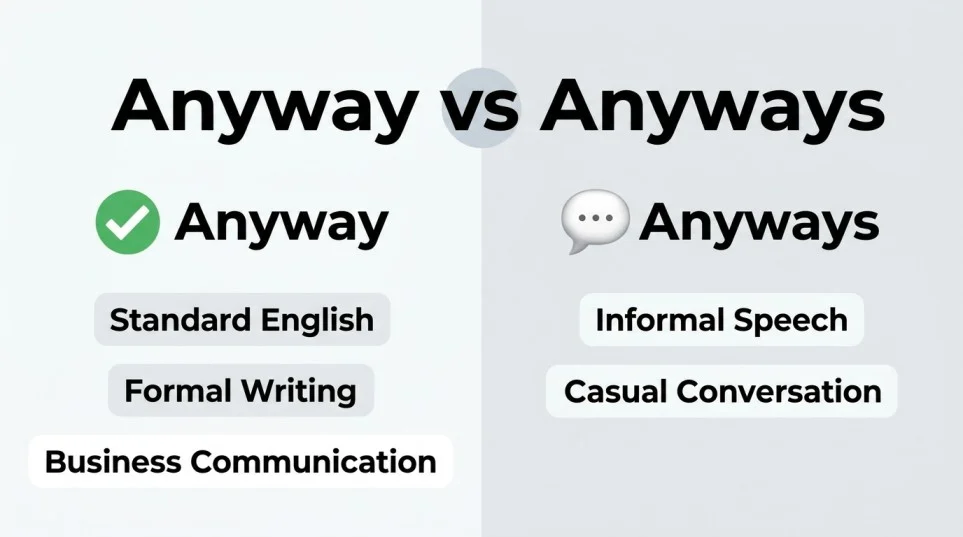
Quick Ans: The main difference between anyway or anyways is usage and formality. Anyway is the standard and widely accepted word in formal and professional English, while anyways is an informal variation commonly used in casual conversation. Although both often mean the same thing, anyway is usually the safer choice for writing.
Many English learners and native speakers wonder about anyway or anyways. The two words look almost identical. They sound nearly the same as well. Because of this similarity, people often assume they are interchangeable in every situation.
However, there is more to the story.
One version is considered standard English. The other is generally viewed as informal speech. Choosing the wrong one may not cause a major misunderstanding, but it can affect how professional your writing appears.
For example, a casual text message to a friend may sound perfectly natural with “anyways.” A business email, academic paper, or professional report usually calls for “anyway” instead.
Understanding the difference between anyway or anyways helps improve communication, writing quality, and grammatical accuracy. It also allows you to adapt your language to different audiences and situations.
In this guide, you will learn definitions, meanings, usage rules, advantages and disadvantages, common mistakes, examples, exercises, and practical tips. By the end, you will know exactly when to use each word.
Quick Answer: Anyway or Anyways
If you need a simple answer, choose anyway in most situations.
| Feature | Anyway | Anyways |
|---|---|---|
| Standard English | Yes | Usually No |
| Formal Writing | Recommended | Not Recommended |
| Academic Writing | Accepted | Avoid |
| Business Communication | Preferred | Avoid |
| Casual Conversation | Common | Common |
| Meaning | Standard usage | Informal variation |
In short, anyway is the standard form. Meanwhile, anyways is an informal alternative that appears mainly in spoken English and casual writing.
What Does “Anyway” Mean?
Anyway is an adverb that serves several functions in English. It often means:
- Regardless
- In any case
- Moving to another topic
- Returning to the main point
Because it has multiple uses, it appears frequently in everyday communication.
Examples of Anyway
Consider these examples:
- I was tired, but I went to work anyway.
- Anyway, let’s continue the meeting.
- The weather looked bad. We traveled anyway.
- Anyway, what were we discussing?
In each sentence, “anyway” helps connect ideas or shift the conversation smoothly.
Why Anyway Is Preferred
Grammar guides and dictionaries generally recognize anyway as the standard form. Therefore, it works well in:
- Essays
- Reports
- Emails
- Articles
- Business communication
- Academic writing
As a result, writers often choose “anyway” when they want a professional tone.
What Does “Anyways” Mean?
Anyways usually carries the same meaning as anyway. The difference is primarily stylistic rather than grammatical.
Many native speakers use “anyways” during casual conversations. The extra “s” does not significantly change the meaning.
Examples of Anyways
Here are some common examples:
- Anyways, let’s get back to work.
- I wasn’t interested anyways.
- Anyways, what happened next?
- We finished the project anyways.
Although these sentences sound natural in conversation, many editors would replace “anyways” with “anyway” in formal writing.
Why People Use Anyways
Several factors contribute to the popularity of “anyways”:
- Regional speech patterns
- Informal communication
- Conversational habits
- Personal preference
Consequently, the word remains common despite being less formal.
Key Differences Between Anyway or Anyways
Formality
The biggest difference between anyway or anyways is formality.
“Anyway” is appropriate in formal and informal situations. In contrast, “anyways” is mainly suitable for casual settings.
Professional Acceptance
Most style guides accept “anyway” without hesitation. However, many professional editors discourage the use of “anyways.”
Perception
Using “anyway” often creates a polished impression. On the other hand, “anyways” may sound conversational or regional.
Writing Versus Speaking
In writing, “anyway” is generally preferred. During everyday speech, both forms are common.
Historical Background of Anyway and Anyways
Interestingly, “anyways” is not a modern invention.
Historical records show that variations of the word appeared centuries ago. Nevertheless, language standards gradually favored “anyway” as the accepted form.
Over time, dictionaries continued recognizing “anyway” as standard English. Meanwhile, “anyways” became associated with informal speech.
Today, both forms exist. However, they serve different stylistic purposes.
Advantages and Disadvantages
Advantages of Using Anyway
- Accepted in formal writing
- Recommended by style guides
- Suitable for business communication
- Works in academic settings
- Universally understood
Disadvantages of Using Anyway
- May sound slightly more formal in casual conversation
- Some speakers prefer the informal feel of “anyways”
Advantages of Using Anyways
- Common in casual speech
- Sounds conversational
- Frequently used in informal settings
Disadvantages of Using Anyways
- Often viewed as nonstandard
- Not ideal for academic writing
- Can appear unprofessional
- Some editors remove it during proofreading
Because of these factors, many writers default to “anyway.”
Real World Examples
Business Email
Professional version:
“Anyway, I wanted to follow up regarding the proposal.”
Less professional version:
“Anyways, I wanted to follow up regarding the proposal.”
Most business professionals would choose the first sentence.
Text Message
Friend 1: “The movie was canceled.”
Friend 2: “Anyways, let’s get dinner.”
In casual texting, “anyways” feels natural.
Academic Essay
Correct:
“Anyway is commonly accepted in formal English.”
Avoid:
“Anyways is commonly accepted in formal English.”
Academic writing favors the standard form.
Regional and Global Usage
United States
Both forms appear in American English. However, “anyway” remains the preferred standard.
United Kingdom
British English strongly favors “anyway” in formal and informal writing.
Canada
Canadian English generally follows the same pattern as American English.
Other English Speaking Countries
Countries such as Australia and New Zealand also tend to prefer “anyway” in published writing.
Therefore, the global preference leans toward “anyway.”
Related Concepts and Comparisons
Anyway vs Any Way
These expressions are different.
Examples:
- Anyway, let’s continue.
- Is there any way to solve this problem?
“Anyway” functions as an adverb. “Any way” refers to a method or manner.
Anyway vs Nonetheless
Both can indicate contrast.
Examples:
- The weather was bad. We went anyway.
- The weather was bad. Nonetheless, we went.
However, “nonetheless” sounds more formal.
Anyway vs Regardless
Both can mean “despite circumstances.”
Examples:
- I went anyway.
- I went regardless.
The meaning is similar, but sentence structure differs.
Common Mistakes About Anyway or Anyways
Using Anyways in Formal Writing
Many writers use “anyways” in professional documents. Editors often replace it with “anyway.”
Confusing Anyway With Any Way
These expressions have different meanings.
Incorrect:
- Anyway can I help?
Correct:
- Any way I can help?
Assuming Anyways Is Always Wrong
Although some people criticize it, “anyways” is not always incorrect. It simply belongs more naturally in informal contexts.
Overusing Either Word
Repeating “anyway” or “anyways” too frequently can make writing sound repetitive.
Instead, consider alternatives such as:
- Regardless
- In any case
- Nevertheless
- Still
Beginner to Advanced Usage Tips
Beginner Level
Use anyway whenever you are unsure.
Intermediate Level
Recognize that “anyways” works best in casual conversations and personal messages.
Advanced Level
Match the word to the audience and tone. Formal communication usually requires “anyway.” Informal dialogue may benefit from the conversational feel of “anyways.”
Developing this awareness improves overall writing style.
Step By Step Decision Guide
Imagine you are writing a sentence and need to choose between anyway or anyways.
Ask yourself:
- Is this formal writing?
- Is this a business document?
- Is this an academic assignment?
- Is this casual conversation?
If the answer is yes to any of the first three questions, choose anyway.
If the communication is purely informal, anyways may also work.
This simple process prevents most usage mistakes.
Exercises With Answers
Exercise 1
Which word is preferred in professional writing?
Answer: Anyway.
Exercise 2
Which version is generally considered informal?
Answer: Anyways.
Exercise 3
Choose the correct sentence:
A. Anyways, I am writing regarding the contract.
B. Anyway, I am writing regarding the contract.
Answer: B.
Exercise 4
True or False: Anyway and anyways always have different meanings.
Answer: False.
Exercise 5
Which word should you normally use in academic essays?
Answer: Anyway.
When Should You Choose Anyway or Anyways?
Choose anyway when you:
- Write emails
- Create reports
- Submit assignments
- Publish articles
- Communicate professionally
Choose anyways when you:
- Chat with friends
- Send casual text messages
- Write informal dialogue
- Mimic conversational speech
For most writers, “anyway” remains the safest option.
FAQs About Anyway or Anyways
What is the difference between anyway or anyways?
The main difference is formality. Anyway is the standard form, while anyways is an informal variation.
Is anyways grammatically correct?
Yes, many dictionaries recognize it. However, it is usually considered informal.
Which is better, anyway or anyways?
Anyway is generally better because it works in both formal and informal situations.
Can I use anyways in an essay?
Most teachers and editors recommend using anyway instead.
Do native speakers say anyways?
Yes. Many native speakers use anyways in everyday conversation.
Is anyways wrong in professional writing?
It is not necessarily wrong, but anyway is usually the preferred choice.
Why do people use anyways instead of anyway?
Habit, regional speech patterns, and conversational style often influence the choice.
Is anyway more formal than anyways?
Yes. Anyway is considered the more formal and standard version.
Are anyway and anyways interchangeable?
In many situations they have the same meaning. However, formality makes a difference.
Which version should English learners use?
English learners should primarily use anyway because it is accepted in all writing contexts.
Conclusion
The debate over anyway or anyways is less about meaning and more about style. Both words generally communicate the same idea. However, their level of formality differs significantly.
Anyway is the standard form recognized in professional, academic, and business writing. Because it works in nearly every situation, it remains the safest and most widely recommended choice.
Anyways continues to appear in everyday speech and casual communication. Many native speakers use it naturally during conversations. Even so, editors and teachers often prefer the standard version when reviewing written work.
Choosing the correct word depends on your audience. Formal communication almost always calls for “anyway.” Casual conversations allow greater flexibility.
When in doubt, use anyway. Doing so ensures your writing appears polished, professional, and grammatically appropriate across all contexts.
Discover More:-
- Stretcher vs Gurney: Key Differences, Uses, and Medical Comparison Guide
- Balcony vs Patio: Differences, Uses, and Outdoor Space Guide

Jennifer Collins is a professional grammar expert and language educator at gramtivo.com, specializing in English grammar, writing skills, and language improvement. She holds a Master’s degree in English Language and Literature from a recognized university in the United States. With years of teaching and content development experience, she is dedicated to helping learners improve their communication skills with clear and practical guidance.