
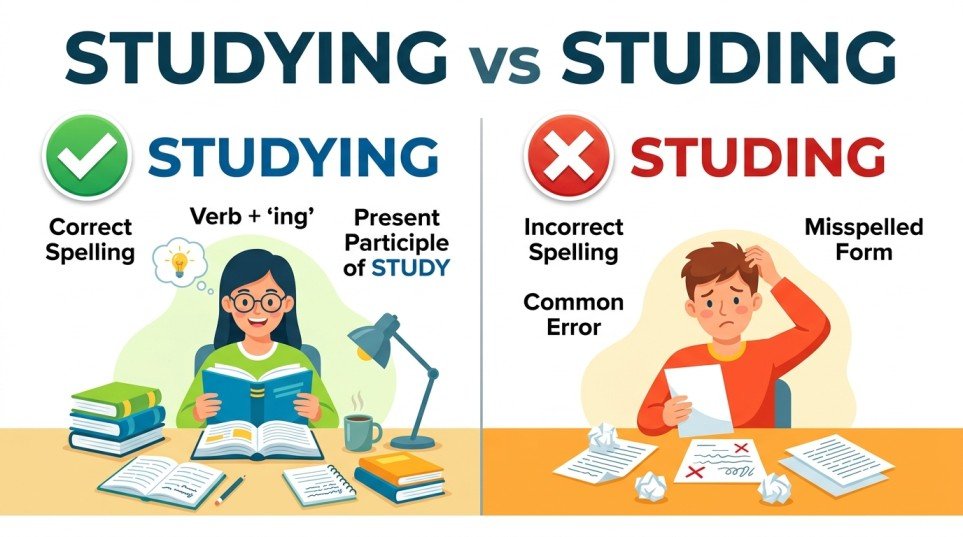
Quick Ans: The correct spelling is studying, not studing. The word “studying” follows English spelling rules because the verb “study” changes the letter “y” to “i” before adding “ing.” “Studing” is a spelling mistake and is not considered correct English.
Many English learners search for studying or studing because the two spellings look similar. One version appears simple, while the other seems longer and slightly confusing.
However, only one spelling is correct.
English spelling rules can sometimes feel difficult. Words ending in “y” often change when adding endings like “ing,” “ed,” or “es.” Because of this, students frequently make mistakes while writing essays, emails, homework, or social media posts.
For example, some people write “I am studing for my exam” because they think removing the “y” makes the word shorter and easier. In reality, English grammar follows a specific spelling pattern.
Understanding the difference between studying or studing helps improve writing accuracy, grammar skills, and professional communication. It also prevents common spelling mistakes in school and workplace writing.
This guide explains everything clearly and simply. You will learn spelling rules, examples, common mistakes, exercises, grammar tips, and real world usage.
Quick Answer: Studying or Studing
The correct spelling is studying.
| Word | Correct or Incorrect |
|---|---|
| Studying | Correct |
| Studing | Incorrect |
The verb “study” keeps the “y” when adding “ing.”
Correct example:
- I am studying English today.
Incorrect example:
- I am studing English today.
Therefore, always use studying in formal and informal writing.
What Does “Studying” Mean?
The word studying is the present participle form of the verb “study.”
It means:
- Learning something
- Reading for education
- Practicing a subject
- Gaining knowledge
People use “studying” in schools, universities, libraries, and workplaces.
Common Examples of Studying
Here are simple examples:
- She is studying math.
- They are studying science.
- We are studying for the test.
- He spends hours studying every night.
In each sentence, “studying” describes the action of learning.
Why “Studing” Is Incorrect
The spelling studing breaks English spelling rules.
The original word is “study.” When adding “ing,” English usually keeps the “y” in words ending with a consonant plus “y.”
Correct transformation:
- Study → Studying
Incorrect transformation:
- Study → Studing
Because of this rule, “studing” is always considered a spelling error.
English Spelling Rule Behind Studying
Understanding the grammar rule makes the difference between studying or studing much easier.
Rule for Words Ending in “Y”
When a verb ends in consonant + “y,” the “y” usually stays before adding “ing.”
Examples include:
| Base Word | Correct ING Form |
|---|---|
| Study | Studying |
| Carry | Carrying |
| Cry | Crying |
| Hurry | Hurrying |
Notice that the “y” remains in every example.
Why Confusion Happens
Some learners confuse “ing” rules with plural or past tense rules.
For example:
- Study → Studies
- Study → Studied
In these forms, the “y” changes to “i.”
However, the rule changes when adding “ing.”
That is why the correct spelling becomes “studying.”
Examples of Studying in Sentences
Everyday Examples
- I am studying English grammar tonight.
- She enjoys studying history.
- They are studying together at the library.
- We were studying before dinner.
Academic Examples
- College students spend many hours studying for exams.
- Effective studying improves long term memory.
- Online studying has become more common worldwide.
Workplace Examples
- Employees are studying new software systems.
- Medical interns spend years studying healthcare practices.
These examples show how commonly the word appears in daily communication.
Differences Between Studying and Other Forms of Study
| Word | Usage |
|---|---|
| Study | Base verb |
| Studying | Present participle |
| Studied | Past tense |
| Studies | Third person singular |
Examples
- I study every morning.
- She is studying right now.
- They studied yesterday.
- He studies science.
Understanding these forms helps avoid confusion between studying or studing.
Advantages of Correct Spelling
Better Academic Writing
Correct spelling improves essays, homework, and assignments.
Professional Communication
Employers notice grammar mistakes in emails and resumes.
Improved English Skills
Learning proper spelling builds stronger grammar knowledge.
Greater Confidence
Writers feel more confident when using correct English.
Therefore, understanding studying or studing supports better communication overall.
Common Mistakes About Studying or Studing
Removing the “Y”
Many learners mistakenly remove the “y” before adding “ing.”
Incorrect:
- Studing
Correct:
- Studying
Mixing Past Tense Rules With ING Rules
Some people think all endings follow the same pattern. However, “studied” and “studying” use different spelling rules.
Typing Too Quickly
Fast typing often causes spelling mistakes. Proofreading helps prevent errors.
Relying Only on Pronunciation
Both spellings sound similar when spoken. Because of this, learners sometimes choose the wrong spelling while writing.
Avoiding these mistakes improves grammar accuracy.
Real World Usage
In School
Teachers expect students to spell “studying” correctly in assignments and exams.
In Emails
Professional emails should always use proper spelling.
Correct example:
- I am studying the project materials today.
On Social Media
Many users accidentally type “studing” online. However, the correct spelling remains “studying.”
In Search Engines
People frequently search “studying or studing” because they want to confirm the correct spelling.
Regional and Global Usage
American English
American English uses the spelling “studying.”
British English
British English also uses “studying.”
International English Learning
Students worldwide learn this spelling rule early in English education.
As a result, “studying” is universally accepted across English speaking countries.
Related Concepts and Comparisons
Studying vs Learning
Studying refers to focused educational effort. Learning can happen through experience or observation.
Studying vs Reading
Reading is one activity used during studying. However, studying may also include writing notes and practicing skills.
Studying vs Practicing
Studying focuses on gaining knowledge. Practicing focuses on improving ability through repetition.
These related concepts help learners better understand educational vocabulary.
Beginner to Advanced Grammar Tips
Beginner Level
Remember this simple rule:
- Keep the “y” when adding “ing.”
Intermediate Level
Practice spelling transformations:
- Cry → Crying
- Carry → Carrying
- Study → Studying
Advanced Level
Learn the difference between “ing,” “ed,” and plural forms.
Examples:
- Study → Studying
- Study → Studied
- Study → Studies
This deeper understanding improves overall grammar accuracy.
Step By Step Spelling Scenario
Suppose you want to write about preparing for an exam.
Start with the base word:
- Study
Next, add “ing.”
Correct result:
- Studying
Incorrect result:
- Studing
Following this process helps prevent spelling mistakes.
Exercises With Answers
Exercise 1
Which spelling is correct?
- Studying
- Studing
Answer: Studying.
Exercise 2
Complete the sentence:
“She is ______ for her science exam.”
Answer: Studying.
Exercise 3
True or False:
“Studing” is correct English spelling.
Answer: False.
Exercise 4
Which spelling follows English grammar rules?
Answer: Studying.
Exercise 5
Write the ING form of “study.”
Answer: Studying.
When Should You Use “Studying”?
Use “studying” when describing ongoing learning or educational activity.
Examples include:
- I am studying mathematics.
- They are studying at the library.
- She spends evenings studying.
Because “studing” is incorrect, it should never appear in formal writing.
FAQs About Studying or Studing
Which is correct, studying or studing?
The correct spelling is “studying.” “Studing” is incorrect.
Why is studying spelled with a Y?
English spelling rules keep the “y” when adding “ing” to verbs ending in consonant + y.
Is studing ever correct in English?
No. “Studing” is always considered a spelling mistake.
How do you spell studying for exams?
The correct spelling is “studying.”
Why do people write studing instead of studying?
Many learners mistakenly remove the “y” because they confuse different grammar rules.
Is studying used in both American and British English?
Yes. Both forms of English use “studying.”
What part of speech is studying?
“Studying” is the present participle form of the verb “study.”
Can studying be used as a noun?
Yes. Example: “Studying improves memory.”
How can I avoid spelling mistakes like studing?
Practice grammar rules and proofread your writing carefully.
Is studying important for academic success?
Yes. Consistent studying improves understanding, memory, and exam performance.
Conclusion
Understanding the difference between studying or studing is simple once you know the spelling rule. The correct form is always “studying.” The spelling “studing” is incorrect and should never be used in formal or academic writing.
The confusion happens because English changes some words differently when adding endings like “ed,” “es,” or “ing.” However, verbs ending in consonant + “y” keep the “y” before adding “ing.”
Correct spelling improves communication, academic writing, and professional credibility. It also helps English learners feel more confident while writing emails, essays, and assignments.
Whenever you write about learning, preparing for exams, or reading educational material, remember to use “studying.”
With regular practice and proofreading, avoiding this spelling mistake becomes easy.
Discover More:-

Lisa Thompson is a USA-based content writer and language specialist focused on grammar, writing improvement and digital publishing.
She holds a degree in English Language and Communication and has professional experience in educational and web content creation.
As the author of Gramtivo.Com, she aims to help readers improve their writing skills through clear and practical guidance.