
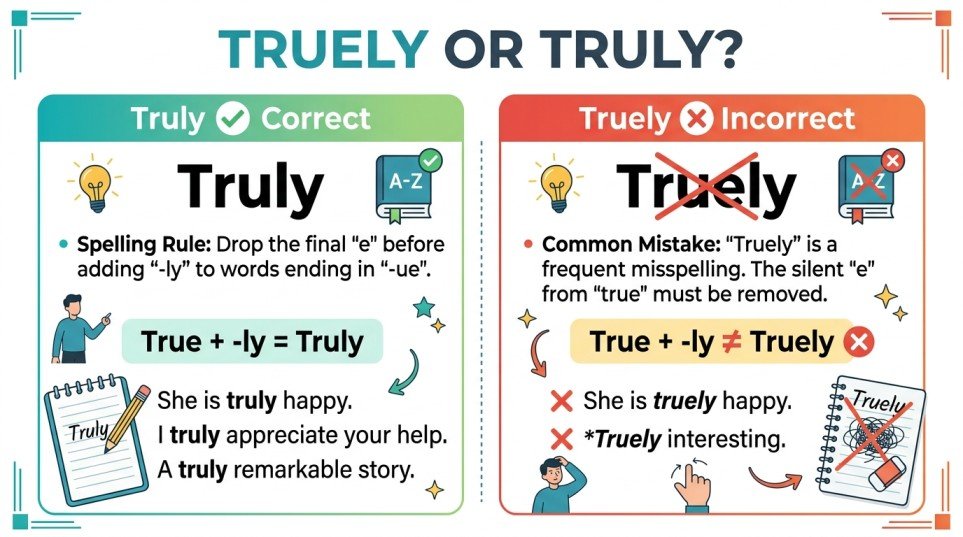
Quick Ans: The correct spelling is truly, not truely. The word truly is the standard English adverb meaning “in a truthful, genuine, or sincere way.” Although many people mistakenly write truely, it is considered a spelling error in modern English.
Many English learners and native speakers search for truely or truly because the spelling seems confusing. After all, the adjective true ends with the letter e, so it feels natural to add ly and write truely.
However, English does not follow that pattern in this case.
The correct form is truly, with the e removed before adding ly. As a result, truely is considered a misspelling and should be avoided in academic, professional, and everyday writing.
This mistake appears frequently in emails, social media posts, blog articles, and even business documents. Therefore, understanding the difference between truely or truly is important for clear communication and strong writing skills.
In this guide, you will learn the correct spelling, grammar rules, common mistakes, examples, memory tricks, real world usage, and practice exercises. By the end, you will confidently know when and how to use truly correctly.
Quick Answer: Truely or Truly
If you are wondering whether to write truely or truly, the answer is simple.
| Word | Correct? |
|---|---|
| Truly | ✅ Yes |
| Truely | ❌ No |
The correct spelling is truly.
Correct Examples
- I truly appreciate your help.
- She is truly talented.
- We are truly grateful for your support.
Incorrect Examples
- I truely appreciate your help.
- She is truely talented.
- We are truely grateful.
Whenever you face the choice between truely or truly, choose truly.
What Does Truly Mean?
Truly is an adverb. It describes how something is done or emphasizes sincerity, truthfulness, or genuineness.
Definition of Truly
The word truly means:
- In a truthful manner
- Genuinely
- Honestly
- Sincerely
- Accurately
Example Sentences
- I truly enjoyed the movie.
- She truly cares about her students.
- This is truly an amazing opportunity.
- They are truly committed to excellence.
In each example, truly strengthens the meaning of the sentence.
Why Is Truly Correct Instead of Truely?
This is the part that causes confusion.
Many people assume the word should become truely because it comes from true. However, English spelling rules create an exception here.
The Rule
For some words ending in e, the final e is dropped before adding ly.
Example:
| Adjective | Adverb |
|---|---|
| True | Truly |
| Due | Duly |
| Whole | Wholly |
Because of this rule, true + ly becomes truly, not truely.
Why People Make This Mistake
The mistake happens because writers apply a logical but incorrect pattern.
For example:
- Safe → Safely
- Wise → Wisely
- Extreme → Extremely
Since many words keep the e, people expect true to follow the same pattern.
However, English contains many exceptions, and truly is one of them.
The History of Truly
The word truly has existed in English for centuries. It comes from the adjective true, which originally referred to faithfulness, accuracy, and honesty.
Over time, truly developed as the accepted adverb form.
Meanwhile, truely never became a standard spelling. Although it occasionally appears in old writings or personal mistakes, dictionaries and style guides recognize truly as the correct version.
Consequently, modern English treats truely as an error.
Key Differences Between Truely or Truly
Spelling
The most important difference is spelling.
- Truly = Correct
- Truely = Incorrect
Dictionary Acceptance
Major dictionaries recognize truly.
No respected dictionary lists truely as the preferred spelling.
Professional Writing
Professional documents should always use truly.
Using truely may create a negative impression and suggest weak proofreading.
Search Engine Recognition
Grammar tools and spell checkers automatically flag truely as a spelling mistake.
Therefore, writers should always choose truly.
Advantages and Disadvantages
Advantages of Using Truly
- Grammatically correct
- Accepted worldwide
- Suitable for formal writing
- Improves credibility
- Recognized by dictionaries
Disadvantages of Using Truly
- None when used correctly
Advantages of Using Truely
There are no grammatical advantages.
Disadvantages of Using Truely
- Incorrect spelling
- May reduce credibility
- Creates confusion
- Flagged by spell check software
As a result, there is no practical reason to use truely.
Real World Examples
Business Email
Correct:
We truly appreciate your partnership.
Incorrect:
We truely appreciate your partnership.
The correct version appears professional and polished.
Academic Writing
Correct:
The research truly demonstrates the impact of climate change.
Incorrect:
The research truely demonstrates the impact of climate change.
Universities expect the correct spelling.
Social Media Posts
Correct:
I am truly excited about this opportunity.
Incorrect:
I am truely excited about this opportunity.
Even casual writing benefits from proper spelling.
Regional and Global Usage
American English
American English uses truly.
British English
British English also uses truly.
Australian English
Australian English follows the same standard.
Canadian English
Canadian English recognizes truly as correct as well.
Therefore, there is no regional variation in the truely or truly debate.
English speaking countries universally prefer truly.
Related Concepts and Comparisons
Truly vs Really
Both words add emphasis, but they are slightly different.
Examples:
- I truly appreciate your help.
- I really appreciate your help.
Truly often sounds more sincere.
Truly vs Honestly
Examples:
- Truly, I enjoyed the event.
- Honestly, I enjoyed the event.
Honestly focuses on truthfulness, while truly emphasizes sincerity.
Truly vs Sincerely
Examples:
- I truly admire your work.
- I sincerely admire your work.
Both are similar, but sincerely is more common in formal communication.
Common Mistakes About Truely or Truly
Adding the Extra E
The most common mistake is writing:
- Truely ❌
Instead of:
- Truly ✅
Trusting Autocorrect Too Much
Although many tools catch the error, some systems may not.
Always proofread important documents.
Mixing Spoken and Written English
People often spell words the way they sound.
Since truely sounds similar to truly, the mistake becomes common.
Assuming Every Word Keeps the E
Some words retain the final e before adding ly. Others do not.
Therefore, memorization helps avoid mistakes.
Beginner to Advanced Writing Tips
Beginner Level
Remember this simple rule:
True becomes truly.
Practice using it in short sentences.
Intermediate Level
Use truly in emails and professional communication.
Review documents for spelling errors before sending them.
Advanced Level
Study common English spelling exceptions.
Understanding patterns improves overall writing accuracy.
Additionally, using grammar checking software can help identify mistakes quickly.
Step By Step Memory Trick
If you struggle with truely or truly, try this method.
Step 1: Start with the word true.
2: Remove the final e.
3: Add ly.
Result:
True → Truly
This simple process helps many learners remember the correct spelling.
Exercises With Answers
Exercise 1
Which spelling is correct?
A. Truely
B. Truly
Answer: B. Truly
Exercise 2
Fill in the blank:
I ______ appreciate your support.
Answer: Truly
Exercise 3
True or False:
Truely is accepted in standard English.
Answer: False
Exercise 4
Which sentence is correct?
A. She is truely talented.
B. She is truly talented.
Answer: B. She is truly talented.
Exercise 5
Complete the sentence:
We are ______ grateful for your assistance.
Answer: Truly
When Should You Use Truly?
Use truly when you want to:
- Express sincerity
- Emphasize a statement
- Show appreciation
- Communicate honestly
- Strengthen meaning
Examples:
- I truly understand your concerns.
- This is truly remarkable.
- We truly value our customers.
These situations require the correct spelling: truly.
FAQs About Truely or Truly
Which is correct, truely or truly?
The correct spelling is truly. The word truely is considered a spelling mistake.
Why is truly spelled without the e?
English spelling rules drop the final e from true before adding ly, creating truly.
Is truely a real word?
No. Standard dictionaries recognize truly, not truely.
Can I use truely in formal writing?
No. Professional, academic, and business writing should always use truly.
Do spell checkers flag truely as incorrect?
Yes. Most grammar and spell checking tools identify truely as a misspelling.
Is truly an adverb?
Yes. Truly functions as an adverb that means sincerely, genuinely, or honestly.
Do British and American English use different spellings?
No. Both varieties use truly.
How can I remember the correct spelling?
Think of the pattern: true → remove e → add ly → truly.
Can truly replace really?
In many situations, yes. However, truly often sounds more sincere and formal.
Why do people confuse truely or truly?
Many writers assume the final e should remain because the base word is true. That assumption leads to the common misspelling truely.
Conclusion
The answer to the truely or truly question is straightforward. Truly is the correct spelling, while truely is incorrect.
Although the mistake seems understandable, English spelling rules require dropping the final e before adding ly. As a result, true becomes truly.
Using the correct spelling improves professionalism, strengthens credibility, and helps avoid grammar errors. Whether you are writing emails, essays, business reports, or social media posts, truly is the form you should always choose.
A simple memory trick can help. Start with true, remove the final e, and then add ly. Following this pattern produces the correct word every time.
By understanding the difference between truely or truly, you can write with greater confidence and accuracy. Small spelling improvements often make a big difference in communication quality.
Discover More:-
- Forty or Fourty: Which Spelling Is Correct and Why?
- Led or Lead: Difference, Meaning, Grammar Rules, and Examples

Lisa Thompson is a USA-based content writer and language specialist focused on grammar, writing improvement and digital publishing.
She holds a degree in English Language and Communication and has professional experience in educational and web content creation.
As the author of Gramtivo.Com, she aims to help readers improve their writing skills through clear and practical guidance.