
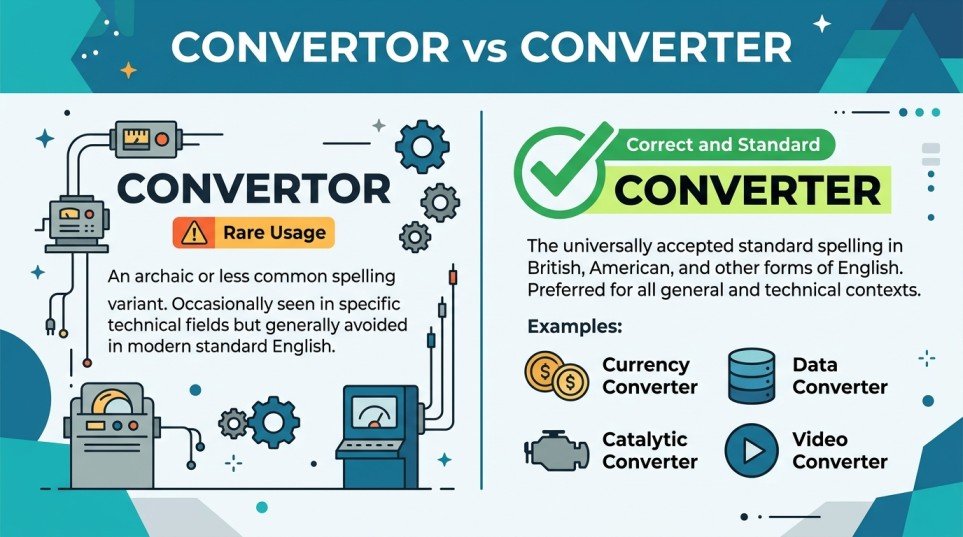
Quick Ans: The correct and widely accepted spelling is converter, while convertor is a less common variant used in limited contexts. In modern English, especially in technology and everyday writing, “converter” is the preferred and standard form.
Many people get confused between convertor or converter when writing or searching online. Both words look similar. Both seem correct. However, only one is commonly accepted in modern usage.
The confusion often happens because English includes many words ending in “-or” and “-er.” For example, “actor” and “writer” both exist. As a result, people assume “convertor” and “converter” are equally correct.
In reality, usage frequency and context matter. Most dictionaries, software tools, and professional writing standards prefer “converter.” Meanwhile, “convertor” appears rarely and is often considered outdated or less standard.
Therefore, understanding the difference between convertor or converter helps improve writing accuracy. It also ensures better communication in academic, technical, and professional settings.
In this guide, you will learn definitions, correct usage, examples, advantages, common mistakes, and practical exercises. By the end, you will confidently choose the right word.
Quick Answer: Convertor or Converter
To quickly understand convertor or converter, focus on standard usage.
| Feature | Converter | Convertor |
|---|---|---|
| Usage Frequency | Very common | Rare |
| Accepted Standard | Yes | Limited |
| Used in Technology | Yes | Rare |
| Dictionary Preference | Preferred | Secondary or outdated |
In simple terms, converter is correct in most situations, while convertor is rarely used.
What Is a Converter?
A converter is a person, device, or tool that changes something from one form to another.
For example:
- A power converter changes electricity voltage
- A file converter changes file formats
- A currency converter changes money values
Because of its wide usage, “converter” appears in both everyday language and technical fields.
Common Uses of Converter
You will often see “converter” in:
- Electronics
- Software tools
- Engineering
- Finance
- Language and data processing
For instance, a video converter changes file formats like MP4 to AVI.
Why “Converter” Is Preferred
Several reasons explain why “converter” is the standard:
- It follows common English word patterns
- It appears in major dictionaries
- It is widely used in technology and business
- It is recognized globally
Therefore, using “converter” ensures clarity and correctness.
What Is a Convertor?
A convertor also means something that converts or changes one form into another. However, this spelling is less common.
You may occasionally see “convertor” in:
- Older texts
- Specific technical contexts
- Regional variations
Even though it has the same meaning, modern usage strongly favors “converter.”
Why “Convertor” Is Rare
Several factors explain its limited use:
- It is not the preferred spelling in most dictionaries
- It appears less frequently in modern writing
- It may seem incorrect to many readers
As a result, using “convertor” can sometimes confuse your audience.
Key Differences Between Convertor or Converter
Spelling Preference
The biggest difference in convertor or converter is acceptance. “Converter” is standard, while “convertor” is uncommon.
Usage Frequency
“Converter” appears in books, websites, and software tools. “Convertor” appears rarely in comparison.
Professional Writing
Most professional fields use “converter.” This includes engineering, IT, and finance.
Reader Perception
Readers recognize “converter” easily. “Convertor” may look like a spelling mistake.
Advantages and Disadvantages
Converter Advantages
- Widely accepted spelling
- Used in professional writing
- Easy to understand
- Preferred in technology
Converter Disadvantages
- None in standard usage
Convertor Advantages
- Historically valid spelling
- Occasionally used in niche contexts
Convertor Disadvantages
- Rare usage
- May confuse readers
- Often considered incorrect
Therefore, choosing “converter” is usually the safer option.
Real World Examples
Technology Example
When you search for tools online, you will see terms like:
- Video converter
- Audio converter
- File converter
You will almost never see “convertor” in software tools.
Everyday Language Example
People commonly say:
- “Use a currency converter”
- “Download a PDF converter”
Using “convertor” in these cases would sound unusual.
Academic Writing
In formal writing, consistency matters. Most academic sources use “converter” because it aligns with standard English rules.
Regional and Global Usage
American English
American English strongly prefers “converter.” It is the standard spelling in schools, businesses, and technology.
British English
British English also favors “converter.” Although “convertor” may appear occasionally, it is not common.
Global Usage
Across the world, “converter” dominates in online content, software tools, and professional communication.
Thus, the convertor or converter debate is largely resolved in favor of “converter.”
Related Concepts and Comparisons
Converter vs Adapter
A converter changes the form of something. An adapter allows compatibility between devices.
Converter vs Transformer
A transformer changes voltage levels in electricity. A converter may change current type or format.
Convertor vs Converter vs Processor
| Term | Meaning | Usage |
|---|---|---|
| Converter | Changes format or form | Common |
| Convertor | Same meaning | Rare |
| Processor | Processes data | Very common |
Understanding these related terms helps clarify the correct usage of “converter.”
Common Mistakes About Convertor or Converter
Using Convertor in Formal Writing
Many people assume both spellings are equal. However, “convertor” is not recommended in formal contexts.
Mixing Both Spellings
Switching between “convertor” and “converter” in the same document creates inconsistency.
Assuming Both Are Standard
Although both exist, only “converter” is widely accepted.
Ignoring Context
Technical writing requires precision. Using the wrong spelling can reduce credibility.
Avoiding these mistakes improves clarity and professionalism.
Beginner to Advanced Usage Tips
Beginner Level
Always use “converter” in writing. This ensures correctness.
Intermediate Level
Check spelling consistency in documents. Use the same form throughout.
Advanced Level
Understand context specific usage. In rare technical cases, verify if “convertor” appears in legacy systems.
However, default to “converter” unless there is a strong reason not to.
Step By Step Usage Scenario
Imagine writing a blog about file tools.
If you choose “converter”:
- Write “file converter”
- Use consistent spelling
- Improve readability
- Match search engine expectations
If you choose “convertor”:
- Write “file convertor”
- Risk confusion
- Reduce credibility
- Appear less professional
Clearly, “converter” provides better results.
Exercises With Answers
Exercise 1
Which spelling is more common: convertor or converter?
Answer: Converter.
Exercise 2
Which term is preferred in professional writing?
Answer: Converter.
Exercise 3
True or False: Convertor is widely used in modern English.
Answer: False.
Exercise 4
Which word appears more in technology tools?
Answer: Converter.
Exercise 5
Should you use convertor in formal documents?
Answer: No.
When Should You Choose Convertor or Converter?
Choose converter when you:
- Write professional content
- Create technical documents
- Develop software or tools
- Communicate clearly
Avoid “convertor” unless:
- You are quoting older text
- A specific technical context requires it
In most situations, “converter” is the correct choice.
FAQs About Convertor or Converter
What is the correct spelling, convertor or converter?
The correct and widely accepted spelling is “converter.”
Is convertor wrong?
Not completely wrong, but it is rare and not recommended in modern usage.
Why is converter more common than convertor?
Because it follows standard English patterns and is widely used in technology and writing.
Do dictionaries accept convertor?
Some dictionaries list it, but they usually mark “converter” as the preferred spelling.
Which should I use in professional writing?
Always use “converter” for clarity and correctness.
Is convertor used in British English?
It may appear occasionally, but “converter” is still more common.
Does convertor mean something different?
No. Both words have the same meaning.
Which spelling is better for SEO, convertor or converter?
“Converter” is better because it is searched more often.
Can I use both in the same document?
No. Always stay consistent and use “converter.”
Why do people confuse convertor and converter?
Because English has similar word endings like “actor” and “writer,” which leads to confusion.
Conclusion
Understanding convertor or converter is important for clear and professional writing. Although both spellings exist, only one is widely accepted in modern English.
“Converter” is the preferred choice across technology, education, and everyday communication. It appears in dictionaries, software tools, and global content. As a result, it ensures clarity and credibility.
“Convertor,” on the other hand, is rare and often outdated. While it is not completely incorrect, it can confuse readers and reduce the quality of your writing.
Therefore, always use “converter” unless a specific context requires otherwise. Consistent spelling improves readability, professionalism, and search engine performance.
By applying this knowledge, you can write more accurately and confidently in any situation.
Discover More:-
- Shingles vs Hives: Differences, Symptoms, Causes, and Treatment Guide
- GT vs Duke: Key Differences, Performance, and Buying Guide

Robert Mitchell is a U.S.-based writer at Gramtivo.Com who focuses on grammar, writing improvement, and language-related content. He holds a degree in English and Linguistics from a U.S. university. His work aims to help readers enhance their writing skills with clear and practical guidance.