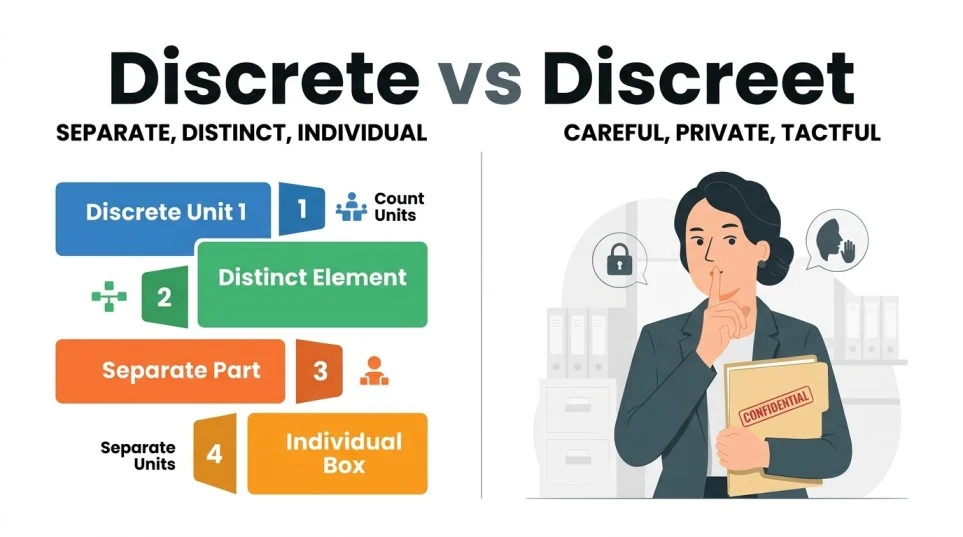
Quick Ans: The difference between discrete or discreet comes down to meaning. Discrete means separate, distinct, or individual, while discreet means careful, private, or tactful. Although the words look almost identical, using the wrong one can completely change the meaning of a sentence.
Many English learners and native speakers get confused by discrete or discreet. The words have similar spellings. They sound almost the same when spoken. As a result, they are among the most commonly mixed-up words in English.
The confusion often happens in writing. Someone may want to describe separate items and accidentally use discreet. Likewise, another person may want to describe private behavior and mistakenly write discrete.
Because these words appear in business writing, academic papers, emails, and everyday communication, knowing the difference is important. A small spelling mistake can make your writing look less professional or even create misunderstandings.
Fortunately, the distinction is simple once you understand it. One word refers to things that are separate from each other. The other describes behavior that is careful and avoids drawing attention.
This guide explains discrete or discreet in detail. You will learn definitions, examples, common mistakes, memory tricks, practice exercises, and frequently asked questions.
Quick Answer: Discrete or Discreet
Here is the simplest way to remember the difference:
| Word | Meaning | Example |
|---|---|---|
| Discrete | Separate, distinct, individual | The project has three discrete phases. |
| Discreet | Careful, private, tactful | She was discreet about the situation. |
A useful memory trick is this:
- Discrete contains the word separate in its meaning.
- Discreet has two e’s together, just like keeping a secret.
Therefore:
- Use discrete for separate things.
- Use discreet for careful behavior.
What Does Discrete Mean?
The word discrete means separate, distinct, individual, or disconnected from something else.
When something is discrete, it exists as its own unit rather than being part of a continuous whole.
Common Uses of Discrete
The word often appears in:
- Mathematics
- Science
- Technology
- Business
- Academic writing
Examples of Discrete
Consider these examples:
- The report is divided into five discrete sections.
- Each department operates as a discrete unit.
- The software contains several discrete functions.
- Researchers studied discrete groups of participants.
In every example, the idea is separation or distinction.
Discrete in Mathematics
Mathematics frequently uses the word discrete.
For example:
- Discrete numbers are separate values.
- Discrete mathematics studies distinct objects.
- Discrete data contains specific values rather than continuous measurements.
A person can count discrete objects such as books or cars. However, continuous data such as temperature can have infinite values between points.
What Does Discreet Mean?
The word discreet describes someone who is careful, tactful, private, or intentionally avoids attracting attention.
A discreet person knows how to handle sensitive information appropriately.
Common Uses of Discreet
The term often appears in:
- Business communication
- Personal relationships
- Customer service
- Professional settings
Examples of Discreet
Look at these examples:
- She was discreet about her financial situation.
- The hotel offers discreet security services.
- He made a discreet exit from the event.
- Please be discreet when discussing confidential information.
Each sentence focuses on privacy, caution, or tact.
Why Discretion Matters
Being discreet is often considered a professional skill.
For example:
- Managers must handle employee concerns discreetly.
- Doctors protect patient information discreetly.
- Lawyers discuss legal matters discreetly.
As a result, discretion helps build trust and maintain confidentiality.
Key Differences Between Discrete or Discreet
Meaning
The biggest difference between discrete or discreet is meaning.
- Discrete means separate.
- Discreet means careful or private.
Usage
Discrete usually describes objects, categories, or units.
Discreet generally describes people, actions, or communication.
Context
Academic and technical writing often uses discrete.
Professional and social situations commonly use discreet.
Example Comparison
| Sentence | Correct Word |
|---|---|
| The study examined three ______ groups. | Discrete |
| Please remain ______ when discussing the issue. | Discreet |
| The software has several ______ modules. | Discrete |
| The assistant handled the matter ______ly. | Discreet |
These examples highlight the difference clearly.
Advantages and Disadvantages of Learning the Difference
Advantages
Understanding discrete or discreet offers several benefits:
- Improves writing accuracy
- Enhances professional communication
- Reduces embarrassing mistakes
- Builds confidence in English usage
Disadvantages of Confusing Them
Mixing the words can cause problems:
- Miscommunication
- Reduced credibility
- Confusing academic writing
- Professional misunderstandings
Therefore, learning the distinction is worthwhile.
Real World Examples
In Business
A company may have discrete departments such as marketing, finance, and sales.
Meanwhile, managers must be discreet when discussing employee performance.
In Education
A teacher might divide a lesson into discrete sections.
At the same time, school staff should remain discreet about student records.
In Technology
Software often contains discrete components that perform different functions.
Developers may also be discreet when discussing confidential projects.
These examples show how both words can appear in the same environment while serving different purposes.
Regional and Global Usage
American English
American English uses both discrete and discreet according to their traditional meanings.
British English
British English follows the same distinction.
International English
English learners worldwide often confuse these words because they differ by only one letter.
Despite this challenge, the meanings remain consistent across English-speaking countries.
Related Concepts and Comparisons
Discrete vs Separate
Both words can indicate distinction.
However, discrete often sounds more formal and technical.
Example:
- Separate rooms
- Discrete units
Discreet vs Private
Both relate to confidentiality.
Private describes information itself. Discreet describes behavior.
Example:
- Private information
- Discreet handling of information
Discrete vs Distinct
Distinct means clearly different.
Discrete emphasizes separation into individual units.
Example:
- Distinct features
- Discrete categories
Understanding these related terms helps strengthen vocabulary.
Common Mistakes About Discrete or Discreet
Using Discreet for Separate Things
Incorrect:
- The report contains three discreet sections.
Correct:
- The report contains three discrete sections.
The sections are separate, not secretive.
Using Discrete for Private Behavior
Incorrect:
- She was discrete about the matter.
Correct:
- She was discreet about the matter.
The sentence refers to careful behavior.
Ignoring Context
Writers sometimes focus only on spelling.
Instead, think about the meaning before choosing a word.
Relying on Spell Check
Spell check may not catch this mistake because both words are correctly spelled English words.
Always review context manually.
Beginner to Advanced Learning Tips
Beginner Level
Remember this simple rule:
- Discrete = Separate
- Discreet = Secretive or careful
Intermediate Level
Practice creating sentences using both words.
Example:
- The company has discrete divisions.
- The manager remained discreet.
Advanced Level
Study the words in professional, academic, and technical contexts.
Notice how discrete often appears in mathematics and research. Meanwhile, discreet frequently appears in business and interpersonal communication.
Regular exposure improves long-term retention.
Step By Step Memory Trick
Many learners struggle with discrete or discreet because the spellings are similar.
Try this memory method:
- Look at the word discreet.
- Notice the double “e”.
- Think of two eyes watching carefully.
- Connect careful behavior with discreet.
Now look at discrete.
- Notice the letters differ.
- Associate the word with separate categories.
- Think of individual boxes standing apart.
This approach helps many learners remember the difference quickly.
Exercises With Answers
Exercise 1
Choose the correct word:
The study analyzed three ______ categories.
Answer: Discrete.
Exercise 2
Choose the correct word:
Please remain ______ when discussing client information.
Answer: Discreet.
Exercise 3
Choose the correct word:
The software consists of several ______ modules.
Answer: Discrete.
Exercise 4
Choose the correct word:
She made a ______ departure from the meeting.
Answer: Discreet.
Exercise 5
True or False:
Discrete means careful and private.
Answer: False.
When Should You Use Discrete or Discreet?
Use discrete when discussing:
- Separate groups
- Individual units
- Distinct categories
- Mathematical concepts
- Technical systems
Use discreet when discussing:
- Privacy
- Confidentiality
- Tactful behavior
- Sensitive information
- Professional communication
Checking the context before writing usually prevents mistakes.
FAQs About Discrete or Discreet
What is the difference between discrete or discreet?
Discrete means separate or distinct, while discreet means careful, private, or tactful.
Is discrete the same as discreet?
No. Although they look similar, the meanings are completely different.
How can I remember discrete or discreet?
Remember that discreet has two e’s together, similar to keeping a secret. Discrete refers to separate things.
Which word means separate?
Discrete means separate, individual, or distinct.
Which word means careful and private?
Discreet describes careful, tactful, and confidential behavior.
Is discrete used in mathematics?
Yes. Discrete mathematics studies distinct and separate objects rather than continuous systems.
Can discreet describe a person?
Yes. A discreet person handles sensitive matters carefully.
Can discrete describe data?
Yes. Discrete data consists of separate, countable values.
Why do people confuse discrete or discreet?
The words have similar spellings and pronunciations, making mistakes common.
Does spell check catch discrete and discreet errors?
Not always. Since both words are valid, context determines whether the choice is correct.
Conclusion
Understanding discrete or discreet is essential for clear and professional communication. Although the words differ by only one letter, their meanings are completely different.
Discrete refers to things that are separate, distinct, or individual. For this reason, the word commonly appears in mathematics, technology, research, and business discussions.
Discreet, on the other hand, describes careful, private, and tactful behavior. Consequently, it is often used when discussing confidentiality, professionalism, and sensitive situations.
The easiest way to remember the difference is through association. Think of discrete as separate units. Then connect discreet with secrets and careful behavior.
Whenever you write, pause and consider the meaning you intend. If you are describing separate items, choose discrete. If you are describing privacy or tact, select discreet.
With regular practice, distinguishing between discrete or discreet becomes simple and automatic.
Discover More:-
- Theragun vs Hypervolt: Detailed Comparison, Features, and Buying Guide
- Balcony vs Patio: Differences, Uses, and Outdoor Space Guide

Lisa Thompson is a USA-based content writer and language specialist focused on grammar, writing improvement and digital publishing.
She holds a degree in English Language and Communication and has professional experience in educational and web content creation.
As the author of Gramtivo.Com, she aims to help readers improve their writing skills through clear and practical guidance.