
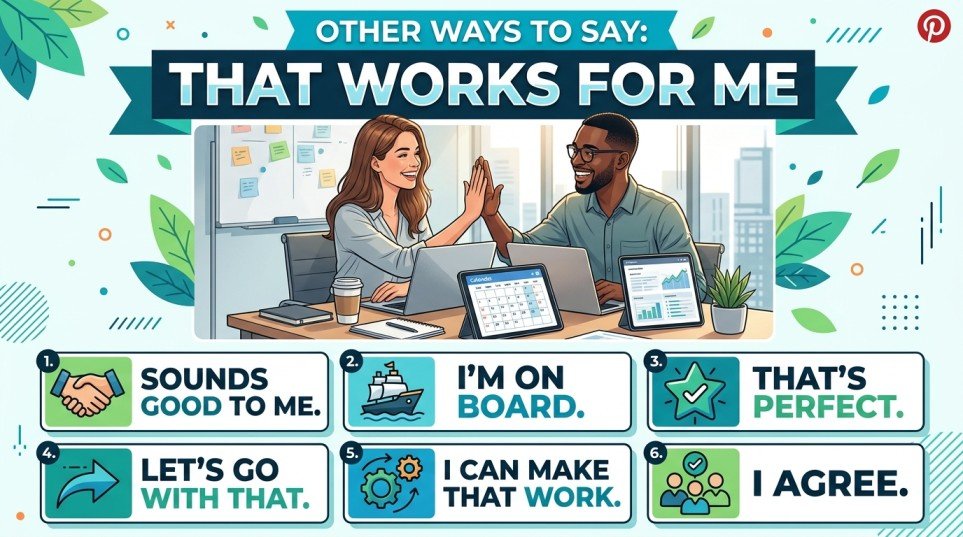
Quick Answer: Instead of saying that works for me, you can say: sounds good, that’s fine with me, I’m okay with that, perfect for me, that suits me well.
The phrase “that works for me” is commonly used to show agreement or acceptance of a plan, suggestion, or schedule. It’s simple, polite, and widely used in both personal and professional conversations.
Although the phrase is useful, repeating it too often can make your English sound repetitive. Native speakers usually switch between several expressions depending on the tone and situation.
Learning alternatives to “that works for me” helps you sound more fluent and natural. It also improves your communication skills in meetings, emails, and casual conversations while helping you express excitement in English more effectively.
Quick Categories Section
Formal alternatives to “that works for me”
- That arrangement is acceptable
- I’m comfortable with that
- That would be suitable
- That is agreeable to me
Pro Tip: Use these in formal emails, meetings, or workplace discussions.
Casual alternatives
- Sounds good
- Works for me
- Sure thing
- I’m good with that
Pro Tip: Perfect for relaxed conversations with friends or coworkers.
Professional alternatives
- That sounds great
- I can make that work
- That timeline works well
- I’m available then
Pro Tip: Keep your tone polite and concise in business communication.
Informal expressions
- Cool with me
- I’m down for that
- Totally works
- Fine by me
Pro Tip: Avoid overly casual phrases in formal settings.
“Professional English often depends on choosing the right tone, not complicated vocabulary.”
Common Mistakes
- Using informal phrases in professional emails
Example: “I’m down for that” in a formal business email. - Repeating the same phrase too often
Example: Saying “that works for me” in every reply. - Sounding too vague
Example: Using unclear responses without confirming details. - Ignoring tone and context
Example: “Cool with me” during serious business discussions. - Overcomplicating simple agreement
Example: Using overly formal language in casual situations.
What Does “That Works for Me” Mean?
It means you agree with or accept a plan, idea, or arrangement.
Grammatically, it’s a conversational phrase used to confirm compatibility or agreement.
Example Sentence:
Friday afternoon works perfectly for me.
When to Use “That Works for Me”
- When agreeing to a schedule
- When confirming plans
- During workplace discussions
- In casual conversations with friends
Spoken vs Written: Common in both
Formal vs Informal: Neutral but slightly informal
Is It Professional or Polite to Say “That Works for Me”?
Polite? ✔️ Yes
Professional? ✔️ Yes (in most situations)
Business Example:
“Thursday at 2 PM works for me. Looking forward to the meeting.”
Pros and Cons of Using “That Works for Me”
Pros
- Simple and natural
- Friendly tone
- Common in professional English
- Easy to understand
Cons
- Can become repetitive
- Slightly informal in strict business settings
- Limited emotional expression
- Not very persuasive
“Fluent English comes from having multiple ways to express the same idea.”
Other Ways to Say “That Works for Me” (With Examples)
These alternatives will help you sound more fluent, confident, and natural in different situations.
Use them according to tone, audience, and context.
1. Phrase: Sounds good
Meaning: The idea or plan is acceptable.
Explanation: One of the most common alternatives.
Example Sentence: Sounds good, let’s do that.
Best Use: casual talk
Worst Use: legal writing
Tone: friendly, relaxed
Context Variability: casual / spoken
2. Phrase: That’s fine with me
Meaning: You accept the suggestion.
Explanation: Neutral and flexible expression.
Example Sentence: That’s fine with me if everyone agrees.
Best Use: general use
Worst Use: highly formal writing
Tone: neutral, calm
Context Variability: casual / professional
3. Phrase: I’m okay with that
Meaning: You agree with the idea.
Explanation: Common in daily conversations.
Example Sentence: I’m okay with that schedule.
Best Use: everyday use
Worst Use: formal documents
Tone: relaxed, neutral
Context Variability: casual / spoken
4. Phrase: Perfect for me
Meaning: The arrangement suits you very well.
Explanation: More enthusiastic agreement.
Example Sentence: Friday morning is perfect for me.
Best Use: scheduling
Worst Use: serious negotiations
Tone: positive, upbeat
Context Variability: casual / professional
5. Phrase: That suits me well
Meaning: The plan fits your needs.
Explanation: Slightly more polished alternative.
Example Sentence: That timing suits me well.
Best Use: professional settings
Worst Use: slang context
Tone: professional, polite
Context Variability: professional / written
“Tone awareness makes your communication sound more natural and polished.”
6. Phrase: I can make that work
Meaning: You can adjust to the arrangement.
Explanation: Flexible and professional.
Example Sentence: I can make that work on my end.
Best Use: workplace
Worst Use: casual slang
Tone: professional, cooperative
Context Variability: professional
7. Phrase: That sounds great
Meaning: You strongly approve of the idea.
Explanation: Positive and energetic.
Example Sentence: That sounds great to me.
Best Use: meetings
Worst Use: formal contracts
Tone: positive, enthusiastic
Context Variability: casual / professional
8. Phrase: Fine by me
Meaning: You have no objections.
Explanation: Casual agreement phrase.
Example Sentence: Fine by me if you prefer that option.
Best Use: friendly talk
Worst Use: business emails
Tone: casual, relaxed
Context Variability: casual
9. Phrase: I’m available then
Meaning: The proposed time works.
Explanation: Useful for scheduling.
Example Sentence: I’m available then, thanks for checking.
Best Use: workplace
Worst Use: non-scheduling context
Tone: professional, clear
Context Variability: professional
10. Phrase: That arrangement works well
Meaning: The setup is acceptable.
Explanation: More formal wording.
Example Sentence: That arrangement works well for our team.
Best Use: formal meetings
Worst Use: casual chat
Tone: professional, formal
Context Variability: professional
11. Phrase: I’m happy with that
Meaning: You are satisfied with the decision.
Explanation: Warm and positive response.
Example Sentence: I’m happy with that solution.
Best Use: teamwork
Worst Use: strict legal writing
Tone: positive, friendly
Context Variability: casual / professional
12. Phrase: That sounds perfect
Meaning: The plan is ideal for you.
Explanation: Enthusiastic agreement.
Example Sentence: That sounds perfect for next week.
Best Use: scheduling
Worst Use: formal negotiations
Tone: excited, positive
Context Variability: casual
13. Phrase: I’m good with that
Meaning: You accept the proposal.
Explanation: Casual but common.
Example Sentence: I’m good with that plan.
Best Use: friendly talk
Worst Use: professional reports
Tone: relaxed, casual
Context Variability: casual
14. Phrase: That will work nicely
Meaning: The arrangement is suitable.
Explanation: Slightly polished expression.
Example Sentence: That will work nicely for the project.
Best Use: workplace
Worst Use: slang context
Tone: professional, calm
Context Variability: professional
15. Phrase: Agreed
Meaning: You fully accept the proposal.
Explanation: Short and direct response.
Example Sentence: Agreed, let’s proceed.
Best Use: meetings
Worst Use: emotional conversations
Tone: direct, professional
Context Variability: professional
“Using varied expressions helps your English sound more advanced.”
16. Phrase: That’s acceptable to me
Meaning: You approve of the arrangement.
Explanation: Formal agreement phrase.
Example Sentence: That’s acceptable to me.
Best Use: formal settings
Worst Use: casual chat
Tone: formal, neutral
Context Variability: professional
17. Phrase: I’m comfortable with that
Meaning: You feel okay with the decision.
Explanation: Calm and professional wording.
Example Sentence: I’m comfortable with that timeline.
Best Use: workplace
Worst Use: slang
Tone: professional, calm
Context Variability: professional
18. Phrase: I have no issue with that
Meaning: You see no problem with the plan.
Explanation: Neutral agreement expression.
Example Sentence: I have no issue with that approach.
Best Use: meetings
Worst Use: casual slang
Tone: neutral, professional
Context Variability: professional
19. Phrase: That fits my schedule
Meaning: The timing is suitable.
Explanation: Scheduling-focused phrase.
Example Sentence: That fits my schedule perfectly.
Best Use: appointments
Worst Use: non-time contexts
Tone: professional, practical
Context Variability: professional
20. Phrase: Count me in
Meaning: You want to participate.
Explanation: Energetic and informal agreement.
Example Sentence: Count me in for the event.
Best Use: social plans
Worst Use: formal documents
Tone: enthusiastic, casual
Context Variability: casual
21. Phrase: I’m on board
Meaning: You support the idea.
Explanation: Common in teamwork discussions.
Example Sentence: I’m on board with the proposal.
Best Use: teamwork
Worst Use: highly formal contracts
Tone: supportive, professional
Context Variability: professional / spoken
22. Phrase: Totally works for me
Meaning: The arrangement is completely suitable.
Explanation: Informal enthusiastic agreement.
Example Sentence: That totally works for me.
Best Use: casual conversations
Worst Use: formal writing
Tone: casual, upbeat
Context Variability: casual
23. Phrase: That sounds reasonable
Meaning: The suggestion seems fair.
Explanation: Professional and balanced.
Example Sentence: That sounds reasonable to me.
Best Use: negotiations
Worst Use: emotional conversations
Tone: professional, logical
Context Variability: professional
24. Phrase: I’d be fine with that
Meaning: You are comfortable accepting it.
Explanation: Soft and polite wording.
Example Sentence: I’d be fine with that option.
Best Use: discussions
Worst Use: legal writing
Tone: polite, neutral
Context Variability: casual / professional
25. Phrase: That works perfectly
Meaning: The arrangement is ideal.
Explanation: More enthusiastic version.
Example Sentence: Tuesday afternoon works perfectly.
Best Use: scheduling
Worst Use: strict formal contexts
Tone: positive, energetic
Context Variability: casual / professional
26. Phrase: I approve
Meaning: You officially agree.
Explanation: Formal and direct phrase.
Example Sentence: I approve of the revised schedule.
Best Use: management
Worst Use: casual chat
Tone: formal, authoritative
Context Variability: professional
27. Phrase: I’m satisfied with that
Meaning: You are pleased with the arrangement.
Explanation: Calm and professional wording.
Example Sentence: I’m satisfied with that outcome.
Best Use: workplace
Worst Use: slang contexts
Tone: professional, calm
Context Variability: professional
28. Phrase: That timeline works for me
Meaning: The schedule is acceptable.
Explanation: Useful in business communication.
Example Sentence: That timeline works for me and my team.
Best Use: project planning
Worst Use: casual chat
Tone: professional, clear
Context Variability: professional
29. Phrase: I can do that
Meaning: You are able to accept the arrangement.
Explanation: Direct and practical response.
Example Sentence: I can do that on Thursday.
Best Use: scheduling
Worst Use: formal reports
Tone: practical, casual
Context Variability: casual / professional
30. Phrase: Works perfectly on my end
Meaning: The arrangement is ideal for you.
Explanation: Common workplace expression.
Example Sentence: Friday afternoon works perfectly on my end.
Best Use: workplace communication
Worst Use: social slang
Tone: professional, friendly
Context Variability: professional
“Confident English speakers know how to adapt their tone for every situation.”
Mini Quiz / Self-Check
1. Which phrase is best for a professional meeting?
A. Totally works for me
B. That arrangement works well
C. Cool with me
Answer: B
2. Which phrase is most casual?
A. Fine by me
B. I approve
C. That arrangement is acceptable
Answer: A
3. Which phrase works best for scheduling?
A. Count me in
B. That fits my schedule
C. I approve
Answer: B
Comparison Table: Top Alternatives
| Phrase | Tone | Best Use |
|---|---|---|
| Sounds good | Casual | Daily talk |
| That’s fine with me | Neutral | General use |
| Perfect for me | Positive | Scheduling |
| That suits me well | Professional | Workplace |
| I can make that work | Professional | Meetings |
| I’m available then | Professional | Scheduling |
| Fine by me | Casual | Friendly conversations |
| Agreed | Direct | Team discussions |
| I’m on board | Supportive | Teamwork |
| Works perfectly on my end | Professional | Business communication |
FAQs
1. What are the best alternatives to “that works for me”?
Popular options include sounds good, that’s fine with me, and I can make that work.
2. Is “that works for me” professional?
Yes, it is polite and commonly used in professional communication.
3. What should I say instead in formal emails?
Use phrases like that arrangement is acceptable or that suits me well.
4. Can I use casual agreement phrases at work?
Only in relaxed environments; formal settings require more polished language.
5. Why learn alternatives to “that works for me”?
It improves fluency, tone variation, and workplace communication skills.
Conclusion
Learning different other ways to say “that works for me” helps you sound more fluent, adaptable, and professional. It also allows you to adjust your tone depending on the situation and audience.
Practice these alternatives regularly in emails, meetings, and daily conversations. Over time, your English will sound more confident and natural.
CTA: Which alternative will you try first in your next conversation?
Discover More:-
- Other Ways to Say Thank You for Your Concern (30+ Examples)
- Other Ways to Say Please Take Your Time (30+ Examples)

Jennifer Collins is a professional grammar expert and language educator at gramtivo.com, specializing in English grammar, writing skills, and language improvement. She holds a Master’s degree in English Language and Literature from a recognized university in the United States. With years of teaching and content development experience, she is dedicated to helping learners improve their communication skills with clear and practical guidance.