
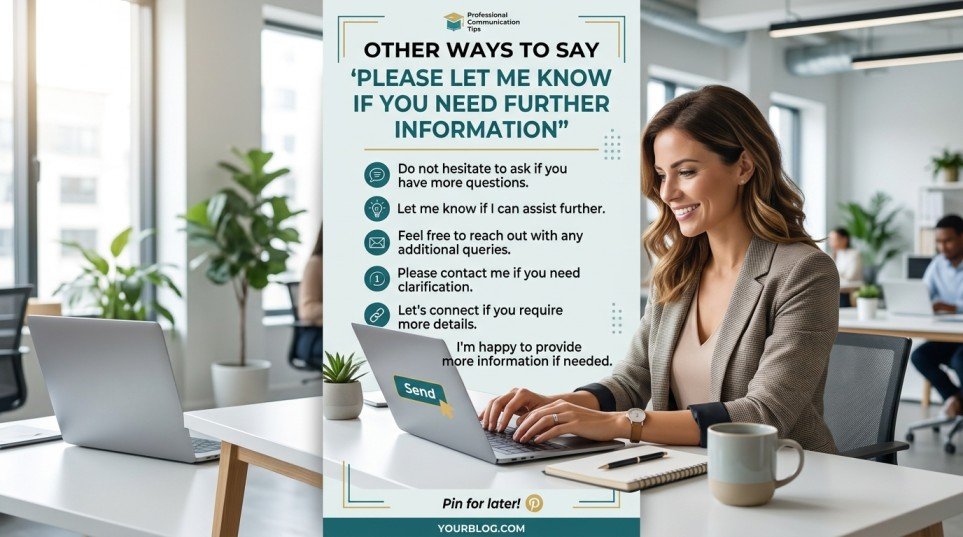
Quick Answer: Instead of saying please let me know if you need further information, you can use: feel free to reach out with any questions, don’t hesitate to contact me, I’m happy to provide additional details, please contact me if you need anything else, let me know if I can assist further.
The phrase “please let me know if you need further information” is commonly used in emails, business communication, and professional correspondence. It politely offers additional assistance and invites follow-up questions.
Although the phrase is clear and professional, using it repeatedly can make your writing sound repetitive. Native English speakers often choose different expressions depending on the audience, formality level, and purpose of the message.
Learning alternatives to “please let me know if you need further information” helps you write more naturally and professionally. It also improves your communication skills by giving you a wider range of professional reaction phrases and workplace expressions.
Quick Categories Section
Formal alternatives to “please let me know if you need further information”
- Should you require additional information, please contact me
- Please advise if further details are required
- Kindly reach out if you need additional information
- Do not hesitate to request further information
Pro Tip: These phrases work well in formal business correspondence and client communication.
Casual alternatives
- Let me know if you need anything else
- Feel free to ask
- Just let me know
- Reach out anytime
Pro Tip: Use these when communicating with colleagues or familiar contacts.
Professional alternatives
- I’m happy to provide additional details
- Please contact me with any questions
- Let me know if I can assist further
- Feel free to reach out for clarification
Pro Tip: These options sound polished without being overly formal.
Informal expressions
- Give me a shout if you need anything
- Just ask if something comes up
- Drop me a message if needed
- Feel free to get in touch
Pro Tip: Save these for friendly conversations rather than formal business emails.
“A strong closing line leaves a professional and helpful impression.”
Common Mistakes
- Repeating the phrase in every email
Example: Using the same closing sentence in every message. - Sounding too formal for simple situations
Example: Using highly formal wording with close coworkers. - Being too vague
Example: “Let me know” without specifying assistance. - Using overly casual language with clients
Example: “Give me a shout” in a formal proposal. - Ending abruptly without offering help
Example: Finishing an email without inviting questions.
What Does “Please Let Me Know If You Need Further Information” Mean?
It means you are willing to provide additional details, clarification, or assistance if needed.
Grammatically, it is a polite request combined with an offer of support.
Example Sentence:
Please let me know if you need further information regarding the project timeline.
When to Use “Please Let Me Know If You Need Further Information”
- At the end of professional emails
- When sending reports or proposals
- When answering questions
- During customer service communication
- When sharing important information
Spoken vs Written: Primarily written
Formal vs Informal: Professional and formal
Is It Professional or Polite to Say “Please Let Me Know If You Need Further Information”?
Polite? ✔️ Yes
Professional? ✔️ Yes
Business Example:
“Thank you for reviewing the proposal. Please let me know if you need further information.”
Pros and Cons of Using “Please Let Me Know If You Need Further Information”
Pros
- Professional and polite
- Easy to understand
- Encourages communication
- Suitable for most industries
Cons
- Frequently overused
- Can sound repetitive
- Sometimes too formal
- Lacks personality
“Professional writing becomes stronger when you vary your closing phrases.”
Other Ways to Say “Please Let Me Know If You Need Further Information” (With Examples)
These alternatives will help you sound more fluent, confident, and professional in workplace communication.
Use them according to tone, context, and audience to improve your email writing and business communication skills.
1. Phrase: Feel free to reach out with any questions
Meaning: You are available to answer questions.
Explanation: Friendly and professional.
Example Sentence: Feel free to reach out with any questions regarding the proposal.
Best Use: business emails
Worst Use: urgent notices
Tone: helpful, professional
Context Variability: professional / written
2. Phrase: Don’t hesitate to contact me
Meaning: Encourage further communication.
Explanation: Common professional phrase.
Example Sentence: Don’t hesitate to contact me if you need clarification.
Best Use: client communication
Worst Use: casual chats
Tone: professional, welcoming
Context Variability: professional / written
3. Phrase: I’m happy to provide additional details
Meaning: Willing to share more information.
Explanation: Warm and professional.
Example Sentence: I’m happy to provide additional details if needed.
Best Use: proposals
Worst Use: brief texts
Tone: supportive, professional
Context Variability: professional
4. Phrase: Let me know if I can assist further
Meaning: Offering continued support.
Explanation: Common workplace expression.
Example Sentence: Let me know if I can assist further with this matter.
Best Use: customer service
Worst Use: personal messages
Tone: helpful, professional
Context Variability: professional
5. Phrase: Please contact me with any questions
Meaning: Inviting follow-up inquiries.
Explanation: Direct and professional.
Example Sentence: Please contact me with any questions about the report.
Best Use: formal emails
Worst Use: informal texts
Tone: clear, professional
Context Variability: professional / written
“The best professional closings sound helpful without sounding repetitive.”
6. Phrase: Feel free to ask if anything is unclear
Meaning: Invite clarification requests.
Explanation: Useful when sharing instructions.
Example Sentence: Feel free to ask if anything is unclear.
Best Use: training materials
Worst Use: legal documents
Tone: supportive, approachable
Context Variability: professional
7. Phrase: Please reach out if you need clarification
Meaning: Offer explanation if needed.
Explanation: Common in business communication.
Example Sentence: Please reach out if you need clarification on any point.
Best Use: workplace communication
Worst Use: casual conversations
Tone: professional, helpful
Context Variability: professional
8. Phrase: Let me know if you have any questions
Meaning: Invite questions.
Explanation: Simple and versatile.
Example Sentence: Let me know if you have any questions about the schedule.
Best Use: general use
Worst Use: highly formal contracts
Tone: friendly, professional
Context Variability: professional / spoken
9. Phrase: Please let me know how I can help
Meaning: Offer assistance.
Explanation: Focuses on support.
Example Sentence: Please let me know how I can help moving forward.
Best Use: teamwork
Worst Use: automated messages
Tone: supportive, collaborative
Context Variability: professional
10. Phrase: I’m available if you need anything else
Meaning: Additional support is available.
Explanation: Friendly and helpful.
Example Sentence: I’m available if you need anything else.
Best Use: colleague communication
Worst Use: legal correspondence
Tone: approachable, professional
Context Variability: professional
11. Phrase: Kindly let me know if further details are needed
Meaning: Additional information can be provided.
Explanation: Formal alternative.
Example Sentence: Kindly let me know if further details are needed.
Best Use: formal emails
Worst Use: casual texts
Tone: formal, polite
Context Variability: professional
12. Phrase: Please advise if you require additional information
Meaning: Ask whether more details are needed.
Explanation: Common in corporate writing.
Example Sentence: Please advise if you require additional information.
Best Use: executive communication
Worst Use: friendly emails
Tone: formal, professional
Context Variability: professional
13. Phrase: I’m happy to answer any questions
Meaning: Willing to provide answers.
Explanation: Friendly and inviting.
Example Sentence: I’m happy to answer any questions you may have.
Best Use: customer support
Worst Use: urgent alerts
Tone: welcoming, professional
Context Variability: professional
14. Phrase: Please get in touch if you need anything further
Meaning: Contact is welcome for additional needs.
Explanation: Professional and polite.
Example Sentence: Please get in touch if you need anything further.
Best Use: client emails
Worst Use: text messages
Tone: courteous, professional
Context Variability: professional
15. Phrase: Let me know if you’d like more information
Meaning: Additional details are available.
Explanation: Direct and helpful.
Example Sentence: Let me know if you’d like more information about the service.
Best Use: sales communication
Worst Use: formal notices
Tone: friendly, professional
Context Variability: professional
“Small wording changes can make your emails sound more polished and engaging.”
16. Phrase: Feel free to contact me for further assistance
Meaning: Additional help is available.
Explanation: Common customer-service phrase.
Example Sentence: Feel free to contact me for further assistance.
Best Use: support emails
Worst Use: casual chats
Tone: professional, helpful
Context Variability: professional
17. Phrase: Please let me know if you require any clarification
Meaning: Clarification can be provided.
Explanation: Formal and precise.
Example Sentence: Please let me know if you require any clarification.
Best Use: reports
Worst Use: friendly texts
Tone: formal, professional
Context Variability: professional
18. Phrase: Reach out if there’s anything else you need
Meaning: Open invitation for assistance.
Explanation: Friendly and modern.
Example Sentence: Reach out if there’s anything else you need.
Best Use: workplace communication
Worst Use: legal writing
Tone: approachable, professional
Context Variability: professional
19. Phrase: I’d be glad to provide more information
Meaning: Happy to share details.
Explanation: Warm and courteous.
Example Sentence: I’d be glad to provide more information upon request.
Best Use: client relations
Worst Use: text messages
Tone: courteous, professional
Context Variability: professional
20. Phrase: Please feel free to ask for additional details
Meaning: Invite requests for information.
Explanation: Professional and clear.
Example Sentence: Please feel free to ask for additional details.
Best Use: business correspondence
Worst Use: casual conversation
Tone: polite, professional
Context Variability: professional
21. Phrase: Let me know if you would like further clarification
Meaning: Offer more explanation.
Explanation: Useful for complex topics.
Example Sentence: Let me know if you would like further clarification on this process.
Best Use: instructions
Worst Use: simple announcements
Tone: professional, helpful
Context Variability: professional
22. Phrase: Please don’t hesitate to reach out
Meaning: Encourage communication.
Explanation: Warm and professional.
Example Sentence: Please don’t hesitate to reach out if you need assistance.
Best Use: customer communication
Worst Use: urgent notices
Tone: welcoming, professional
Context Variability: professional
23. Phrase: I’m here to help if needed
Meaning: Support is available.
Explanation: Friendly and concise.
Example Sentence: I’m here to help if needed.
Best Use: colleague communication
Worst Use: formal contracts
Tone: supportive, friendly
Context Variability: professional / spoken
24. Phrase: Let me know if additional information would be helpful
Meaning: Offer more details.
Explanation: Consultative and professional.
Example Sentence: Let me know if additional information would be helpful.
Best Use: proposals
Worst Use: casual chats
Tone: thoughtful, professional
Context Variability: professional
25. Phrase: Kindly contact me should you need anything further
Meaning: Formal offer of support.
Explanation: Suitable for high-level communication.
Example Sentence: Kindly contact me should you need anything further.
Best Use: formal business
Worst Use: casual emails
Tone: formal, courteous
Context Variability: professional
26. Phrase: Please feel free to get in touch
Meaning: Contact is welcome.
Explanation: Simple and versatile.
Example Sentence: Please feel free to get in touch with any questions.
Best Use: business emails
Worst Use: urgent alerts
Tone: professional, approachable
Context Variability: professional
27. Phrase: Let me know if I can provide anything else
Meaning: More resources are available.
Explanation: Helpful closing statement.
Example Sentence: Let me know if I can provide anything else.
Best Use: customer support
Worst Use: formal notices
Tone: helpful, professional
Context Variability: professional
28. Phrase: I’m available to discuss this further
Meaning: Open to further conversation.
Explanation: Useful for complex matters.
Example Sentence: I’m available to discuss this further if needed.
Best Use: meetings
Worst Use: casual texts
Tone: professional, collaborative
Context Variability: professional
29. Phrase: Please let me know if you need any assistance
Meaning: Offer help and support.
Explanation: Common workplace expression.
Example Sentence: Please let me know if you need any assistance moving forward.
Best Use: workplace communication
Worst Use: informal chats
Tone: professional, supportive
Context Variability: professional
30. Phrase: I’d be happy to help with any additional questions
Meaning: Willing to answer more questions.
Explanation: Warm and customer-focused.
Example Sentence: I’d be happy to help with any additional questions you may have.
Best Use: client communication
Worst Use: urgent notifications
Tone: friendly, professional
Context Variability: professional / written
“The most effective professional communicators offer help in a clear and welcoming way.”
Mini Quiz / Self-Check
1. Which phrase is best for a formal business email?
A. Reach out anytime
B. Please advise if you require additional information
C. Give me a shout
Answer: B
2. Which phrase sounds the most casual?
A. Kindly let me know if further details are needed
B. Reach out anytime
C. Please advise if you require clarification
Answer: B
3. Which phrase is ideal for customer service?
A. I’d be happy to help with any additional questions
B. Just ask
C. Give me a shout
Answer: A
Comparison Table: Top Alternatives
| Phrase | Tone | Best Use |
|---|---|---|
| Feel free to reach out with any questions | Professional | Business emails |
| Don’t hesitate to contact me | Professional | Client communication |
| I’m happy to provide additional details | Professional | Proposals |
| Let me know if I can assist further | Professional | Customer support |
| Please contact me with any questions | Professional | Formal emails |
| Kindly let me know if further details are needed | Formal | Corporate writing |
| Please advise if you require additional information | Formal | Executive communication |
| I’m here to help if needed | Friendly | Team communication |
| I’m available to discuss this further | Professional | Meetings |
| I’d be happy to help with any additional questions | Professional | Client relations |
FAQs
1. What are the best alternatives to “please let me know if you need further information”?
Some of the best options include don’t hesitate to contact me, feel free to reach out with any questions, and I’m happy to provide additional details.
2. Is “please let me know if you need further information” professional?
Yes, it is a highly professional and polite phrase commonly used in business communication.
3. What is a more modern alternative for emails?
Feel free to reach out with any questions is a modern and approachable alternative.
4. Which alternative is best for clients?
I’d be happy to help with any additional questions works particularly well with clients.
5. Why should I learn alternatives to this phrase?
Using varied expressions improves professionalism, avoids repetition, and strengthens communication skills.
Conclusion
Learning other ways to say “please let me know if you need further information” helps you write more polished, engaging, and professional emails. It also prevents repetitive language and allows you to tailor your tone to different audiences.
Practice these alternatives regularly and choose phrases that match the situation. Over time, your professional communication will become more natural, confident, and effective.
CTA: Which of these professional alternatives will you add to your email templates today?
Discover More:-
- Other Ways to Say Thank You for Taking Care of This (30+ Examples)
- Other Ways to Say I Understand That You Are Busy (30+ Examples)

Lisa Thompson is a USA-based content writer and language specialist focused on grammar, writing improvement and digital publishing.
She holds a degree in English Language and Communication and has professional experience in educational and web content creation.
As the author of Gramtivo.Com, she aims to help readers improve their writing skills through clear and practical guidance.