
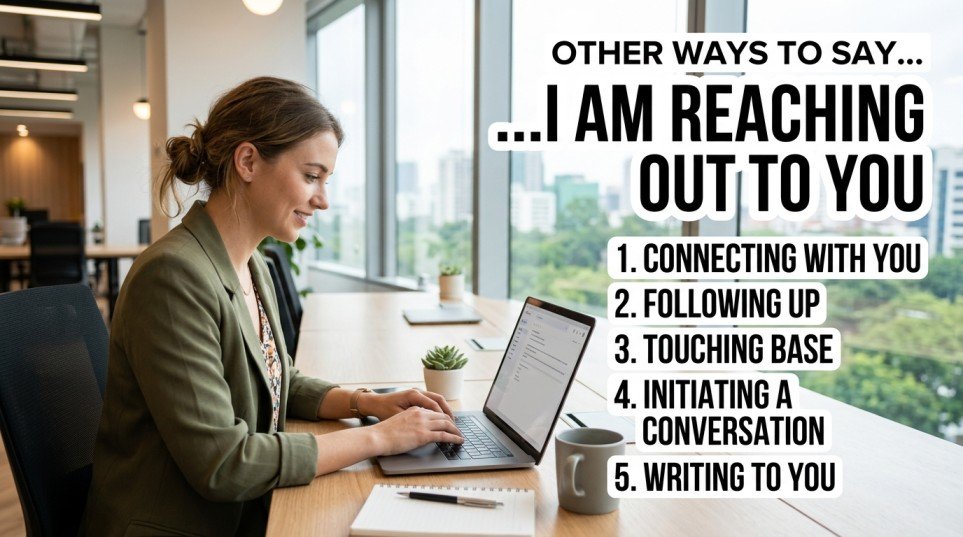
Quick Answer: Instead of saying I am reaching out to you, you can use I’m contacting you, I wanted to connect with you, I’m getting in touch, I’d like to discuss, I’m writing to you.
The phrase “I am reaching out to you” is commonly used in emails, professional communication, networking messages, and customer service interactions. It signals that someone is initiating contact for a specific reason.
Although the phrase is widely accepted, it has become somewhat overused in business writing. Using different expressions can make your communication sound fresher, more natural, and better suited to specific situations.
Learning alternatives to “I am reaching out to you” helps improve your professional writing skills and communication confidence. It also expands your vocabulary and helps you sound more fluent when communicating in English.
Quick Categories Section
Formal alternatives to “I am reaching out to you”
- I am writing to inquire
- I would like to discuss
- I am contacting you regarding
- I wish to bring to your attention
Pro Tip: These options work well in formal emails, academic communication, and business correspondence.
Casual alternatives
- I wanted to connect
- Just checking in
- I wanted to touch base
- I thought I’d reach out
Pro Tip: Use these when communicating with colleagues, friends, or familiar contacts.
Professional alternatives
- I am contacting you
- I am getting in touch
- I would like to follow up
- I’m writing regarding
Pro Tip: These phrases sound polished without being overly formal.
Informal expressions
- Dropping you a quick note
- Just wanted to say hi
- Wanted to catch up
- Thought I’d check in
Pro Tip: Reserve these for casual conversations and friendly messages.
“Professional communication sounds stronger when you choose precise language.”
Common Mistakes
- Using “reaching out” too frequently
Example: Every email begins with “I’m reaching out to you.” - Being too vague
Example: “I’m reaching out” without explaining why. - Using casual alternatives in formal emails
Example: “Just wanted to say hi” to a potential client. - Writing unnecessarily long introductions
Example: Three sentences before explaining the purpose. - Choosing the wrong tone for the audience
Example: Using highly formal language with close coworkers.
What Does “I Am Reaching Out to You” Mean?
The phrase means initiating communication with someone for a specific purpose, request, discussion, or opportunity.
Grammatically, it is a present continuous construction commonly used in professional communication.
Example Sentence:
I am reaching out to you regarding our upcoming project meeting.
When to Use “I Am Reaching Out to You”
- Business emails
- Networking messages
- Client communication
- Follow-up emails
- Customer support interactions
- Professional introductions
Spoken vs Written: Primarily written but occasionally spoken.
Formal vs Informal: Neutral and professional.
Is It Professional or Polite to Say “I Am Reaching Out to You”?
Polite? ✔️ Yes
Professional? ✔️ Yes
Business Example:
“I am reaching out to you regarding the proposal submitted last week.”
Pros and Cons of Using “I Am Reaching Out to You”
Pros
- Professional tone
- Widely accepted
- Clear intention
- Suitable for many situations
Cons
- Overused in business writing
- Can sound generic
- Less direct than alternatives
- Sometimes feels impersonal
“The best business writing is clear, direct, and purposeful.”
Other Ways to Say “I Am Reaching Out to You” (With Examples)
These alternatives will help you sound more fluent, confident, and professional in different situations.
Use them according to your audience, purpose, and communication style.
1. Phrase: I am contacting you
Meaning: I am communicating with you directly.
Explanation: A clear and professional alternative.
Example Sentence: I am contacting you regarding your recent inquiry.
Best Use: business email
Worst Use: close friends
Tone: professional, direct
Context Variability: professional / written
2. Phrase: I am writing to you
Meaning: I am sending this message for a reason.
Explanation: One of the most common professional openings.
Example Sentence: I am writing to you about the upcoming event.
Best Use: formal emails
Worst Use: casual texting
Tone: professional, neutral
Context Variability: professional / written
3. Phrase: I wanted to connect with you
Meaning: I would like to establish communication.
Explanation: Popular in networking situations.
Example Sentence: I wanted to connect with you after seeing your presentation.
Best Use: networking
Worst Use: legal correspondence
Tone: friendly, professional
Context Variability: professional / casual
4. Phrase: I am getting in touch
Meaning: I am initiating contact.
Explanation: Friendly yet professional.
Example Sentence: I am getting in touch regarding your application.
Best Use: workplace communication
Worst Use: highly formal documents
Tone: professional, approachable
Context Variability: professional / spoken
5. Phrase: I would like to discuss
Meaning: I want to talk about a specific topic.
Explanation: Focuses on the purpose of communication.
Example Sentence: I would like to discuss potential partnership opportunities.
Best Use: business meetings
Worst Use: casual chat
Tone: formal, professional
Context Variability: professional / written
“Direct communication often sounds more confident than generic phrases.”
6. Phrase: I am following up
Meaning: I am checking on a previous discussion.
Explanation: Common in business communication.
Example Sentence: I am following up on our meeting last week.
Best Use: follow-ups
Worst Use: first contact
Tone: professional, direct
Context Variability: professional
7. Phrase: I am writing regarding
Meaning: This message concerns a specific matter.
Explanation: Formal and concise.
Example Sentence: I am writing regarding your recent request.
Best Use: formal emails
Worst Use: friendly conversations
Tone: professional, formal
Context Variability: written
8. Phrase: I wanted to touch base
Meaning: I want to briefly reconnect.
Explanation: Common workplace expression.
Example Sentence: I wanted to touch base about the project timeline.
Best Use: coworkers
Worst Use: legal communication
Tone: friendly, professional
Context Variability: workplace
9. Phrase: I wish to inform you
Meaning: I want to provide information.
Explanation: Formal communication phrase.
Example Sentence: I wish to inform you of recent changes.
Best Use: official notices
Worst Use: casual messages
Tone: formal, professional
Context Variability: professional
10. Phrase: I am writing to inquire
Meaning: I am seeking information.
Explanation: Common for requests and questions.
Example Sentence: I am writing to inquire about your services.
Best Use: inquiries
Worst Use: social conversations
Tone: formal, professional
Context Variability: written
11. Phrase: I wanted to check in
Meaning: I am seeing how things are going.
Explanation: Friendly and conversational.
Example Sentence: I wanted to check in on your progress.
Best Use: colleagues
Worst Use: formal notices
Tone: friendly, supportive
Context Variability: casual / professional
12. Phrase: I would like to follow up
Meaning: Continue a previous conversation.
Explanation: Professional and widely accepted.
Example Sentence: I would like to follow up on our discussion.
Best Use: business communication
Worst Use: first introductions
Tone: professional, polite
Context Variability: professional
13. Phrase: I am reaching out regarding
Meaning: Contacting someone about a specific matter.
Explanation: Slightly more specific version.
Example Sentence: I am reaching out regarding the contract review.
Best Use: business emails
Worst Use: personal chats
Tone: professional, neutral
Context Variability: written
14. Phrase: I would appreciate your input
Meaning: Requesting advice or feedback.
Explanation: Focuses on collaboration.
Example Sentence: I would appreciate your input on this proposal.
Best Use: teamwork
Worst Use: informal texts
Tone: respectful, professional
Context Variability: professional
15. Phrase: I wanted to discuss
Meaning: Introduce a topic for conversation.
Explanation: Direct and purposeful.
Example Sentence: I wanted to discuss the upcoming deadline.
Best Use: meetings
Worst Use: casual greetings
Tone: professional, direct
Context Variability: professional
“Clear purpose is more important than fancy wording.”
16. Phrase: I am writing concerning
Meaning: Referring to a specific issue.
Explanation: Formal business language.
Example Sentence: I am writing concerning your recent request.
Best Use: formal correspondence
Worst Use: casual messages
Tone: formal, professional
Context Variability: written
17. Phrase: I would like to bring to your attention
Meaning: Highlighting important information.
Explanation: Used for significant matters.
Example Sentence: I would like to bring to your attention an important update.
Best Use: announcements
Worst Use: casual conversations
Tone: formal, professional
Context Variability: professional
18. Phrase: I wanted to introduce myself
Meaning: Beginning a new connection.
Explanation: Useful for networking.
Example Sentence: I wanted to introduce myself and learn more about your work.
Best Use: networking
Worst Use: ongoing discussions
Tone: friendly, professional
Context Variability: professional
19. Phrase: I thought I’d reach out
Meaning: Decided to initiate contact.
Explanation: Casual variation.
Example Sentence: I thought I’d reach out and see how things are going.
Best Use: informal networking
Worst Use: legal documents
Tone: friendly, casual
Context Variability: casual
20. Phrase: I am emailing you
Meaning: Sending an email for a purpose.
Explanation: Very direct.
Example Sentence: I am emailing you about the project schedule.
Best Use: workplace
Worst Use: phone conversations
Tone: direct, professional
Context Variability: written
21. Phrase: I wanted to make contact
Meaning: Establish communication.
Explanation: Slightly formal.
Example Sentence: I wanted to make contact regarding future opportunities.
Best Use: networking
Worst Use: casual chats
Tone: professional, formal
Context Variability: professional
22. Phrase: I am communicating with you
Meaning: Sharing information directly.
Explanation: Formal and straightforward.
Example Sentence: I am communicating with you about recent developments.
Best Use: official communication
Worst Use: friendly emails
Tone: formal, direct
Context Variability: professional
23. Phrase: I wanted to get in touch
Meaning: Initiate communication.
Explanation: Friendly and common.
Example Sentence: I wanted to get in touch regarding the event.
Best Use: networking
Worst Use: formal notices
Tone: friendly, professional
Context Variability: casual / professional
24. Phrase: I am writing with regard to
Meaning: Referring to a specific topic.
Explanation: Formal email phrase.
Example Sentence: I am writing with regard to your application.
Best Use: business writing
Worst Use: casual messages
Tone: formal, professional
Context Variability: written
25. Phrase: I wanted to ask about
Meaning: Seeking information.
Explanation: Direct inquiry.
Example Sentence: I wanted to ask about your availability.
Best Use: questions
Worst Use: official announcements
Tone: friendly, direct
Context Variability: professional / casual
26. Phrase: I hope to connect with you
Meaning: Seeking future communication.
Explanation: Networking-friendly expression.
Example Sentence: I hope to connect with you soon.
Best Use: networking
Worst Use: urgent requests
Tone: positive, professional
Context Variability: professional
27. Phrase: I wanted to reach out personally
Meaning: Creating a personal connection.
Explanation: More warm and individualized.
Example Sentence: I wanted to reach out personally to thank you.
Best Use: appreciation messages
Worst Use: automated emails
Tone: warm, professional
Context Variability: professional
28. Phrase: I am sending this message to
Meaning: Explaining the purpose of contact.
Explanation: Straightforward and clear.
Example Sentence: I am sending this message to request information.
Best Use: formal communication
Worst Use: friendly chat
Tone: direct, professional
Context Variability: written
29. Phrase: I wanted to share
Meaning: Providing information or updates.
Explanation: Friendly and collaborative.
Example Sentence: I wanted to share an update with you.
Best Use: teamwork
Worst Use: legal notices
Tone: positive, professional
Context Variability: professional
30. Phrase: I would like to connect
Meaning: Establish communication or relationship.
Explanation: Popular in networking and business.
Example Sentence: I would like to connect to discuss future opportunities.
Best Use: networking
Worst Use: urgent complaints
Tone: professional, friendly
Context Variability: professional / casual
“Professional English becomes more effective when every phrase has a purpose.”
Mini Quiz / Self-Check
1. Which phrase is best for a formal inquiry?
A. I wanted to touch base
B. I am writing to inquire
C. Just checking in
Answer: B
2. Which phrase is most suitable for networking?
A. I would like to connect
B. I wish to inform you
Answer: A
3. Which phrase is best for a follow-up email?
A. I am following up
B. I wanted to introduce myself
Answer: A
Comparison Table: Top Alternatives
| Phrase | Tone | Best Use |
|---|---|---|
| I am contacting you | Professional | Business emails |
| I am writing to you | Neutral | General communication |
| I wanted to connect | Friendly | Networking |
| I am getting in touch | Professional | Workplace |
| I would like to discuss | Formal | Meetings |
| I am following up | Professional | Follow-ups |
| I am writing regarding | Formal | Business writing |
| I wanted to touch base | Friendly | Colleagues |
| I am writing to inquire | Formal | Requests |
| I would like to connect | Professional | Networking |
FAQs
1. What can I say instead of “I am reaching out to you”?
You can use phrases like I am contacting you, I am writing to you, or I would like to connect.
2. Is “I am reaching out to you” professional?
Yes, it is professional and commonly used in business communication.
3. Why is “reaching out” considered overused?
Many professionals use it frequently, making it sound generic in emails.
4. What is the most formal alternative?
I am writing to inquire and I wish to bring to your attention are highly formal options.
5. What phrase works best for networking?
I wanted to connect with you and I would like to connect are excellent networking phrases.
Conclusion
Learning other ways to say “I am reaching out to you” helps you write more engaging, professional, and effective messages. Different situations require different tones, and having multiple options improves your communication skills.
Practice these alternatives in emails, networking messages, and workplace communication. The more variety you use, the more natural and confident your English will sound.
CTA: Which alternative do you use most often? Try replacing it with a new phrase in your next email.
Discover More:-
- Other Ways to Say Please Let Me Know What You Think (30+ Examples)
- Other Ways to Say Thank You for Taking Care of This (30+ Examples)

Lisa Thompson is a USA-based content writer and language specialist focused on grammar, writing improvement and digital publishing.
She holds a degree in English Language and Communication and has professional experience in educational and web content creation.
As the author of Gramtivo.Com, she aims to help readers improve their writing skills through clear and practical guidance.