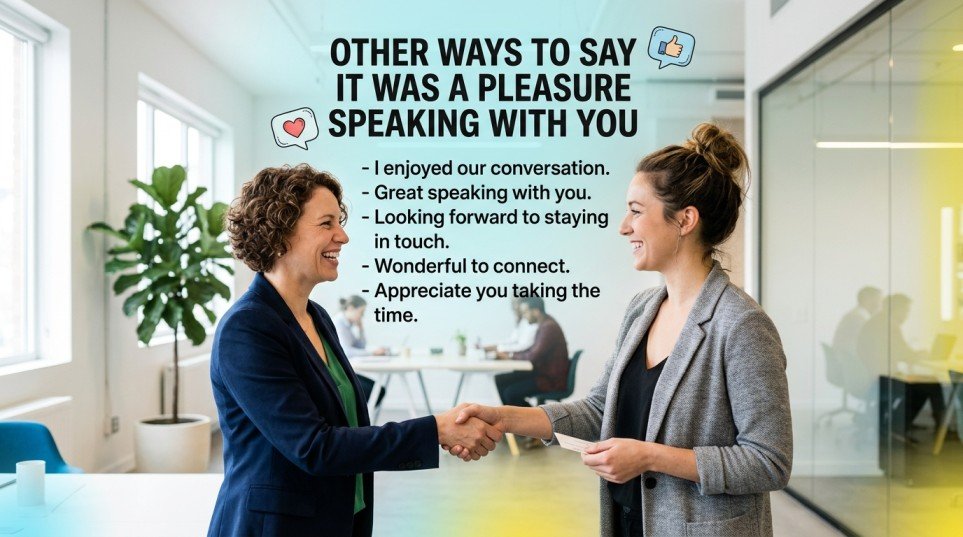
Quick Answer: Instead of saying it was a pleasure speaking with you, you can use I enjoyed our conversation, it was great talking with you, I appreciated our discussion, it was wonderful connecting with you, I’m glad we had the chance to talk.
The phrase “it was a pleasure speaking with you” is a polite way to end a conversation on a positive note. It expresses appreciation for the interaction and leaves a favorable impression.
People commonly use it after meetings, interviews, networking events, phone calls, and professional discussions. While effective, using the same expression repeatedly can make your communication sound repetitive.
Learning alternatives to “it was a pleasure speaking with you” helps you sound more natural, professional, and fluent. It also expands your vocabulary, improves workplace communication, and helps you express excitement in English when reflecting on a meaningful conversation.
Quick Categories Section
Formal alternatives to “it was a pleasure speaking with you”
- I appreciated our discussion
- It was a delight speaking with you
- Thank you for the conversation
- I valued our exchange
Pro Tip: These expressions work well in formal emails, interviews, and business correspondence.
Casual alternatives
- Great talking with you
- Nice chatting with you
- I enjoyed our conversation
- It was fun talking with you
Pro Tip: Use these with friends, colleagues, and acquaintances in relaxed settings.
Professional alternatives
- I appreciate your time today
- It was wonderful connecting with you
- I enjoyed speaking with you today
- Thank you for taking the time to speak with me
Pro Tip: These phrases are excellent for follow-up emails and networking messages.
Informal expressions
- Good catching up with you
- Loved our chat
- Glad we talked
- Always great talking to you
Pro Tip: Keep these for friendly conversations rather than formal communication.
“A strong closing phrase can leave a lasting positive impression.”
Common Mistakes
- Using overly formal phrases with close friends
Example: “It was a delight speaking with you” may sound unnatural among friends. - Using casual expressions after job interviews
Example: “Loved our chat” sounds too informal. - Repeating the same phrase in every email
Example: Ending every message with “it was a pleasure speaking with you.” - Forgetting to match tone with context
Example: Using “nice chatting with you” in a formal business proposal. - Making the phrase sound generic
Example: Using the expression without personalizing your message.
What Does “It Was a Pleasure Speaking with You” Mean?
It means you enjoyed the conversation and appreciated the opportunity to talk with the other person.
Grammatically, it is a past-tense expression used after a conversation has taken place.
Example Sentence:
It was a pleasure speaking with you today about the project.
When to Use “It Was a Pleasure Speaking with You”
- After business meetings
- Following interviews
- At the end of phone calls
- After networking conversations
- In follow-up emails
- In professional and personal communication
Spoken vs Written: Common in both
Formal vs Informal: Generally professional and polite
Is It Professional or Polite to Say “It Was a Pleasure Speaking with You”?
Polite? ✔️ Yes
Professional? ✔️ Yes
Business Example:
“Thank you for your insights today. It was a pleasure speaking with you, and I look forward to staying in touch.”
Pros and Cons of Using “It Was a Pleasure Speaking with You”
Pros
- Professional and polite
- Creates a positive impression
- Suitable for many situations
- Easy to understand
Cons
- Can sound repetitive
- Slightly formal for casual conversations
- Commonly overused
- May feel generic without personalization
“The best communicators know how to vary their language while keeping the same meaning.”
Other Ways to Say “It Was a Pleasure Speaking with You” (With Examples)
These alternatives will help you sound more fluent, confident, and natural in different situations.
Use them according to tone, context, and audience.
1. Phrase: I enjoyed our conversation
Meaning: You found the discussion enjoyable.
Explanation: Warm and versatile expression.
Example Sentence: I enjoyed our conversation and learned a lot from your insights.
Best Use: general communication
Worst Use: highly formal documents
Tone: warm, friendly
Context Variability: casual / professional / spoken
2. Phrase: It was great talking with you
Meaning: You had a positive conversation.
Explanation: Common and natural alternative.
Example Sentence: It was great talking with you today.
Best Use: everyday communication
Worst Use: legal correspondence
Tone: positive, friendly
Context Variability: casual / professional
3. Phrase: I appreciated our discussion
Meaning: You valued the exchange of ideas.
Explanation: Professional and respectful.
Example Sentence: I appreciated our discussion regarding the upcoming project.
Best Use: workplace communication
Worst Use: casual texting
Tone: professional, respectful
Context Variability: professional / written
4. Phrase: It was wonderful connecting with you
Meaning: You were happy to establish or strengthen a connection.
Explanation: Popular networking phrase.
Example Sentence: It was wonderful connecting with you at the conference.
Best Use: networking events
Worst Use: highly informal chats
Tone: professional, warm
Context Variability: professional / spoken
5. Phrase: I’m glad we had the chance to talk
Meaning: You appreciate the opportunity to converse.
Explanation: Personal and sincere.
Example Sentence: I’m glad we had the chance to talk today.
Best Use: personal conversations
Worst Use: formal reports
Tone: sincere, friendly
Context Variability: casual / professional
“Small wording changes can make your communication sound more genuine.”
6. Phrase: Thank you for the conversation
Meaning: You appreciate the discussion.
Explanation: Direct and polite.
Example Sentence: Thank you for the conversation today.
Best Use: follow-up emails
Worst Use: close friendships
Tone: professional, polite
Context Variability: professional / written
7. Phrase: It was a delight speaking with you
Meaning: You greatly enjoyed the interaction.
Explanation: More formal and elegant.
Example Sentence: It was a delight speaking with you this afternoon.
Best Use: formal communication
Worst Use: casual texting
Tone: formal, gracious
Context Variability: professional
8. Phrase: I valued our exchange
Meaning: You found the discussion meaningful.
Explanation: Formal and thoughtful.
Example Sentence: I valued our exchange and your perspective.
Best Use: executive communication
Worst Use: casual conversations
Tone: professional, respectful
Context Variability: professional
9. Phrase: Nice chatting with you
Meaning: You enjoyed a casual conversation.
Explanation: Friendly and informal.
Example Sentence: Nice chatting with you earlier.
Best Use: casual interactions
Worst Use: formal interviews
Tone: casual, pleasant
Context Variability: casual / spoken
10. Phrase: It was nice getting to know you
Meaning: You enjoyed learning about the person.
Explanation: Common after first meetings.
Example Sentence: It was nice getting to know you today.
Best Use: networking
Worst Use: long-term colleagues
Tone: warm, friendly
Context Variability: casual / professional
11. Phrase: I appreciate your time today
Meaning: You value the person’s time.
Explanation: Professional and respectful.
Example Sentence: I appreciate your time today and your valuable insights.
Best Use: business meetings
Worst Use: casual chats
Tone: professional, courteous
Context Variability: professional
12. Phrase: I enjoyed speaking with you today
Meaning: You found the conversation pleasant.
Explanation: Direct and professional.
Example Sentence: I enjoyed speaking with you today about the position.
Best Use: interviews
Worst Use: informal texting
Tone: professional, positive
Context Variability: professional
13. Phrase: Thank you for taking the time to speak with me
Meaning: You appreciate the opportunity.
Explanation: Formal and respectful.
Example Sentence: Thank you for taking the time to speak with me today.
Best Use: follow-up emails
Worst Use: casual conversations
Tone: professional, appreciative
Context Variability: professional / written
14. Phrase: It was lovely talking with you
Meaning: You enjoyed the interaction.
Explanation: Warm and friendly.
Example Sentence: It was lovely talking with you this morning.
Best Use: friendly communication
Worst Use: legal correspondence
Tone: warm, pleasant
Context Variability: casual / spoken
15. Phrase: I’m grateful for our conversation
Meaning: You appreciate the discussion deeply.
Explanation: More heartfelt expression.
Example Sentence: I’m grateful for our conversation and advice.
Best Use: mentorship situations
Worst Use: casual small talk
Tone: appreciative, sincere
Context Variability: professional / personal
“The right closing phrase can strengthen relationships and build trust.”
16. Phrase: Great speaking with you
17. Phrase: I truly enjoyed our discussion
18. Phrase: It was fantastic talking with you
19. Phrase: I appreciated the opportunity to connect
20. Phrase: Thank you for your insights
21. Phrase: It was a privilege speaking with you
22. Phrase: I enjoyed our exchange of ideas
23. Phrase: It was refreshing talking with you
24. Phrase: I’m happy we connected
25. Phrase: It was rewarding speaking with you
26. Phrase: I enjoyed hearing your perspective
27. Phrase: I’m thankful for our discussion
28. Phrase: It was meaningful speaking with you
29. Phrase: I appreciated getting to know you
30. Phrase: I look forward to speaking with you again
“Fluent speakers choose phrases that match both the situation and the relationship.”
Mini Quiz / Self-Check
1. Which phrase is best after a job interview?
A. Nice chatting with you
B. Thank you for taking the time to speak with me
C. Loved our chat
Answer: B
2. Which phrase is most casual?
A. I valued our exchange
B. Nice chatting with you
C. It was a privilege speaking with you
Answer: B
3. Which phrase is ideal for networking?
A. It was wonderful connecting with you
B. Loved our chat
C. Good catching up
Answer: A
Comparison Table: Top Alternatives
| Phrase | Tone | Best Use |
|---|---|---|
| I enjoyed our conversation | Warm | General use |
| It was great talking with you | Friendly | Everyday communication |
| I appreciated our discussion | Professional | Meetings |
| It was wonderful connecting with you | Professional | Networking |
| I’m glad we had the chance to talk | Sincere | Personal conversations |
| Thank you for the conversation | Professional | Follow-up emails |
| It was a delight speaking with you | Formal | Business communication |
| I valued our exchange | Respectful | Executive communication |
| Nice chatting with you | Casual | Friendly interactions |
| I appreciate your time today | Professional | Workplace discussions |
FAQs
1. What are the best alternatives to “it was a pleasure speaking with you”?
Some of the best alternatives include I enjoyed our conversation, it was wonderful connecting with you, and I appreciated our discussion.
2. Is “it was a pleasure speaking with you” professional?
Yes, it is both professional and polite, making it suitable for business communication.
3. What can I say after a job interview instead?
You can say thank you for taking the time to speak with me or I enjoyed speaking with you today.
4. Is “nice chatting with you” professional?
It is generally more casual and better suited for informal conversations.
5. Why learn other ways to say “it was a pleasure speaking with you”?
Learning alternatives improves fluency, prevents repetition, and helps you adapt your tone to different situations.
Conclusion
Learning other ways to say “it was a pleasure speaking with you” helps you communicate more naturally, professionally, and confidently. Different situations require different tones, and having multiple expressions available makes your English more versatile.
Practice these alternatives regularly and pay attention to context. Over time, you’ll develop stronger communication skills and leave more positive impressions in both personal and professional interactions.
CTA: Which alternative do you use most often? Try using a new one in your next conversation.
Discover More:-
- Other Ways to Say Please Forward This Email (30+ Examples)
- Other Ways to Say Thank You for Your Understanding (30+ Examples)

Robert Mitchell is a U.S.-based writer at Gramtivo.Com who focuses on grammar, writing improvement, and language-related content. He holds a degree in English and Linguistics from a U.S. university. His work aims to help readers enhance their writing skills with clear and practical guidance.