
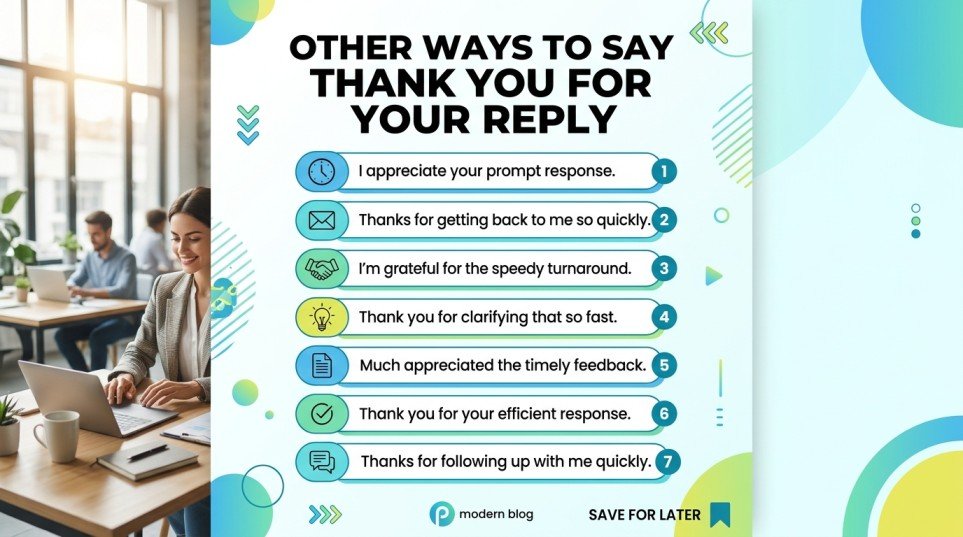
Quick Answer: Instead of saying thank you for your reply, you can say I appreciate your response, thanks for getting back to me, thank you for your prompt reply, I’m grateful for your feedback, thanks for responding.
The phrase “thank you for your reply” is a polite way to acknowledge and appreciate someone’s response to your message, email, question, or request.
Although it is widely used and understood, repeating the same expression can make your communication sound repetitive. Native English speakers often choose different phrases depending on the level of formality and the situation.
Learning alternatives to “thank you for your reply” helps you sound more natural, professional, and confident. It also improves your writing skills, expands your vocabulary, and allows you to express excitement in English while maintaining the appropriate tone.
Quick Categories Section
Formal alternatives to “thank you for your reply”
- I appreciate your response
- Thank you for your prompt reply
- Thank you for your timely response
- I am grateful for your reply
Pro Tip: Use these in business emails, customer service communication, and formal correspondence.
Casual alternatives
- Thanks for getting back to me
- Thanks for responding
- Appreciate the reply
- Thanks for the update
Pro Tip: These work well in everyday conversations and informal emails.
Professional alternatives
- Thank you for your feedback
- I appreciate your quick response
- Thank you for addressing my concerns
- Many thanks for your response
Pro Tip: These phrases sound polished and workplace-appropriate.
Informal expressions
- Thanks for writing back
- Glad to hear from you
- Thanks for the quick note
- Appreciate you getting back to me
Pro Tip: Save these for colleagues you know well or casual conversations.
“Professional communication becomes stronger when you vary your expressions of appreciation.”
Common Mistakes
- Using the same phrase repeatedly Example: Starting every email with “Thank you for your reply.”
- Being too informal in professional emails Example: “Thanks a bunch for getting back to me!”
- Overly formal wording in casual conversations Example: “I am sincerely grateful for your correspondence.”
- Forgetting to acknowledge the response Example: Replying without thanking someone who helped you.
- Using excessive gratitude Example: “Thank you so much, greatly appreciated, many thanks, forever grateful.”
What Does “Thank You for Your Reply” Mean?
The phrase “thank you for your reply” means that you appreciate someone taking the time to respond to your message.
Grammatically, it is a polite expression of gratitude directed toward a response or communication.
Example Sentence:
Thank you for your reply. I appreciate the information you provided.
When to Use “Thank You for Your Reply”
- After receiving an email response
- When someone answers your question
- During customer service interactions
- In professional communication
- In academic correspondence
- During business negotiations
Spoken vs Written: More common in writing
Formal vs Informal: Neutral and professional
Is It Professional or Polite to Say “Thank You for Your Reply”?
Polite? ✔️ Yes
Professional? ✔️ Yes
Unlike many appreciation phrases, “thank you for your reply” is both polite and professional, making it suitable for workplace communication.
Business Example:
“Thank you for your reply. I appreciate your clarification regarding the project timeline.”
Pros and Cons of Using “Thank You for Your Reply”
Pros
- Professional and respectful
- Easy to understand
- Suitable for most situations
- Widely accepted in business communication
Cons
- Can become repetitive
- Lacks personality
- Sometimes sounds generic
- May feel formal in casual conversations
“The best communicators know when to vary their language without losing professionalism.”
Other Ways to Say “Thank You for Your Reply” (With Examples)
These alternatives will help you sound more fluent, confident, and natural in different situations.
Use them according to tone, context, and audience to improve your communication skills.
1. Phrase: I Appreciate Your Response
Meaning: I value the time you took to reply.
Explanation: Professional and respectful.
Example Sentence: I appreciate your response and the information you provided.
Best Use: business email
Worst Use: casual texting
Tone: professional, polite
Context Variability: professional / written
2. Phrase: Thanks for Getting Back to Me
Meaning: Thank you for responding.
Explanation: Common and friendly.
Example Sentence: Thanks for getting back to me so quickly.
Best Use: workplace chat
Worst Use: legal correspondence
Tone: friendly, professional
Context Variability: casual / professional
3. Phrase: Thank You for Your Prompt Reply
Meaning: Thank you for responding quickly.
Explanation: Highlights speed of response.
Example Sentence: Thank you for your prompt reply regarding my request.
Best Use: business communication
Worst Use: casual texting
Tone: formal, professional
Context Variability: professional / written
4. Phrase: Thanks for Responding
Meaning: Thank you for answering.
Explanation: Simple and versatile.
Example Sentence: Thanks for responding to my question.
Best Use: everyday email
Worst Use: formal letter
Tone: neutral, friendly
Context Variability: casual / professional
5. Phrase: Many Thanks for Your Response
Meaning: A stronger expression of gratitude.
Explanation: Sounds professional and warm.
Example Sentence: Many thanks for your response and assistance.
Best Use: formal email
Worst Use: text messages
Tone: professional, appreciative
Context Variability: professional / written
“A thoughtful thank-you can strengthen both personal and professional relationships.”
6. Phrase: Thank You for Getting Back to Me
Meaning: Thank you for replying.
Explanation: One of the most common alternatives.
Example Sentence: Thank you for getting back to me regarding the proposal.
Best Use: work communication
Worst Use: highly formal documents
Tone: professional, friendly
Context Variability: professional / casual
7. Phrase: I’m Grateful for Your Reply
Meaning: I sincerely appreciate your response.
Explanation: More heartfelt than standard thanks.
Example Sentence: I’m grateful for your reply and support.
Best Use: thoughtful messages
Worst Use: routine business emails
Tone: warm, sincere
Context Variability: personal / professional
8. Phrase: Thank You for the Update
Meaning: Thank you for sharing new information.
Explanation: Useful when someone provides progress details.
Example Sentence: Thank you for the update on the project.
Best Use: workplace
Worst Use: direct answers
Tone: professional, appreciative
Context Variability: professional
9. Phrase: Appreciate the Reply
Meaning: I appreciate your response.
Explanation: Short and conversational.
Example Sentence: Appreciate the reply and clarification.
Best Use: quick messages
Worst Use: formal correspondence
Tone: casual, friendly
Context Variability: casual
10. Phrase: Thank You for Your Quick Response
Meaning: Thank you for replying quickly.
Explanation: Emphasizes promptness.
Example Sentence: Thank you for your quick response to my inquiry.
Best Use: business email
Worst Use: casual chat
Tone: professional, appreciative
Context Variability: professional
11. Phrase: Thanks for Writing Back
Meaning: Thank you for replying.
Explanation: Casual and friendly.
Example Sentence: Thanks for writing back so soon.
Best Use: casual email
Worst Use: formal reports
Tone: friendly, informal
Context Variability: casual
12. Phrase: I Appreciate Your Feedback
Meaning: Thank you for sharing your thoughts.
Explanation: Ideal when receiving opinions or suggestions.
Example Sentence: I appreciate your feedback on the presentation.
Best Use: reviews
Worst Use: simple replies
Tone: professional, respectful
Context Variability: professional
13. Phrase: Thank You for Addressing My Concerns
Meaning: Thank you for answering my questions.
Explanation: Useful in support or business situations.
Example Sentence: Thank you for addressing my concerns so thoroughly.
Best Use: customer service
Worst Use: casual conversation
Tone: professional, appreciative
Context Variability: professional
14. Phrase: Glad to Hear from You
Meaning: Happy to receive your response.
Explanation: Friendly and warm.
Example Sentence: Glad to hear from you after all this time.
Best Use: personal messages
Worst Use: formal communication
Tone: warm, friendly
Context Variability: casual
15. Phrase: Thanks for the Information
Meaning: Thank you for providing details.
Explanation: Appropriate when someone answers a question.
Example Sentence: Thanks for the information. It was very helpful.
Best Use: informational replies
Worst Use: emotional conversations
Tone: appreciative, neutral
Context Variability: casual / professional
“The right expression can make your gratitude sound genuine rather than routine.”
16. Phrase: Thank You for Your Timely Response
Meaning: Thank you for replying promptly.
Explanation: Professional and formal.
Example Sentence: Thank you for your timely response to my request.
Best Use: business emails
Worst Use: casual texts
Tone: formal, professional
Context Variability: professional
17. Phrase: I Value Your Response
Meaning: Your reply is important to me.
Explanation: Shows respect for the person’s input.
Example Sentence: I value your response and insights.
Best Use: professional communication
Worst Use: casual chats
Tone: respectful, professional
Context Variability: professional
18. Phrase: Thank You for Reaching Out
Meaning: Thank you for contacting me.
Explanation: Common in customer support and business.
Example Sentence: Thank you for reaching out regarding this issue.
Best Use: customer service
Worst Use: direct responses
Tone: professional, welcoming
Context Variability: professional
19. Phrase: I Appreciate You Taking the Time to Reply
Meaning: Thank you for making the effort to respond.
Explanation: Shows deeper appreciation.
Example Sentence: I appreciate you taking the time to reply.
Best Use: meaningful responses
Worst Use: quick chats
Tone: sincere, professional
Context Variability: professional
20. Phrase: Thank You for Your Insight
Meaning: Thank you for sharing your perspective.
Explanation: Best when receiving advice.
Example Sentence: Thank you for your insight on this matter.
Best Use: expert feedback
Worst Use: simple replies
Tone: professional, respectful
Context Variability: professional
21. Phrase: Much Appreciated
Meaning: Thank you very much.
Explanation: Short but appreciative.
Example Sentence: Your quick response is much appreciated.
Best Use: emails
Worst Use: formal letters
Tone: friendly, appreciative
Context Variability: casual / professional
22. Phrase: Thank You for Clarifying
Meaning: Thank you for explaining.
Explanation: Useful after receiving clarification.
Example Sentence: Thank you for clarifying the policy.
Best Use: workplace
Worst Use: unrelated replies
Tone: professional, appreciative
Context Variability: professional
23. Phrase: Thanks for the Explanation
Meaning: Thank you for explaining.
Explanation: Casual alternative.
Example Sentence: Thanks for the explanation. It makes sense now.
Best Use: everyday communication
Worst Use: formal documents
Tone: friendly, appreciative
Context Variability: casual
24. Phrase: Thank You for the Detailed Response
Meaning: Thank you for providing comprehensive information.
Explanation: Ideal when someone gives a thorough answer.
Example Sentence: Thank you for the detailed response.
Best Use: business communication
Worst Use: short replies
Tone: professional, appreciative
Context Variability: professional
25. Phrase: I Appreciate the Information
Meaning: Thank you for sharing details.
Explanation: Common workplace phrase.
Example Sentence: I appreciate the information you provided.
Best Use: office communication
Worst Use: emotional contexts
Tone: professional, polite
Context Variability: professional
26. Phrase: Thanks for Your Help
Meaning: Thank you for assisting me.
Explanation: Useful when the reply was helpful.
Example Sentence: Thanks for your help with this issue.
Best Use: support situations
Worst Use: unrelated responses
Tone: appreciative, friendly
Context Variability: casual / professional
27. Phrase: Thank You for Your Assistance
Meaning: Thank you for helping me.
Explanation: More formal version of “thanks for your help.”
Example Sentence: Thank you for your assistance throughout the process.
Best Use: professional settings
Worst Use: casual texting
Tone: formal, respectful
Context Variability: professional
28. Phrase: Thanks for the Quick Note
Meaning: Thank you for the brief response.
Explanation: Informal and conversational.
Example Sentence: Thanks for the quick note.
Best Use: casual emails
Worst Use: formal correspondence
Tone: casual, friendly
Context Variability: casual
29. Phrase: Thank You for Following Up
Meaning: Thank you for checking in or providing additional information.
Explanation: Common in business communication.
Example Sentence: Thank you for following up on this matter.
Best Use: workplace communication
Worst Use: initial responses
Tone: professional, appreciative
Context Variability: professional
30. Phrase: Your Response Is Appreciated
Meaning: Your reply is valued.
Explanation: Formal and respectful.
Example Sentence: Your response is appreciated and will be reviewed carefully.
Best Use: formal correspondence
Worst Use: casual texting
Tone: formal, professional
Context Variability: professional / written
“Expanding your vocabulary helps your gratitude sound authentic and engaging.”
Mini Quiz / Self-Check
1. Which phrase is best for a business email?
A. Thanks for writing back
B. Thank you for your prompt reply
C. Glad to hear from you
Answer: B
2. Which phrase is the most casual?
A. I value your response
B. Thanks for writing back
C. Thank you for your timely response
Answer: B
3. Which phrase emphasizes speed?
A. Thank you for your quick response
B. Thank you for your insight
C. Thanks for the information
Answer: A
Comparison Table: Top Alternatives
| Phrase | Tone | Best Use |
|---|---|---|
| I Appreciate Your Response | Professional | Business Emails |
| Thanks for Getting Back to Me | Friendly | Everyday Communication |
| Thank You for Your Prompt Reply | Formal | Professional Emails |
| Thanks for Responding | Neutral | General Use |
| Many Thanks for Your Response | Professional | Formal Messages |
| Thank You for the Update | Professional | Workplace Communication |
| I Appreciate Your Feedback | Respectful | Reviews & Suggestions |
| Thank You for Clarifying | Professional | Explanations |
| Thank You for Your Assistance | Formal | Business Communication |
| Your Response Is Appreciated | Formal | Official Correspondence |
FAQs
1. What are the best alternatives to “thank you for your reply”?
Some of the best options include I appreciate your response, thanks for getting back to me, and thank you for your prompt reply.
2. Is “thank you for your reply” professional?
Yes. It is both professional and polite, making it suitable for most workplace communications.
3. What can I say instead of “thank you for your reply” in an email?
You can use thank you for your quick response, I appreciate your response, or many thanks for your response.
4. What is a formal way to thank someone for replying?
Formal alternatives include thank you for your timely response and your response is appreciated.
5. Why should I learn other ways to say “thank you for your reply”?
Using varied expressions improves fluency, avoids repetition, and makes your communication more engaging.
Conclusion
Learning other ways to say thank you for your reply can significantly improve both your written and spoken English. It helps you avoid repetition while sounding more professional, natural, and confident.
Practice these alternatives regularly and pay attention to context. The more expressions you know, the easier it becomes to choose the perfect phrase for every situation.
CTA: Which of these alternatives do you use most often? Try incorporating a new one into your next email.
Discover More:-
- Other Ways to Say Happy to Be Part of the Team (30+ Examples)
- Other Ways to Say I Look Forward to the Interview (30+ Examples)

Jennifer Collins is a professional grammar expert and language educator at gramtivo.com, specializing in English grammar, writing skills, and language improvement. She holds a Master’s degree in English Language and Literature from a recognized university in the United States. With years of teaching and content development experience, she is dedicated to helping learners improve their communication skills with clear and practical guidance.