
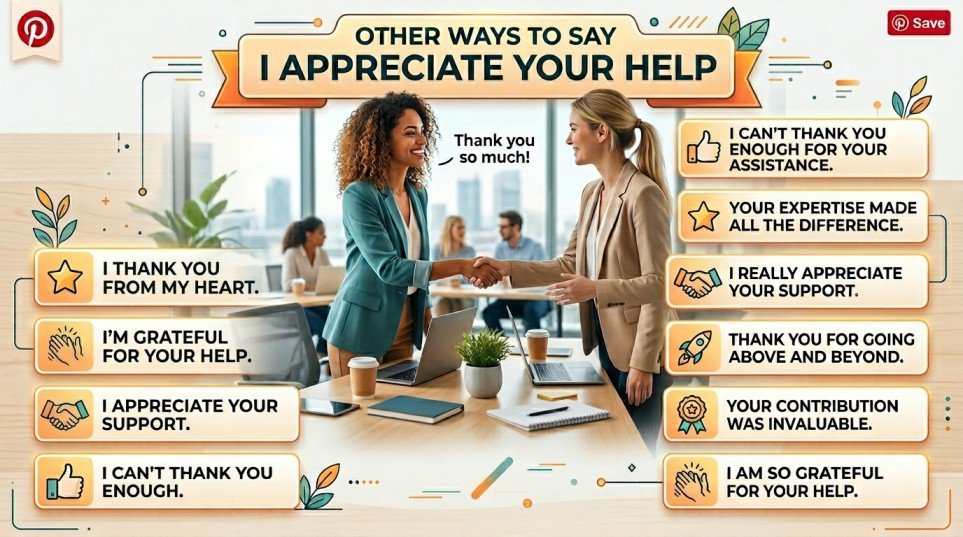
Quick Answer: Instead of saying I appreciate your help, you can use thank you for your support, I’m grateful for your assistance, you’ve been incredibly helpful, thanks for your guidance, I truly value your help.
The phrase “I appreciate your help” is a common and polite way to thank someone for their assistance. It expresses gratitude and acknowledges the effort another person has made on your behalf.
Although it is effective, using the same expression repeatedly can make your communication feel repetitive. Native English speakers often use a variety of phrases depending on the situation, relationship, and level of formality.
Learning alternatives to “I appreciate your help” helps you sound more fluent and natural. It also improves your ability to communicate gratitude in professional and personal settings while expanding your vocabulary and confidence in English.
Quick Categories Section
Formal alternatives to “I appreciate your help”
- I am grateful for your assistance
- Thank you for your support
- Your assistance is greatly appreciated
- I sincerely appreciate your help
Pro Tip: Use these phrases in formal emails, business communication, and professional correspondence.
Casual alternatives
- Thanks for helping out
- You’re a lifesaver
- Thanks a bunch
- I owe you one
Pro Tip: These work best with friends, family members, and close colleagues.
Professional alternatives
- Thank you for your guidance
- I value your support
- Your help has been invaluable
- Thank you for your assistance
Pro Tip: Professional gratitude sounds strongest when it’s specific and sincere.
Informal expressions
- You saved the day
- Much appreciated
- Couldn’t have done it without you
- Thanks a ton
Pro Tip: Informal expressions create warmth but should be avoided in formal business writing.
“Expressing gratitude effectively can strengthen both personal and professional relationships.”
Common Mistakes
- Using the same phrase repeatedly
Ending every email with “I appreciate your help.”
- Being too informal in professional situations
“You’re a lifesaver!” in a formal business email.
- Not matching the level of help received
Saying “Thanks a ton” for major professional assistance.
- Sounding generic
Giving thanks without acknowledging specific support.
- Overusing gratitude expressions
Example: Repeating multiple thank-you phrases in one message.
What Does “I Appreciate Your Help” Mean?
The phrase “I appreciate your help” means that you recognize and value the assistance someone has provided.
Grammatically, it combines the verb appreciate with the noun help to express gratitude.
Example Sentence:
I appreciate your help with the project presentation.
When to Use “I Appreciate Your Help”
- After receiving assistance
- In professional emails
- During workplace collaboration
- When thanking mentors or teachers
- In personal conversations
- After someone solves a problem for you
Spoken vs Written: Common in both
Formal vs Informal: Generally polite and semi-formal
Is It Professional or Polite to Say “I Appreciate Your Help”?
Polite? ✔️ Yes
Professional? ✔️ Yes
Business Example:
“I appreciate your help in completing the client proposal ahead of schedule.”
Pros and Cons of Using “I Appreciate Your Help”
Pros
- Polite and respectful
- Suitable for most situations
- Professional tone
- Easy to understand
Cons
- Can become repetitive
- Lacks emotional variety
- Somewhat generic
- May sound impersonal if overused
“The best gratitude expressions feel sincere, specific, and appropriate to the situation.”
Other Ways to Say “I Appreciate Your Help” (With Examples)
These alternatives will help you sound more fluent, confident, and natural in different situations.
Use them according to tone, context, and audience to express gratitude effectively.
1. Phrase: Thank you for your support
Meaning: Thanking someone for assistance and encouragement.
Explanation: Works well in both personal and professional situations.
Example Sentence: Thank you for your support throughout this project.
Best Use: workplace emails
Worst Use: very casual chats
Tone: professional, grateful
Context Variability: professional / written / spoken
2. Phrase: I’m grateful for your assistance
Meaning: Expressing sincere gratitude for help received.
Explanation: More formal than the original phrase.
Example Sentence: I’m grateful for your assistance during the transition.
Best Use: formal communication
Worst Use: casual texting
Tone: formal, appreciative
Context Variability: professional / written
3. Phrase: Thanks for helping out
Meaning: Thanking someone for lending a hand.
Explanation: Casual and friendly.
Example Sentence: Thanks for helping out with the move.
Best Use: friends
Worst Use: executive emails
Tone: casual, warm
Context Variability: casual / spoken
4. Phrase: Your help means a lot to me
Meaning: Their assistance is personally important.
Explanation: Adds emotional sincerity.
Example Sentence: Your help means a lot to me during this difficult time.
Best Use: personal support
Worst Use: formal reports
Tone: heartfelt, warm
Context Variability: spoken / personal
5. Phrase: I truly value your help
Meaning: You highly appreciate the assistance.
Explanation: Suitable for professional and personal contexts.
Example Sentence: I truly value your help and guidance.
Best Use: workplace
Worst Use: sarcastic situations
Tone: respectful, appreciative
Context Variability: professional / spoken
“A thoughtful thank-you can leave a lasting positive impression.”
6. Phrase: Thank you for your assistance
Meaning: Appreciation for support received.
Explanation: Professional and straightforward.
Example Sentence: Thank you for your assistance with the report.
Best Use: business emails
Worst Use: close friendships
Tone: professional, polite
Context Variability: professional / written
7. Phrase: I’m thankful for your help
Meaning: Expressing gratitude.
Explanation: Simple and sincere.
Example Sentence: I’m thankful for your help during the event.
Best Use: general use
Worst Use: none
Tone: grateful, friendly
Context Variability: spoken / written
8. Phrase: Much appreciated
Meaning: Your help is appreciated.
Explanation: Short but effective.
Example Sentence: Much appreciated for stepping in today.
Best Use: quick messages
Worst Use: formal letters
Tone: casual, grateful
Context Variability: casual / professional
9. Phrase: You’ve been incredibly helpful
Meaning: The person provided significant assistance.
Explanation: Acknowledges effort directly.
Example Sentence: You’ve been incredibly helpful throughout the process.
Best Use: workplace
Worst Use: formal documents
Tone: appreciative, sincere
Context Variability: professional / spoken
10. Phrase: I couldn’t have done it without you
Meaning: Their help was essential.
Explanation: Strong expression of gratitude.
Example Sentence: I couldn’t have done it without you.
Best Use: major support
Worst Use: minor favors
Tone: heartfelt, appreciative
Context Variability: personal / spoken
11. Phrase: Your support has been invaluable
Meaning: Their help was extremely valuable.
Explanation: Professional and powerful.
Example Sentence: Your support has been invaluable to the team.
Best Use: workplace
Worst Use: casual chats
Tone: professional, respectful
Context Variability: professional
12. Phrase: Thanks a ton
Meaning: Thank you very much.
Explanation: Informal gratitude.
Example Sentence: Thanks a ton for helping me move.
Best Use: friends
Worst Use: formal emails
Tone: casual, cheerful
Context Variability: casual
13. Phrase: I sincerely appreciate your support
Meaning: Deep gratitude for support.
Explanation: Formal and professional.
Example Sentence: I sincerely appreciate your support during this project.
Best Use: business communication
Worst Use: casual texting
Tone: professional, sincere
Context Variability: professional
14. Phrase: You saved the day
Meaning: Their help solved a problem.
Explanation: Informal and enthusiastic.
Example Sentence: You saved the day by fixing that issue.
Best Use: casual appreciation
Worst Use: formal meetings
Tone: enthusiastic, friendly
Context Variability: casual
15. Phrase: Thank you for your guidance
Meaning: Appreciation for advice or direction.
Explanation: Common in professional settings.
Example Sentence: Thank you for your guidance throughout the project.
Best Use: mentorship
Worst Use: small favors
Tone: professional, respectful
Context Variability: professional
“The more gratitude phrases you know, the more natural your English will sound.”
16. Phrase: I owe you one
Meaning: You feel indebted for the help.
Explanation: Casual and friendly.
Example Sentence: I owe you one for helping me out.
Best Use: friends
Worst Use: workplace emails
Tone: informal, appreciative
Context Variability: casual
17. Phrase: Thanks for your assistance
Meaning: Appreciation for support.
Explanation: Formal and concise.
Example Sentence: Thanks for your assistance with the paperwork.
Best Use: business use
Worst Use: emotional situations
Tone: professional, polite
Context Variability: professional
18. Phrase: Your help was greatly appreciated
Meaning: The assistance was valued.
Explanation: Common in professional writing.
Example Sentence: Your help was greatly appreciated during the event.
Best Use: formal communication
Worst Use: casual chat
Tone: formal, appreciative
Context Variability: written
19. Phrase: I can’t thank you enough
Meaning: Gratitude exceeds words.
Explanation: Strong emotional appreciation.
Example Sentence: I can’t thank you enough for your kindness.
Best Use: major support
Worst Use: routine tasks
Tone: heartfelt, grateful
Context Variability: personal
20. Phrase: I’m deeply grateful
Meaning: Strong gratitude.
Explanation: More emotional and formal.
Example Sentence: I’m deeply grateful for everything you’ve done.
Best Use: meaningful support
Worst Use: minor favors
Tone: sincere, emotional
Context Variability: spoken / written
21. Phrase: Your assistance was invaluable
Meaning: The help was extremely important.
Explanation: Professional appreciation.
Example Sentence: Your assistance was invaluable during the launch.
Best Use: business settings
Worst Use: casual texts
Tone: professional, respectful
Context Variability: professional
22. Phrase: Many thanks for your help
Meaning: A more formal thank-you.
Explanation: Common in British English.
Example Sentence: Many thanks for your help with the arrangements.
Best Use: emails
Worst Use: very casual talk
Tone: polite, professional
Context Variability: written
23. Phrase: I appreciate everything you’ve done
Meaning: Gratitude for multiple efforts.
Explanation: Comprehensive appreciation.
Example Sentence: I appreciate everything you’ve done for me.
Best Use: ongoing support
Worst Use: small tasks
Tone: warm, sincere
Context Variability: personal / professional
24. Phrase: Thanks for being there
Meaning: Appreciation for support and presence.
Explanation: Often emotional.
Example Sentence: Thanks for being there when I needed help.
Best Use: friendships
Worst Use: formal reports
Tone: warm, personal
Context Variability: personal
25. Phrase: I value your contribution
Meaning: Appreciation for someone’s effort.
Explanation: Common in workplaces.
Example Sentence: I value your contribution to the project.
Best Use: team environments
Worst Use: casual conversations
Tone: professional, respectful
Context Variability: professional
26. Phrase: Thank you for going the extra mile
Meaning: Appreciation for extra effort.
Explanation: Recognizes exceptional support.
Example Sentence: Thank you for going the extra mile to help us succeed.
Best Use: workplace
Worst Use: minor favors
Tone: appreciative, professional
Context Variability: professional
27. Phrase: Your help made a difference
Meaning: Their assistance had an impact.
Explanation: Highlights value.
Example Sentence: Your help made a difference in completing the project.
Best Use: recognition
Worst Use: insignificant tasks
Tone: appreciative, encouraging
Context Variability: professional / personal
28. Phrase: I’m thankful for your support
Meaning: Gratitude for assistance.
Explanation: Similar to the original but more emotional.
Example Sentence: I’m thankful for your support and encouragement.
Best Use: personal support
Worst Use: none
Tone: warm, grateful
Context Variability: spoken / written
29. Phrase: You’ve been a huge help
Meaning: The person provided significant assistance.
Explanation: Friendly and natural.
Example Sentence: You’ve been a huge help this week.
Best Use: everyday use
Worst Use: formal reports
Tone: friendly, appreciative
Context Variability: casual / spoken
30. Phrase: I truly appreciate everything
Meaning: Deep gratitude for all assistance.
Explanation: Broad and sincere.
Example Sentence: I truly appreciate everything you’ve done.
Best Use: meaningful support
Worst Use: tiny favors
Tone: sincere, appreciative
Context Variability: personal / professional
“Gratitude expressed thoughtfully builds stronger relationships and better communication.”
Mini Quiz / Self-Check
1. Which phrase is most professional?
A. Thanks a ton
B. Your support has been invaluable
C. You saved the day
Answer: B
2. Which phrase is best for a close friend?
A. I owe you one
B. Your assistance was invaluable
C. I sincerely appreciate your support
Answer: A
3. Which phrase shows strong emotional gratitude?
A. Much appreciated
B. I’m deeply grateful
C. Thanks for your assistance
Answer: B
4. Which phrase is appropriate for thanking a mentor?
A. Thank you for your guidance
B. Thanks a bunch
C. You saved the day
Answer: A
Comparison Table: Top Alternatives
| Phrase | Tone | Best Use |
|---|---|---|
| Thank you for your support | Professional | Workplace |
| I’m grateful for your assistance | Formal | Business emails |
| Thanks for helping out | Casual | Friends |
| I truly value your help | Professional | Colleagues |
| Your support has been invaluable | Professional | Team projects |
| Thank you for your guidance | Respectful | Mentors |
| Much appreciated | Casual | Quick messages |
| I can’t thank you enough | Emotional | Significant help |
| I value your contribution | Professional | Team recognition |
| You’ve been a huge help | Friendly | Everyday conversations |
FAQs
1. What are the best alternatives to “I appreciate your help”?
Some of the best alternatives include thank you for your support, I’m grateful for your assistance, and your help has been invaluable.
2. Is “I appreciate your help” professional?
Yes. It is polite, professional, and appropriate in most workplace situations.
3. How can I sound more professional when thanking someone?
Use phrases like I sincerely appreciate your support or your assistance was invaluable.
4. What is a casual alternative to “I appreciate your help”?
Try thanks for helping out, thanks a ton, or you’ve been a huge help.
5. Why should I learn other ways to say “I appreciate your help”?
Using varied expressions improves fluency, avoids repetition, and helps you communicate gratitude more naturally.
Conclusion
Learning other ways to say “I appreciate your help” allows you to express gratitude with greater precision, warmth, and professionalism. Different situations call for different levels of formality, and having a variety of phrases helps you communicate more effectively.
Practice these expressions regularly and pay attention to tone and context. As your vocabulary grows, your English will sound more natural, confident, and engaging.
CTA: Which gratitude phrase do you use most often? Challenge yourself to use a new one this week.
Discover More:-
- Other Ways to Say How Can I Help You (30+ Examples)
- Other Ways to Say Thank You for Following Up (30+ Examples)

Lisa Thompson is a USA-based content writer and language specialist focused on grammar, writing improvement and digital publishing.
She holds a degree in English Language and Communication and has professional experience in educational and web content creation.
As the author of Gramtivo.Com, she aims to help readers improve their writing skills through clear and practical guidance.