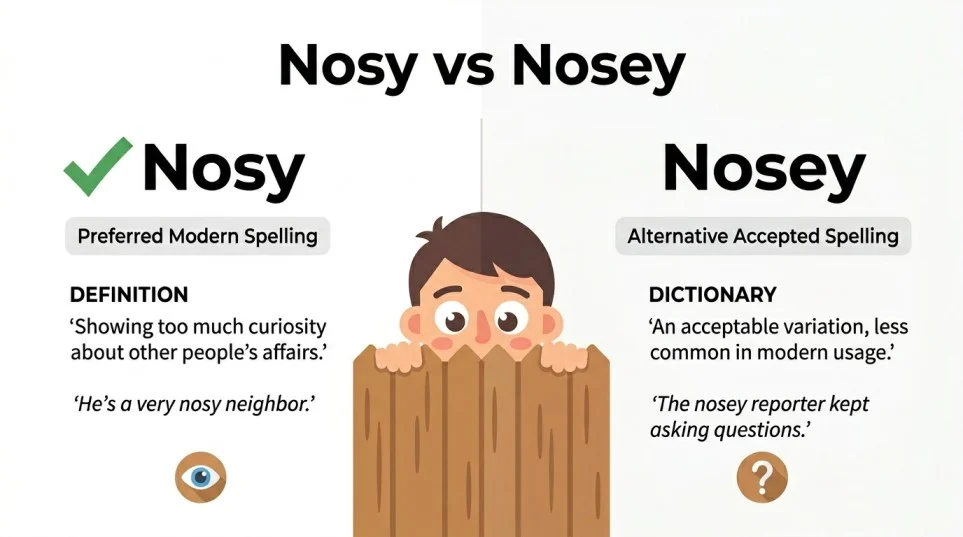
Quick Ans: The difference between nosy or nosey is mainly spelling, not meaning. Both words describe someone who is overly curious about other people’s private matters. However, nosy is the more widely accepted and commonly used spelling in modern English, while nosey is considered an alternative variant.
Many English learners and native speakers wonder whether they should write nosy or nosey. Since both spellings appear in books, websites, and everyday conversations, confusion is understandable.
At first glance, the two words seem different. One includes an extra letter, while the other does not. Despite this difference, both spellings carry the same meaning. They describe a person who asks too many personal questions or interferes in matters that do not concern them.
Writers often hesitate when choosing between these forms because grammar checkers, style guides, and dictionaries sometimes show different preferences. As a result, many people search for the correct spelling before using the word in formal writing.
Understanding the distinction between nosy or nosey helps improve writing accuracy and confidence. Whether you are writing an email, article, school assignment, or social media post, knowing which version to use can make your communication clearer.
This guide explains the meaning, history, usage, advantages, common mistakes, examples, and grammar rules related to nosy or nosey.
Quick Answer: Nosy or Nosey
If you need a quick answer, choose nosy in most situations.
| Feature | Nosy | Nosey |
|---|---|---|
| Meaning | Overly curious person | Overly curious person |
| Modern Usage | More common | Less common |
| Dictionary Acceptance | Yes | Yes |
| Preferred in Writing | Usually preferred | Alternative spelling |
| Formal Usage | Recommended | Less common |
In simple terms, both spellings are correct. Nevertheless, nosy is the preferred choice in modern English.
What Does Nosy Mean?
The word nosy describes a person who shows too much interest in other people’s private affairs.
Someone who is nosy may:
- Ask personal questions
- Listen to private conversations
- Seek information that is not their concern
- Interfere in personal matters
For example:
“My neighbor is very nosy and always asks about my salary.”
In this sentence, the neighbor is overly curious about private information.
Origin of the Word Nosy
The word comes from the noun nose.
Historically, people associated a large or active nose with someone who “sticks their nose” into other people’s business. Over time, the adjective nosy developed to describe intrusive curiosity.
Common Uses of Nosy
The word often appears in situations involving:
- Neighbors
- Coworkers
- Family members
- Reporters
- Social media users
Although curiosity can be positive, being nosy usually carries a negative meaning.
What Does Nosey Mean?
Nosey has exactly the same meaning as nosy.
A person described as nosey is:
- Too curious
- Intrusive
- Interested in private matters
- Constantly asking questions
For example:
“The children became nosey when they overheard the conversation.”
The meaning remains identical to the version spelled nosy.
Why Does the Alternative Spelling Exist?
English spelling has changed over centuries. Since the word originated from “nose,” some writers naturally preferred the spelling nosey.
Eventually, both forms appeared in dictionaries. However, language usage trends favored nosy, making it the dominant spelling today.
Is Nosey Wrong?
No, nosey is not wrong.
Many dictionaries still recognize it as a valid spelling. Even so, it appears less frequently in modern publications.
Key Differences Between Nosy or Nosey
Meaning
There is no difference in meaning.
Both words describe someone who is overly interested in private matters.
Popularity
The major difference involves frequency of use.
Modern writers use nosy more often than nosey.
Formal Writing
Most style guides recommend nosy for formal documents.
Meanwhile, nosey appears more commonly in informal contexts.
Reader Expectations
Many readers expect to see nosy because it has become the standard spelling.
Consequently, using nosy may look more natural in professional writing.
Advantages and Disadvantages
Advantages of Using “Nosy”
- More widely accepted
- Preferred by many style guides
- Common in newspapers and websites
- Looks familiar to readers
Disadvantages of Using “Nosy”
- Some people may expect the spelling to match “nose”
Advantages of Using “Nosey”
- Clearly connected to the word “nose”
- Accepted by major dictionaries
- Easy for some learners to understand
Disadvantages of Using “Nosey”
- Less common in modern writing
- May appear outdated
- Less preferred in professional content
Therefore, most writers choose nosy when deciding between nosy or nosey.
Examples of Nosy in Sentences
Here are some examples using the preferred spelling.
- My coworker is too nosy about everyone’s personal life.
- The reporter seemed nosy during the interview.
- She asked several nosy questions at dinner.
- The child became nosy after hearing part of the conversation.
- Their neighbor is known for being nosy.
These examples show how the word functions as an adjective.
Examples of Nosey in Sentences
The alternative spelling works exactly the same way.
- My aunt can be quite nosey sometimes.
- The students became nosey about the surprise announcement.
- He sounded nosey when asking about their finances.
- Several nosey questions made the guest uncomfortable.
- The character in the novel was famously nosey.
Although the spelling differs, the meaning stays unchanged.
Regional and Global Usage
American English
American English generally prefers nosy.
Most newspapers, blogs, and educational resources use this spelling.
British English
British English also favors nosy.
However, nosey occasionally appears in older publications.
International English
Across the English speaking world, nosy has become the dominant form.
As a result, learners usually encounter it more frequently.
Related Concepts and Comparisons
Nosy vs Curious
These words are similar but not identical.
| Feature | Nosy | Curious |
|---|---|---|
| Meaning | Excessively interested in private matters | Interested in learning |
| Tone | Negative | Usually positive |
| Social Impact | Intrusive | Acceptable |
A curious person wants knowledge. A nosy person wants private information.
Nosy vs Inquisitive
An inquisitive person asks many questions to learn.
A nosy person asks questions that may invade privacy.
Nosy vs Meddlesome
A meddlesome person interferes in other people’s affairs.
Meanwhile, a nosy person focuses on gathering private information.
Understanding these related terms makes the nosy or nosey distinction easier to remember.
Common Mistakes About Nosy or Nosey
Thinking One Spelling Is Completely Wrong
Many people assume one version is incorrect.
In reality, both spellings are accepted.
Using Nosey in Formal Writing Without Checking Style Guidelines
Some editors prefer nosy.
Therefore, checking publication requirements is important.
Confusing Nosy With Curious
Curiosity is often positive.
Nosiness usually has a negative tone.
Assuming Dictionaries Only Accept One Form
Most major dictionaries include both spellings.
However, they typically list nosy first.
Beginner to Advanced Writing Tips
Beginner Level
Use nosy whenever you are unsure.
This choice works in most situations.
Intermediate Level
Learn the difference between curiosity and nosiness.
Context affects the tone of your writing.
Advanced Level
Adapt your spelling based on audience and style guide requirements.
Professional publications often prefer the standard form.
As a result, advanced writers consider consistency throughout their work.
Step By Step Usage Scenario
Imagine you are writing an article.
If you choose nosy:
- Follow modern usage trends.
- Match common style guides.
- Meet reader expectations.
- Maintain consistency.
If you choose nosey:
- Use a valid alternative spelling.
- Ensure consistency throughout the document.
- Understand that some editors may change it.
- Consider audience expectations.
Both choices are correct, but nosy remains the safer option.
Exercises With Answers
Exercise 1
Which spelling is more common in modern English?
Answer: Nosy.
Exercise 2
Do nosy and nosey have different meanings?
Answer: No.
Exercise 3
Which spelling is generally preferred in formal writing?
Answer: Nosy.
Exercise 4
True or False: Nosey is always incorrect.
Answer: False.
Exercise 5
Which word describes someone who asks too many personal questions?
Answer: Nosy or nosey.
When Should You Use Nosy or Nosey?
Use nosy when:
- Writing professionally
- Creating website content
- Publishing articles
- Following modern style guides
Use nosey when:
- Personal preference allows it
- Informal writing is acceptable
- Consistency is maintained
For most situations, nosy is the better choice.
FAQs About Nosy or Nosey
Which is correct, nosy or nosey?
Both spellings are correct. However, nosy is more commonly used in modern English.
Is nosey considered wrong?
No. Dictionaries recognize nosey as a valid alternative spelling.
Why is nosy more popular than nosey?
Language usage gradually favored nosy, making it the standard form in many publications.
Should I use nosy or nosey in formal writing?
Most style guides recommend using nosy in professional and academic writing.
Do nosy and nosey mean the same thing?
Yes. Both words describe someone who is overly interested in private matters.
Which spelling appears more often in dictionaries?
Most dictionaries include both forms, although nosy is often listed first.
Is nosy a negative word?
Generally, yes. It usually suggests intrusive curiosity.
Can nosy describe children?
Yes. Children can be described as nosy if they constantly ask personal questions.
What is the opposite of nosy?
Words such as respectful, discreet, or private can serve as opposites.
Which spelling should English learners use?
English learners should usually choose nosy because it is the most common spelling.
Conclusion
The debate over nosy or nosey is largely about spelling preference rather than meaning. Both forms describe someone who takes too much interest in other people’s private affairs. Dictionaries recognize each version, so neither spelling is technically wrong.
Modern English, however, strongly favors nosy. Newspapers, websites, schools, and style guides generally recommend this spelling. Because readers encounter it more often, it usually looks more natural in professional writing.
Writers who choose nosey are still using a valid word. Nevertheless, they should understand that some editors may prefer the standard form. Consistency also matters. Switching between the two spellings in the same document can create confusion.
For most situations, using nosy is the safest and most practical choice. It aligns with current usage trends and meets reader expectations. By understanding the difference between nosy or nosey, you can write with greater confidence and accuracy.
Discover More:-
- Stretcher vs Gurney: Key Differences, Uses, and Medical Comparison Guide
- Balcony vs Patio: Differences, Uses, and Outdoor Space Guide

Lisa Thompson is a USA-based content writer and language specialist focused on grammar, writing improvement and digital publishing.
She holds a degree in English Language and Communication and has professional experience in educational and web content creation.
As the author of Gramtivo.Com, she aims to help readers improve their writing skills through clear and practical guidance.