
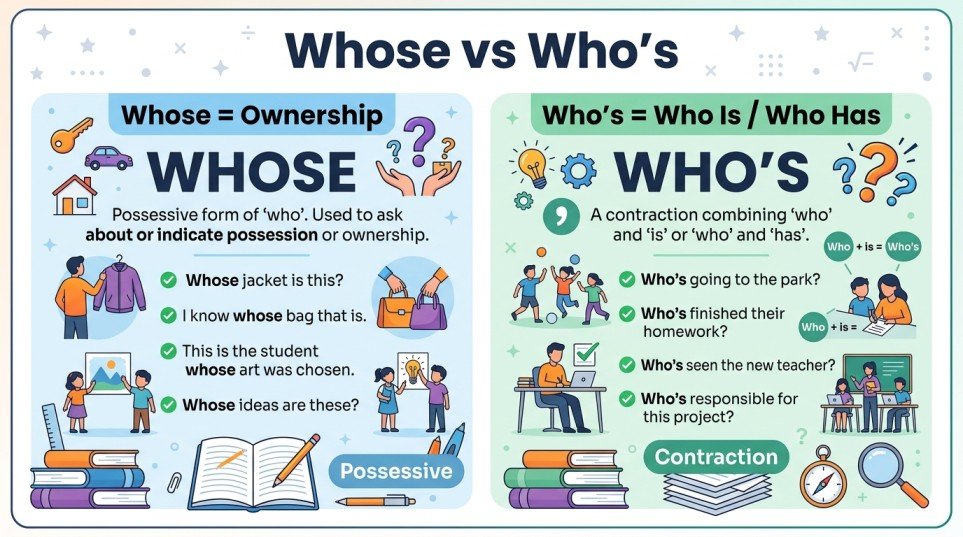
Quick Ans: The difference between whose or who’s is simple. Whose shows ownership or possession, while who’s is a contraction of “who is” or “who has.” Understanding this distinction helps you avoid one of the most common grammar mistakes in English writing.
Many English learners and native speakers struggle with whose or who’s. The words sound exactly the same when spoken. However, they have completely different meanings and uses.
Because they are homophones, people often use the wrong one in emails, essays, social media posts, and professional documents. Even experienced writers occasionally make this mistake.
The confusion usually happens because apostrophes often show possession. For example, “John’s car” means the car belongs to John. As a result, many people incorrectly assume that “who’s” shows ownership too.
In reality, the opposite is true.
Whose is the possessive form of “who.” Meanwhile, who’s is simply a shortened form of “who is” or “who has.”
Understanding whose or who’s improves grammar, writing clarity, and professional communication. This guide explains the differences in simple language with examples, comparison tables, exercises, common mistakes, and practical tips.
Quick Answer: Whose or Who’s
The easiest way to remember whose or who’s is this:
| Word | Meaning | Example |
|---|---|---|
| Whose | Shows ownership | Whose book is this? |
| Who’s | Means “who is” or “who has” | Who’s coming today? |
A quick test can help.
If you can replace the word with who is or who has, use who’s.
If the sentence talks about ownership, use whose.
What Is Whose?
Whose is a possessive pronoun and determiner. It shows ownership, possession, or relationship.
In simple terms, it asks or tells who owns something.
Examples of Whose
- Whose jacket is on the chair?
- Whose phone keeps ringing?
- Do you know whose bicycle is outside?
- Whose idea was this project?
In each example, whose refers to ownership.
How Whose Works
Think of whose as similar to:
- My
- Your
- His
- Her
- Their
However, instead of naming the owner directly, it asks or refers to an unknown owner.
For example:
- This is Sarah’s laptop.
- Whose laptop is this?
Both sentences discuss ownership.
Common Uses of Whose
Writers use whose in several situations:
- Asking about ownership
- Identifying a person through possession
- Creating relative clauses
- Formal and informal writing
Because of its flexibility, whose appears frequently in everyday English.
What Is Who’s?
Who’s is a contraction.
It combines:
- Who + is
- Who + has
The apostrophe replaces missing letters.
Examples of Who’s Meaning “Who Is”
- Who’s at the door?
- Who’s ready to begin?
- Who’s your favorite teacher?
- Who’s responsible for this report?
Expanded versions:
- Who is at the door?
- Who is ready to begin?
The meaning remains exactly the same.
Examples of Who’s Meaning “Who Has”
- Who’s completed the assignment?
- Who’s already seen the movie?
- Who’s finished the project?
Expanded versions:
- Who has completed the assignment?
- Who has already seen the movie?
Again, the meaning does not change.
Why Writers Get Confused
Many people see the apostrophe and assume ownership. Unfortunately, that assumption leads to errors.
Unlike nouns such as “John’s car,” who’s never indicates possession.
Instead, it always means who is or who has.
Key Differences Between Whose or Who’s
Meaning
The biggest difference between whose or who’s is meaning.
- Whose = ownership
- Who’s = who is or who has
Grammar Function
Whose acts as a possessive word.
Who’s acts as a contraction.
Apostrophe Usage
Whose has no apostrophe.
Who’s includes an apostrophe because letters have been removed.
Example Comparison
| Correct Usage | Explanation |
|---|---|
| Whose backpack is this? | Ownership |
| Who’s carrying the backpack? | Who is carrying |
| Whose dog is barking? | Ownership |
| Who’s walking the dog? | Who is walking |
These examples clearly show the distinction.
Advantages and Disadvantages
Advantages of Using Whose Correctly
- Improves grammar accuracy
- Makes writing more professional
- Prevents reader confusion
- Strengthens communication skills
Disadvantages of Misusing Whose
- Creates grammatical errors
- Reduces credibility
- Confuses readers
- Weakens academic writing
Advantages of Using Who’s Correctly
- Makes writing concise
- Sounds natural in conversation
- Improves readability
- Works well in informal and formal contexts
Disadvantages of Misusing Who’s
- Changes sentence meaning
- Creates unnecessary mistakes
- May confuse editors or teachers
Therefore, understanding whose or who’s helps writers communicate more effectively.
Real World Examples
Workplace Email
Incorrect:
- Who’s desk needs cleaning?
Correct:
- Whose desk needs cleaning?
The sentence asks about ownership.
Team Meeting
Incorrect:
- Whose attending today’s meeting?
Correct:
- Who’s attending today’s meeting?
The sentence means “Who is attending.”
Classroom Example
Incorrect:
- Who’s notebook is on the floor?
Correct:
- Whose notebook is on the floor?
The notebook belongs to someone.
Social Media Post
Incorrect:
- Whose going to the concert tonight?
Correct:
- Who’s going to the concert tonight?
The intended meaning is “Who is going.”
Regional and Global Usage
American English
American English follows the same rules for whose or who’s.
British English
British English also uses identical grammar rules.
International English Learning
Students worldwide commonly confuse these words because pronunciation is identical.
Consequently, grammar teachers often include whose or who’s in lessons about homophones and apostrophes.
Related Concepts and Comparisons
Whose vs Whom
Many learners confuse these words.
- Whose = ownership
- Whom = object of a verb or preposition
Example:
- Whose bag is this?
- Whom did you call?
Who vs Who’s
| Word | Meaning |
|---|---|
| Who | Question word |
| Who’s | Who is or who has |
Example:
- Who called?
- Who’s calling?
Its vs It’s
This comparison is very similar.
| Word Pair | Possession | Contraction |
|---|---|---|
| Whose or Who’s | Whose | Who’s |
| Its or It’s | Its | It’s |
Learning one pair often helps with the other.
Common Mistakes About Whose or Who’s
Using Who’s for Ownership
Incorrect:
- Who’s shoes are these?
Correct:
- Whose shoes are these?
Ownership requires whose.
Using Whose Instead of Who Is
Incorrect:
- Whose coming to dinner?
Correct:
- Who’s coming to dinner?
The sentence means “Who is coming.”
Ignoring the Expansion Test
Many mistakes disappear when writers expand the contraction.
Ask yourself:
Can I replace the word with “who is” or “who has”?
If yes, use who’s.
If not, use whose.
Relying Only on Apostrophes
People often think apostrophes automatically show possession. While that rule works for many nouns, it does not work for whose or who’s.
Remember this exception.
Beginner to Advanced Grammar Tips
Beginner Level
Memorize one rule:
- Whose = ownership
- Who’s = who is
Intermediate Level
Practice expanding contractions while proofreading.
For example:
- Who’s arriving early?
- Who is arriving early?
The sentence still works.
Advanced Level
Study relative clauses that use whose.
Example:
- The teacher whose class I attend is excellent.
This structure appears frequently in formal writing.
Step By Step Proofreading Scenario
Imagine you wrote this sentence:
- Who’s backpack is on the desk?
Step 1: Replace who’s with “who is.”
- Who is backpack is on the desk?
The sentence sounds wrong.
Step 2: Check for ownership.
The backpack belongs to someone.
Step 3: Use whose.
Correct sentence:
- Whose backpack is on the desk?
This simple process helps eliminate mistakes.
Exercises With Answers
Exercise 1
Choose the correct word:
___ car is parked outside?
Answer: Whose.
Exercise 2
Choose the correct word:
___ coming to the party tonight?
Answer: Who’s.
Exercise 3
Choose the correct word:
Do you know ___ laptop this is?
Answer: Whose.
Exercise 4
Choose the correct word:
___ already finished the assignment?
Answer: Who’s.
Exercise 5
True or False:
Who’s can show ownership.
Answer: False.
When Should You Use Whose or Who’s?
Use whose when:
- Talking about ownership
- Asking who owns something
- Referring to possession
Use who’s when:
- You mean “who is”
- You mean “who has”
- A contraction fits naturally
The expansion test is the easiest way to decide.
FAQs About Whose or Who’s
What is the difference between whose or who’s?
Whose shows ownership, while who’s means “who is” or “who has.”
Is whose possessive?
Yes. Whose is the possessive form of the word “who.”
Does who’s ever show ownership?
No. Who’s is always a contraction for “who is” or “who has.”
How do I know whether to use whose or who’s?
Replace who’s with “who is” or “who has.” If the sentence still makes sense, use who’s.
Which is correct: who’s book or whose book?
“Whose book” is correct because the sentence refers to ownership.
Can whose be used in formal writing?
Yes. Whose is common in academic, business, and professional writing.
Why do people confuse whose or who’s?
The words sound identical when spoken, which causes confusion.
Is whose a pronoun?
Yes. Depending on usage, whose can function as a possessive pronoun or determiner.
Can who’s start a question?
Yes. Example: “Who’s responsible for the report?”
What is the easiest trick for remembering whose or who’s?
Remember that whose shows ownership. If you can replace the word with “who is” or “who has,” use who’s.
Conclusion
Understanding whose or who’s is essential for clear and professional writing. Although the two words sound the same, they serve very different purposes.
Whose indicates ownership, possession, or relationship. Whenever you ask who owns something, whose is the correct choice.
Who’s, on the other hand, is a contraction of “who is” or “who has.” The apostrophe does not indicate possession. Instead, it replaces missing letters.
A simple proofreading strategy can prevent most errors. First, try expanding who’s into “who is” or “who has.” Next, check whether the sentence still makes sense. If it does, use who’s. Otherwise, use whose.
Mastering the difference between whose or who’s improves grammar, strengthens communication, and makes your writing more professional. With regular practice, choosing the correct word becomes automatic.
Discover More:-
- Yuca vs Yucca: Differences, Uses, Benefits, and Complete Guide
- Exception vs Acception: Meaning, Differences, and Correct Usage Guide

Robert Mitchell is a U.S.-based writer at Gramtivo.Com who focuses on grammar, writing improvement, and language-related content. He holds a degree in English and Linguistics from a U.S. university. His work aims to help readers enhance their writing skills with clear and practical guidance.