
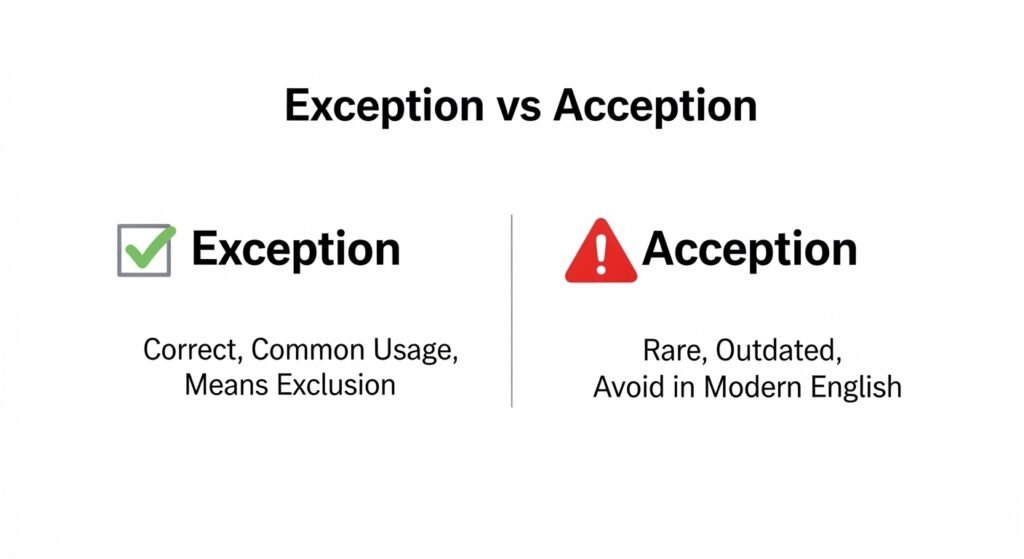
Quick Ans: The difference between exception vs acception is simple but important. Exception is a correct English word that means something excluded or different, while acception is rare, outdated, and often considered incorrect in modern usage. In most cases, you should use “exception” instead of “acception.”
Many people get confused about exception vs acception. The words look very similar. The spelling is almost the same. Because of this, learners often mix them up.
However, only one of these words is commonly used today.
Exception is a standard English word. You will see it in everyday writing, exams, and conversations. On the other hand, acception is rarely used. In fact, many dictionaries mark it as obsolete or outdated.
This confusion can cause mistakes in writing. For example, using acception instead of exception may make your sentence look incorrect. As a result, it can affect clarity and professionalism.
Therefore, understanding the difference between exception vs acception is important for students, writers, and professionals.
In this guide, you will learn clear definitions, examples, differences, common mistakes, and practical exercises. By the end, you will confidently use the correct word.
Quick Answer: Exception vs Acception
To understand exception vs acception quickly, look at this table.
| Word | Meaning | Usage |
|---|---|---|
| Exception | Something excluded or different | Common and correct |
| Acception | Acceptance or meaning (rare) | Obsolete or rarely used |
In short, always use exception in modern English writing.
What Is an Exception?
An exception is something that does not follow a rule. It is a case that is different from the general pattern.
Simple Definition
An exception means:
- Something excluded
- Something unusual
- A special case
Examples of Exception
Here are simple examples:
- Everyone passed the test except Ali. He was the exception.
- This rule applies to all students, with one exception.
- She eats everything, with the exception of spicy food.
Common Uses of Exception
You will often see exception used in:
- Grammar rules
- Legal documents
- Everyday conversation
- Academic writing
Because it is widely used, learning this word is essential.
What Is Acception?
The word acception is rarely used in modern English. Historically, it had meanings related to “acceptance” or “interpretation of a word.”
Simple Definition
Acception can mean:
- Acceptance
- A particular meaning of a word
However, these meanings are outdated in everyday English.
Examples of Acception (Rare Usage)
- The word has a different acception in this context.
- This term carries a special acception in literature.
Although these examples are correct in historical usage, modern English prefers other words like “meaning” or “sense.”
Why Acception Is Rare
Language changes over time. Words that were once common may fall out of use. Today, acception is considered:
- Obsolete in most contexts
- Confusing for readers
- Replaced by simpler words
Therefore, it is best to avoid using it.
Key Differences Between Exception vs Acception
Usage Frequency
The biggest difference in exception vs acception is usage. Exception is widely used. Acception is rarely used.
Meaning
Exception means something excluded from a rule. Acception refers to acceptance or meaning, but this usage is outdated.
Clarity
Using exception ensures clear communication. Using acception may confuse readers.
Modern Relevance
Exception is relevant in modern English. Acception is mostly historical.
Advantages and Disadvantages
Exception Advantages
- Widely accepted in modern English
- Easy to understand
- Used in all types of writing
- Clear meaning
Exception Disadvantages
- None in standard usage
Acception Advantages
- Useful in historical or linguistic contexts
- Can express specific meanings in rare cases
Acception Disadvantages
- Rarely understood
- Often considered incorrect
- Can confuse readers
Therefore, choosing the right word in exception vs acception is important for clarity.
Real World Examples
In School Writing
Students often write “acception” instead of “exception.” This is a spelling mistake and should be corrected.
Correct:
- There is one exception to the rule.
Incorrect:
- There is one acception to the rule.
In Professional Emails
Using correct vocabulary improves credibility.
Correct:
- All employees must follow this rule, with no exceptions.
In Dictionaries
Most modern dictionaries list acception as obsolete. They recommend using exception or “meaning” instead.
Regional and Global Usage
Modern English
In modern English worldwide, exception is the standard word. It appears in American, British, and international English.
Historical English
Acception appeared in older texts. However, its usage has declined over time.
Global Learning Context
English learners are often taught only exception. As a result, acception is rarely included in modern language education.
Related Concepts and Comparisons
Exception vs Exemption
- Exception: Something excluded from a rule
- Exemption: Freedom from an obligation
Acceptance vs Acception
- Acceptance: Approval or agreement
- Acception: Outdated form related to meaning
Exception vs Error
- Exception: Special case
- Error: Mistake
Understanding these related words helps avoid confusion.
Common Mistakes About Exception vs Acception
Spelling Confusion
Many learners mistakenly write acception instead of exception. This is one of the most common errors.
Misunderstanding Meaning
Some people think both words mean the same. In reality, they have different meanings and usage levels.
Using Outdated Words
Using acception in modern writing can make your text look incorrect or old fashioned.
Overcomplicating Language
Simple words improve clarity. Using rare or outdated terms can confuse readers.
Beginner to Advanced Learning Tips
Beginner Level
Focus on learning and using exception correctly. Avoid using acception.
Intermediate Level
Practice writing sentences using exception in different contexts.
Advanced Level
Study historical texts to understand rare words like acception. However, use modern alternatives in everyday writing.
Step By Step Usage Scenario
Imagine you are writing a sentence about a rule.
If you want to show something excluded:
- Use the word exception
- Place it correctly in the sentence
- Check grammar
Example:
- Everyone is invited, with one exception.
If you think of using acception, replace it with:
- Meaning
- Sense
- Interpretation
This approach improves clarity.
Exercises With Answers
Exercise 1
Which word is correct in modern English?
Answer: Exception.
Exercise 2
Fill in the blank:
There is one ______ to this rule.
Answer: Exception.
Exercise 3
True or False: Acception is commonly used today.
Answer: False.
Exercise 4
Which word means something excluded?
Answer: Exception.
Exercise 5
Which word should you avoid in modern writing?
Answer: Acception.
When Should You Use Exception vs Acception?
Use exception when:
- You describe something excluded
- You write formal or informal English
- You want clarity
Avoid acception unless:
- You study historical texts
- You discuss linguistic meanings
In most situations, exception is the correct choice.
FAQs About Exception vs Acception
What is the difference between exception vs acception?
Exception is a commonly used word meaning something excluded, while acception is rare and outdated.
Is acception a real word?
Yes, but it is obsolete in modern English and rarely used.
Which is correct, exception or acception?
Exception is correct for modern writing and communication.
Can I use acception in essays?
It is not recommended. Use “exception” or “meaning” instead.
Why do people confuse exception vs acception?
The words look similar in spelling, which causes confusion.
Is acception wrong?
It is not completely wrong, but it is outdated and not suitable for modern use.
What does exception mean?
It means something excluded from a general rule.
Is exception used in formal writing?
Yes, it is widely used in both formal and informal contexts.
What word should replace acception?
Use “meaning,” “sense,” or “interpretation” depending on context.
How can I avoid confusion between exception vs acception?
Remember that “exception” is the correct modern word and should be used in most cases.
Conclusion
Understanding exception vs acception is essential for clear and correct English. Although the words look similar, their usage is very different.
Exception is a modern, widely used word. It describes something excluded from a rule and appears in everyday speech and writing.
Acception, on the other hand, is outdated and rarely used. Most modern contexts replace it with simpler and clearer words.
Choosing the correct word improves communication. It also makes your writing more professional and easier to understand.
Therefore, always use exception in modern English unless you are studying historical language.
By applying this knowledge, you can avoid common mistakes and write with confidence.
Discover More:-
- OD vs Ophthalmologist: Key Differences, Training, and Eye Care Guide
- Ipamorelin vs Tesamorelin: Key Differences, Benefits, and Peptide Comparison

Lisa Thompson is a USA-based content writer and language specialist focused on grammar, writing improvement and digital publishing.
She holds a degree in English Language and Communication and has professional experience in educational and web content creation.
As the author of Gramtivo.Com, she aims to help readers improve their writing skills through clear and practical guidance.


Pingback: Fennel vs Anise: Differences, Flavor, Uses, and Cooking Guide
Pingback: Obamacare vs Medicaid: Key Differences, Eligibility, and Coverage Guide
Pingback: Tamal vs Tamale: Meaning, Grammar Differences, and Usage Guide