
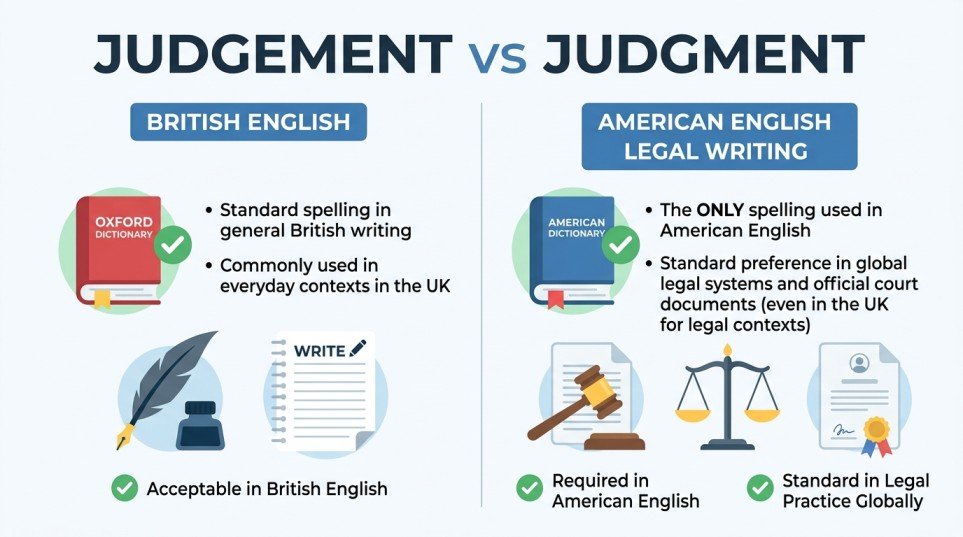
Quick Ans: The difference between judgement or judgment is primarily a matter of spelling preference. Judgment is the preferred spelling in American English and is also the standard form used in legal writing worldwide. Judgement is accepted in British English, although judgment is increasingly common there as well.
Many writers wonder whether they should use judgement or judgment. The two words look almost identical. They sound exactly the same when spoken. However, the extra “e” creates confusion for students, professionals, and even experienced writers.
The good news is that both spellings are recognized in English. Nevertheless, one version is more common depending on where you are writing and who will read your work.
For example, a legal document in the United States almost always uses judgment. A British publication may use either spelling, although judgement often appears in general writing. Because of these differences, choosing the correct form can feel challenging.
Understanding judgement or judgment helps improve writing accuracy and professionalism. It also ensures consistency in academic papers, business communication, legal documents, and everyday writing.
This guide explains the differences, usage rules, advantages, disadvantages, common mistakes, examples, and practical exercises. By the end, you will know exactly when to use each spelling.
Quick Answer: Judgement or Judgment
If you need a simple answer, use the following guideline:
| English Type | Preferred Spelling |
|---|---|
| American English | Judgment |
| Legal Writing | Judgment |
| British English | Judgement or Judgment |
| Academic Writing | Usually Judgment |
| International English | Judgment |
In most situations, judgment is the safer choice because it is accepted worldwide.
What Does Judgment Mean?
The word judgment refers to the ability to make decisions, form opinions, or evaluate situations.
It can also refer to an official decision made by a court.
Common Meanings of Judgment
The word may describe:
- A personal opinion
- Decision making ability
- Evaluation of facts
- A court ruling
- Critical thinking
Examples of Judgment
Consider these examples:
- Good judgment helps people make smart decisions.
- The judge announced the final judgment.
- Her judgment proved correct.
- Sound judgment is important in business.
In each sentence, the word relates to deciding, evaluating, or reaching a conclusion.
What Does Judgement Mean?
Judgement has the same meaning as judgment. There is no difference in pronunciation or definition.
The distinction involves spelling rather than meaning.
Examples of Judgement
Here are a few examples:
- His judgement improved with experience.
- The court delivered its final judgement.
- Good judgement comes from practice.
These sentences mean exactly the same as if judgment were used.
Why Does the Extra “E” Exist?
Historically, English spelling developed differently across regions. British English often retained spellings that American English simplified.
As a result, judgement became common in many British publications while judgment remained dominant in legal and formal writing.
Key Differences Between Judgement or Judgment
Meaning
There is no difference in meaning.
Both words refer to:
- Opinions
- Decisions
- Evaluations
- Court rulings
Pronunciation
The pronunciation is identical.
Both are spoken as:
JUHJ-muhnt
Regional Preference
The main distinction concerns regional writing conventions.
- American English prefers judgment
- British English often accepts judgement
- International legal writing usually uses judgment
Professional Usage
Most professional style guides recommend judgment.
Consequently, it appears more frequently in formal documents.
Historical Background of Judgement or Judgment
The debate over judgement or judgment has existed for centuries.
Older English texts included both forms. Over time, style guides and dictionaries began favoring specific versions.
American English gradually standardized judgment. British English retained both spellings for a longer period.
Today, many British publishers still accept judgement. However, judgment continues to gain popularity in academic and professional contexts.
Therefore, modern writers often encounter both versions.
Why Legal Writing Uses Judgment
Legal professionals almost always use judgment.
Court systems in many English speaking countries have adopted this spelling as the standard legal form.
Examples include:
- Court judgments
- Judgment orders
- Judgment creditors
- Summary judgment
Because legal terminology requires consistency, the spelling rarely changes.
Anyone writing legal content should generally use judgment.
Advantages and Disadvantages
Advantages of Using Judgment
- Preferred in American English
- Standard legal spelling
- Accepted internationally
- Common in professional writing
Disadvantages of Using Judgment
- Some British readers may expect judgement
- May look unfamiliar in certain UK publications
Advantages of Using Judgement
- Familiar to many British readers
- Common in traditional UK writing
- Accepted by some British style guides
Disadvantages of Using Judgement
- Less common internationally
- Rare in legal writing
- May appear inconsistent in global publications
Because of these factors, many writers choose judgment for broader audiences.
Real World Examples
Business Writing
A company report might state:
“Management exercised good judgment during the crisis.”
Most international businesses prefer this spelling.
Academic Writing
Research papers frequently use:
“The author’s judgment was supported by evidence.”
Universities often follow style guides that recommend judgment.
Legal Documents
Court decisions almost always use:
“The judgment was entered on Monday.”
This spelling dominates legal systems worldwide.
British Publications
Some newspapers and magazines still use:
“The minister showed poor judgement.”
Regional style preferences influence this choice.
Regional and Global Usage
United States
American English overwhelmingly prefers judgment.
The spelling appears in:
- Newspapers
- Books
- Academic papers
- Government documents
United Kingdom
British English accepts both spellings.
Many publishers use judgement in general writing. Nevertheless, judgment remains common in formal contexts.
Australia and New Zealand
Both versions appear. However, judgment is often preferred in professional and legal documents.
International English
Global organizations generally use judgment because it works across regions.
As a result, international communication tends to favor the shorter spelling.
Related Concepts and Comparisons
Judgement vs Judgment vs Opinion
An opinion is a personal belief.
A judgment often involves evaluation or decision making based on information.
Judgment vs Decision
A decision is the final choice.
Judgment refers to the thinking process behind that choice.
Judgment vs Verdict
A verdict is the conclusion reached by a jury.
A judgment is the official court decision entered afterward.
Comparison Table
| Term | Meaning |
|---|---|
| Judgment | Evaluation or court decision |
| Judgement | Alternative spelling of judgment |
| Opinion | Personal belief |
| Decision | Choice made after consideration |
| Verdict | Jury conclusion |
These distinctions help writers use each word accurately.
Common Mistakes About Judgement or Judgment
Mixing Spellings in One Document
Many writers switch between the two forms.
For example:
- Correct: Use judgment throughout.
- Correct: Use judgement throughout.
- Incorrect: Alternate between both spellings.
Consistency matters more than personal preference.
Using Judgement in Legal Documents
Legal writing almost always requires judgment.
Therefore, the longer spelling may appear incorrect in court related content.
Assuming One Spelling Is Wrong
Both forms are recognized by dictionaries.
The difference concerns usage preference rather than correctness.
Ignoring Audience Expectations
A British audience may expect judgement. An American audience usually expects judgment.
Writers should consider readers before choosing a spelling.
Beginner to Advanced Writing Tips
Beginner Level
Use judgment if you are unsure.
This spelling works in most situations.
Intermediate Level
Match the spelling to your audience.
American readers generally expect judgment.
Advanced Level
Follow the style guide required by your organization, publisher, or institution.
Consistency should remain the primary goal.
Step By Step Decision Guide
Imagine you are writing an article.
First, determine your audience.
If the audience is American, use judgment.
If the audience is international, choose judgment as well.
For a British audience, either spelling may work. However, consistency remains important.
Following these steps eliminates most uncertainty.
Exercises With Answers
Exercise 1
Which spelling is preferred in American English?
Answer: Judgment.
Exercise 2
Do judgement and judgment have different meanings?
Answer: No.
Exercise 3
Which spelling is standard in legal writing?
Answer: Judgment.
Exercise 4
True or False: Judgement is always incorrect.
Answer: False.
Exercise 5
Which spelling is generally safer for international audiences?
Answer: Judgment.
When Should You Use Judgement or Judgment?
Use judgment when:
- Writing for American audiences
- Creating legal documents
- Publishing academic content
- Communicating internationally
Use judgement when:
- Following a British style guide
- Writing for readers who prefer traditional UK spelling
- Maintaining consistency with existing content
Choosing the correct form depends on audience and context.
FAQs About Judgement or Judgment
Which is correct, judgement or judgment?
Both are correct. However, judgment is the preferred spelling in American English and legal writing.
Is judgement wrong?
No. Judgement is an accepted spelling in British English.
Why do Americans use judgment instead of judgement?
American English standardized the shorter spelling over time.
Which spelling should I use in legal documents?
Use judgment. Legal systems overwhelmingly prefer this version.
Do judgement and judgment mean different things?
No. They have the same meaning and pronunciation.
Which spelling is more common worldwide?
Judgment is generally more common in international and professional writing.
Can I use judgement in academic writing?
You can if your style guide allows it. However, judgment is often preferred.
Which spelling appears in dictionaries?
Most major dictionaries include both forms.
Should I switch between judgement and judgment?
No. Choose one spelling and use it consistently.
What is the safest choice for global audiences?
Judgment is usually the safest option because it is widely accepted.
Conclusion
The debate over judgement or judgment is largely a matter of spelling preference rather than meaning. Both words refer to decision making, evaluation, opinions, and court rulings. Pronunciation also remains identical.
The most important distinction involves audience and context. American English strongly prefers judgment, while British English may use either spelling. Legal writing almost always requires judgment, making it the dominant professional choice.
For most writers, judgment offers the greatest flexibility. It is widely accepted in academic, business, legal, and international communication. Nevertheless, judgement remains correct when used consistently in contexts that favor British spelling conventions.
When deciding between judgement or judgment, focus on your readers, follow the appropriate style guide, and maintain consistency throughout your document. Doing so will ensure clear, professional, and polished writing.
Discover More:-
- Stretcher vs Gurney: Key Differences, Uses, and Medical Comparison Guide
- TheraBreath vs Listerine: Differences, Ingredients, Benefits, and Best Mouthwash Guide

Lisa Thompson is a USA-based content writer and language specialist focused on grammar, writing improvement and digital publishing.
She holds a degree in English Language and Communication and has professional experience in educational and web content creation.
As the author of Gramtivo.Com, she aims to help readers improve their writing skills through clear and practical guidance.