
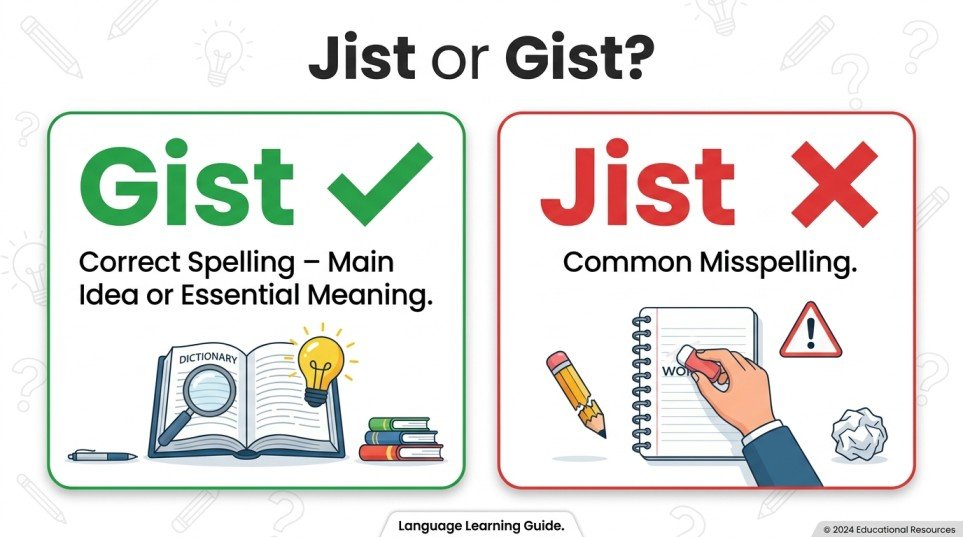
Quick Ans: The correct word is gist, not jist. “Gist” means the main point, essential meaning, or general idea of something, while “jist” is a common misspelling that appears because the word is often pronounced with a soft “j” sound. Understanding the difference between jist or gist helps improve writing accuracy and communication.
Many people wonder about jist or gist because the two words sound almost identical when spoken. You may hear someone say, “I got the gist of it,” and assume the word starts with the letter J. As a result, many writers accidentally type “jist” instead of “gist.”
This mistake is extremely common. In fact, spell checkers frequently catch it because “jist” is not considered the standard spelling in modern English. Nevertheless, the confusion continues because pronunciation does not clearly reveal the correct spelling.
Learning the difference between jist or gist is important for students, professionals, writers, and anyone who communicates in English. Using the wrong spelling can make writing appear less polished and less professional.
This guide explains everything you need to know about jist or gist, including definitions, origins, examples, common mistakes, usage tips, exercises, and frequently asked questions. By the end, you will know exactly which word to use and why.
Quick Answer: Jist or Gist
If you are deciding between jist or gist, the answer is simple:
| Word | Correct? | Meaning |
|---|---|---|
| Gist | Yes | Main point or essential meaning |
| Jist | No (standard English) | Common misspelling of gist |
Therefore, always use gist when referring to the central idea or summary of something.
Simple Example
Correct:
- I understand the gist of the report.
Incorrect:
- I understand the jist of the report.
The first sentence is correct because gist is the accepted English spelling.
What Does Gist Mean?
The word gist refers to the main point, central idea, or essential meaning of something.
Instead of remembering every detail, you focus on the overall message.
Examples of Gist
Consider these examples:
- I did not read the entire article, but I understood the gist.
- Can you give me the gist of the meeting?
- She explained the gist of the project in five minutes.
- Although the lecture was long, I understood the gist.
In each example, gist means the most important information.
Simple Analogy
Imagine watching a two hour movie.
You may not remember every scene. However, you can still explain the story in a few sentences.
That summary represents the gist of the movie.
What Does Jist Mean?
When discussing jist or gist, many people are surprised to learn that jist is generally not accepted as a standard English word.
Instead, it is usually considered:
- A spelling mistake
- A phonetic spelling of gist
- An informal variation sometimes seen online
Because “gist” sounds like “jist,” people often assume the spelling begins with J.
However, dictionaries and style guides overwhelmingly recognize gist as the correct spelling.
Why Do People Write Jist?
Several factors contribute to the confusion:
- The pronunciation sounds like “jist.”
- English spelling is not always phonetic.
- People often learn the word by hearing it before seeing it written.
- Typing quickly can lead to spelling mistakes.
Consequently, “jist” appears frequently in emails, social media posts, and informal writing.
The Origin of the Word Gist
Understanding the history of the word can make the spelling easier to remember.
The word gist comes from an old legal term derived from French.
Historically, it referred to the essential point of a legal case.
Over time, the meaning expanded to include the central idea of any message, story, discussion, or document.
Today, the word appears regularly in:
- Business communication
- Academic writing
- Journalism
- Everyday conversation
Because of its long history, the spelling has remained gist rather than changing to match pronunciation.
Key Differences Between Jist or Gist
Correctness
The biggest difference is correctness.
Gist is accepted in standard English. Jist is generally considered incorrect.
Dictionary Recognition
Most dictionaries include gist as the proper word.
Meanwhile, “jist” is often listed as a misspelling or variant spelling.
Professional Writing
Professional documents should always use gist.
Using “jist” may create a negative impression.
Educational Standards
Schools, universities, and exams recognize gist as the correct spelling.
Therefore, students should avoid using “jist.”
Comparison Table: Jist vs Gist
| Feature | Gist | Jist |
|---|---|---|
| Standard English | Yes | No |
| Dictionary Approved | Yes | Usually No |
| Professional Writing | Recommended | Not Recommended |
| Means Main Idea | Yes | Intended Meaning Only |
| Common Usage | Very Common | Common Mistake |
This table highlights why gist should always be your preferred choice.
Advantages and Disadvantages
Advantages of Using Gist
- Grammatically correct
- Widely recognized
- Professional appearance
- Accepted in academic writing
- Easy for readers to understand
Disadvantages of Using Gist
- Some learners find the spelling unusual
- Pronunciation can cause confusion
Advantages of Using Jist
There are very few advantages.
Some people may understand your intended meaning because the pronunciation is familiar.
Disadvantages of Using Jist
- Incorrect in standard English
- May reduce credibility
- Often flagged by spell check software
- Can appear unprofessional
Therefore, choosing gist is always the safer option.
Real World Examples
Business Communication
Correct:
- Please send me the gist of the meeting.
Incorrect:
- Please send me the jist of the meeting.
Business writing requires accuracy. Therefore, the first version is preferred.
Academic Writing
Correct:
- The student understood the gist of the chapter.
Professors and teachers expect proper spelling.
Everyday Conversation
You might hear:
- I got the gist of what you said.
Although the pronunciation sounds similar to “jist,” the written form remains “gist.”
News and Journalism
Journalists often summarize complex stories.
For example:
- Readers can quickly understand the gist of the report.
Professional publications consistently use gist.
Regional and Global Usage
United States
American English uses gist as the standard spelling.
United Kingdom
British English also recognizes gist as the correct form.
Canada
Canadian English follows the same standard.
Australia
Australian English uses gist in both formal and informal writing.
As a result, the answer to jist or gist remains the same across major English speaking regions.
Related Concepts and Comparisons
Gist vs Summary
A summary contains condensed information from the original source.
The gist focuses on the main idea.
Gist vs Main Point
These terms are closely related.
However, the gist may include several key ideas rather than one single point.
Gist vs Theme
A theme refers to an underlying message.
The gist refers to the overall meaning or content.
Gist vs Abstract
An abstract provides a formal overview of a document.
The gist is often more informal and conversational.
Understanding these related concepts improves comprehension and communication.
Common Mistakes About Jist or Gist
Writing Jist Instead of Gist
This is the most common error.
Remember that the correct spelling starts with G.
Assuming Pronunciation Determines Spelling
Many English words do not follow phonetic spelling rules.
Therefore, pronunciation alone cannot determine spelling.
Using Jist in Professional Documents
Professional communication requires standard spelling.
Always proofread before sending emails or reports.
Forgetting Context
Gist refers to the main idea.
It does not mean every detail of a message.
Avoid using it when discussing complete information.
Beginner to Advanced Usage Tips
Beginner Level
Remember this simple phrase:
“Get the gist, not the jist.”
This memory trick helps reinforce the correct spelling.
Intermediate Level
Practice using gist in sentences:
- I understood the gist of the presentation.
- Can you explain the gist of the article?
Advanced Level
Use gist naturally in professional writing:
- The executive summary provides the gist of the proposal.
- Readers should understand the gist before reviewing detailed data.
Regular practice makes the spelling automatic.
Step By Step Learning Scenario
Imagine your manager sends a ten page report.
You do not have time to read every detail.
First, skim the document.
Next, identify the key points.
Then, summarize the central message.
Finally, explain the gist in one or two sentences.
This process demonstrates how the word is used in real life.
Exercises With Answers
Exercise 1
Which spelling is correct?
A. Jist
B. Gist
Answer: B. Gist.
Exercise 2
Complete the sentence:
“I understood the _____ of the presentation.”
Answer: Gist.
Exercise 3
True or False:
“Jist” is the preferred spelling in professional English.
Answer: False.
Exercise 4
Which word means the main idea?
Answer: Gist.
Exercise 5
Which sentence is correct?
A. I got the jist of the story.
B. I got the gist of the story.
Answer: B. I got the gist of the story.
When Should You Use Gist?
Use gist when:
- Summarizing information
- Explaining the main idea
- Discussing overall meaning
- Referring to key points of a conversation
- Describing the central message of a document
Avoid using “jist” in formal writing, academic work, or professional communication.
FAQs About Jist or Gist
What is correct, jist or gist?
Gist is the correct spelling. Jist is generally considered a misspelling in standard English.
Why do people write jist instead of gist?
People often hear the word spoken before seeing it written. Because gist sounds like “jist,” confusion occurs.
Is jist a real word?
In modern standard English, jist is not the accepted spelling for the word meaning “main idea.”
What does gist mean?
Gist refers to the essential meaning, central idea, or main point of something.
Can I use jist in professional writing?
No. Professional writing should always use gist instead of jist.
Is gist used in academic writing?
Yes. Students and researchers frequently use gist when discussing key ideas or summaries.
How do I remember the correct spelling of gist?
A useful memory trick is: “Get the gist, not the jist.”
Does gist mean summary?
Not exactly. A summary contains condensed details, while the gist focuses on the core meaning.
Is gist correct in American and British English?
Yes. Both American and British English recognize gist as the standard spelling.
Why is gist spelled with a G?
The spelling comes from the word’s historical origins and has remained unchanged despite pronunciation differences.
Conclusion
The answer to jist or gist is straightforward. The correct word is gist, and it refers to the main point, essential meaning, or overall idea of something. Although many people mistakenly write “jist,” standard English dictionaries, schools, businesses, and publishers recognize only “gist” as correct.
The confusion usually comes from pronunciation. Since the word sounds like it starts with a J, writers often spell it incorrectly. However, understanding the history and usage of the word makes it easier to remember the proper form.
Whether you are writing emails, academic papers, reports, or social media posts, using gist helps maintain professionalism and accuracy. Furthermore, correct spelling improves credibility and ensures clear communication.
Whenever you need to describe the central message of a conversation, article, presentation, or document, choose gist. Following this simple rule will help you avoid one of the most common spelling mistakes in English.
Discover More:-
- Yuca vs Yucca: Differences, Uses, Benefits, and Complete Guide
- Exception vs Acception: Meaning, Differences, and Correct Usage Guide

Robert Mitchell is a U.S.-based writer at Gramtivo.Com who focuses on grammar, writing improvement, and language-related content. He holds a degree in English and Linguistics from a U.S. university. His work aims to help readers enhance their writing skills with clear and practical guidance.