
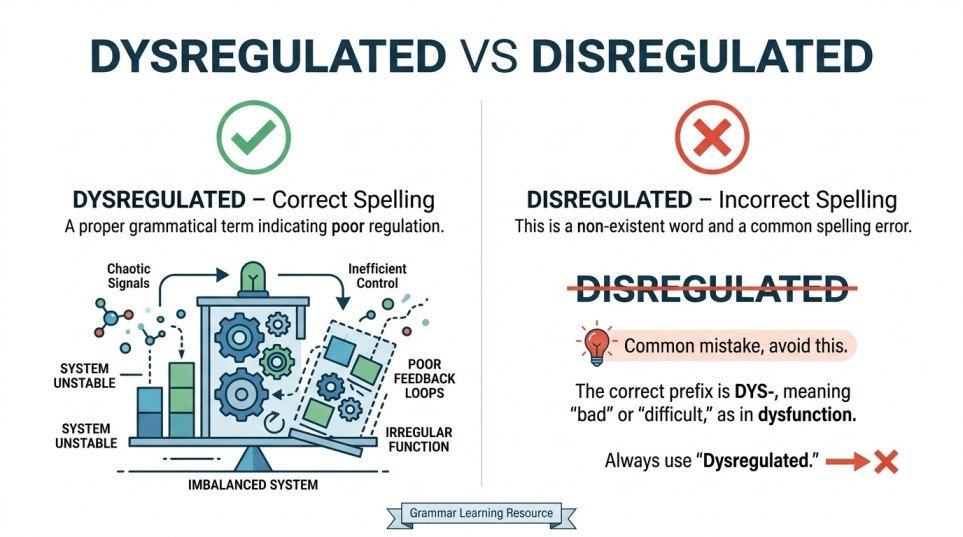
Quick Ans: The correct spelling is dysregulated, which means impaired or abnormal regulation, often used in medical or psychological contexts. The term disregulated is generally incorrect and rarely accepted in standard English usage. Therefore, in most cases, you should use dysregulated.
Many people search for dysregulated or disregulated when they are unsure which spelling is correct. The confusion happens because both words look similar. However, only one is widely accepted in formal English.
The word dysregulated appears often in psychology, medicine, and health discussions. It describes situations where normal control or balance is disrupted. On the other hand, disregulated is usually a misspelling or a nonstandard variation.
This difference may seem small. Still, using the wrong word can affect clarity, professionalism, and credibility in writing. For example, academic papers, medical reports, and professional communication require correct terminology.
Understanding dysregulated or disregulated helps you avoid common spelling mistakes. It also ensures your writing remains clear and accurate.
In this guide, you will learn definitions, correct usage, examples, common errors, and practice exercises. By the end, you will confidently know which term to use.
Quick Answer: Dysregulated or Disregulated
Here is the simple answer:
| Term | Correct? | Meaning |
|---|---|---|
| Dysregulated | Yes | Impaired or abnormal regulation |
| Disregulated | No (generally incorrect) | Considered a misspelling |
In short, always use dysregulated in professional and everyday writing.
What Does Dysregulated Mean?
The word dysregulated describes a condition where normal control or balance does not function properly. It is commonly used in medical and psychological contexts.
The prefix dys- means “bad,” “impaired,” or “abnormal.” Therefore, dysregulated refers to something that is not regulated in a healthy or normal way.
Common Contexts
You may see dysregulated in:
- Mental health discussions
- Emotional control topics
- Hormonal or biological systems
- Nervous system responses
Examples of Dysregulated
- A person may have dysregulated emotions, meaning they struggle to manage feelings.
- A patient might experience dysregulated hormones, causing imbalance in the body.
- Stress can lead to a dysregulated nervous system, affecting mood and behavior.
In each case, the system exists but does not function properly.
Why Disregulated Is Incorrect
The confusion in dysregulated or disregulated often comes from mixing prefixes.
The prefix dis- usually means “not” or “opposite of.” While it works in many words, it does not apply correctly here.
As a result:
- Disregulated is rarely found in dictionaries
- It is considered a spelling mistake in most contexts
- Professional writing avoids it completely
Although some people use it informally, it is not standard English.
Key Differences Between Dysregulated or Disregulated
Spelling
The correct spelling is dysregulated. The alternative form disregulated is incorrect.
Meaning
Dysregulated has a clear meaning related to impaired regulation. Disregulated lacks accepted meaning.
Usage
Professionals use dysregulated in academic, medical, and psychological writing. Disregulated does not appear in formal usage.
Acceptance
Dictionaries and style guides recognize dysregulated. They do not accept disregulated as standard.
Advantages and Disadvantages
Using Dysregulated (Correct Term)
Advantages:
- Accurate meaning
- Accepted in professional writing
- Widely recognized in medical and academic fields
- Improves clarity
Disadvantages:
- May sound technical for beginners
Using Disregulated (Incorrect Term)
Advantages:
- None in formal writing
Disadvantages:
- Considered incorrect
- Reduces credibility
- May confuse readers
- Not accepted in academic contexts
Therefore, choosing the correct term matters.
Real World Examples
Academic Writing
Researchers use dysregulated when describing conditions such as emotional disorders or biological imbalance.
Example:
“The patient showed signs of a dysregulated stress response.”
Workplace Communication
Professionals may use the word when discussing behavior or systems.
Example:
“A dysregulated workflow can reduce efficiency.”
Everyday Conversation
Although less common in casual speech, people still use it in discussions about mental health.
Example:
“He felt dysregulated after a stressful day.”
In all cases, the correct form remains consistent.
Regional and Global Usage
English Speaking Countries
In countries like the United States, United Kingdom, Canada, and Australia, dysregulated is the accepted spelling.
Academic and Medical Fields
Globally, medical professionals use dysregulated in research papers and clinical reports.
Informal Usage
Some people mistakenly write disregulated, especially online. However, this form is not recognized in formal English.
Thus, global usage strongly supports dysregulated.
Related Concepts and Comparisons
Unregulated vs Dysregulated
- Unregulated means not regulated at all
- Dysregulated means poorly regulated
Dysregulated vs Irregular
- Dysregulated refers to malfunction in control
- Irregular refers to inconsistency
Dysregulated vs Disorder
- Dysregulated describes a process
- Disorder describes a condition
Understanding these related terms improves clarity when discussing dysregulated or disregulated.
Common Mistakes About Dysregulated or Disregulated
Using the Wrong Prefix
Many writers replace dys- with dis- by mistake. This creates the incorrect form disregulated.
Assuming Both Are Correct
Some people think both spellings work. In reality, only dysregulated is accepted.
Ignoring Context
Using dysregulated in the wrong context can confuse readers. It should describe systems that exist but function improperly.
Spelling Errors
Typing quickly can lead to missing the “y” in dysregulated. Always proofread carefully.
Avoiding these mistakes improves writing accuracy.
Beginner to Advanced Usage Tips
Beginner Level
Learn the correct spelling: dysregulated. Practice using it in simple sentences.
Intermediate Level
Use the word in context, such as emotional or biological discussions.
Advanced Level
Apply the term in academic writing, research papers, or professional communication.
Over time, correct usage becomes natural.
Step By Step Usage Scenario
Imagine writing about stress.
If you use the correct term:
“The patient has a dysregulated stress response.”
If you use the incorrect term:
“The patient has a disregulated stress response.”
The second sentence looks unprofessional and may be marked incorrect. Therefore, choosing the right word is important.
Exercises With Answers
Exercise 1
Which spelling is correct in dysregulated or disregulated?
Answer: Dysregulated.
Exercise 2
What does dysregulated mean?
Answer: Impaired or abnormal regulation.
Exercise 3
Is “disregulated” accepted in formal writing?
Answer: No.
Exercise 4
Which prefix means abnormal or impaired?
Answer: Dys-.
Exercise 5
True or False: Both spellings are equally correct.
Answer: False.
When Should You Use Dysregulated?
Use dysregulated when:
- Describing emotional imbalance
- Explaining medical conditions
- Writing academic or professional content
- Discussing systems that are not functioning properly
Avoid using disregulated in all formal situations.
FAQs About Dysregulated or Disregulated
What is correct: dysregulated or disregulated?
The correct spelling is dysregulated. The form disregulated is considered incorrect.
What does dysregulated mean?
It means a system is not functioning properly or is out of balance.
Is disregulated a real word?
No. It is generally a misspelling of dysregulated.
Why do people confuse dysregulated or disregulated?
The confusion comes from mixing the prefixes dys- and dis-.
Can I use disregulated in casual writing?
It is better to avoid it, even in casual writing, to maintain accuracy.
Is dysregulated a medical term?
Yes. It is commonly used in psychology and medicine.
What is an example of dysregulated behavior?
Difficulty controlling emotions is an example of dysregulated behavior.
Does dysregulated mean broken?
Not exactly. It means something is functioning improperly, not completely broken.
Is dysregulated used worldwide?
Yes. It is accepted in global academic and medical communities.
How can I remember the correct spelling?
Remember that dys- means abnormal or impaired, which matches the meaning.
Conclusion
Understanding dysregulated or disregulated is important for clear and professional communication. Although both words look similar, only dysregulated is correct and widely accepted.
The term describes systems that do not function properly, especially in medical and psychological contexts. In contrast, disregulated is considered a spelling mistake and should be avoided.
Using the correct word improves credibility and ensures your message is understood clearly. This is especially important in academic writing, professional communication, and health related discussions.
To make the right choice, remember the meaning of the prefix dys-, which indicates abnormal or impaired function. With practice, using dysregulated will become natural.
By applying what you have learned, you can write more accurately and confidently in any context.
Discover More:-
- Partnership vs LLC: Key Differences, Benefits, and Business Structure Guide
- Hominy vs Corn: Differences, Uses, Nutrition, and Cooking Guide

Robert Mitchell is a U.S.-based writer at Gramtivo.Com who focuses on grammar, writing improvement, and language-related content. He holds a degree in English and Linguistics from a U.S. university. His work aims to help readers enhance their writing skills with clear and practical guidance.