
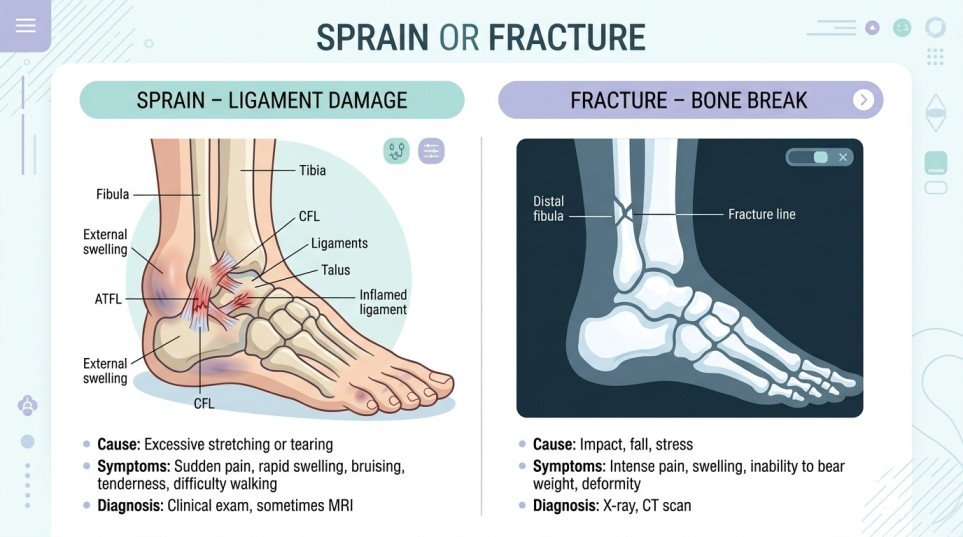
Quick Ans: The main difference between a sprain or fracture is the type of injury involved. A sprain happens when ligaments stretch or tear, while a fracture means a bone has cracked or broken. Although both injuries can cause pain and swelling, treatment and recovery are very different.
Many people struggle to tell the difference between a sprain or fracture after an accident or fall. Both injuries can cause swelling, bruising, pain, and difficulty moving the affected area. Because the symptoms often look similar, confusion is very common.
A person may twist an ankle during sports and assume it is only a sprain. However, the injury could actually involve a broken bone. In other situations, severe swelling from a sprain may feel just as painful as a fracture.
Understanding the difference matters because proper treatment helps prevent long term damage. A sprain usually affects ligaments, which connect bones together. A fracture, on the other hand, involves damage to the bone itself.
This guide explains everything about sprain or fracture in simple language. You will learn symptoms, causes, treatment methods, recovery time, common mistakes, and real world examples. By the end, you will better understand how these injuries differ and when medical care is necessary.
Quick Answer: Sprain or Fracture
The easiest way to understand sprain or fracture is to look at the injured body part.
| Feature | Sprain | Fracture |
|---|---|---|
| Injury Type | Ligament injury | Bone injury |
| Common Cause | Twisting joint | Direct impact or severe force |
| Swelling | Common | Common |
| Bruising | Often present | Often present |
| Bone Damage | No | Yes |
| Treatment | Rest and support | Cast, brace, or surgery |
In simple terms, a sprain affects ligaments, while a fracture affects bones.
What Is a Sprain?
A sprain happens when ligaments stretch too far or tear. Ligaments are strong bands of tissue that connect bones at joints.
Sprains commonly occur in:
- Ankles
- Wrists
- Knees
- Thumbs
Sports injuries frequently cause sprains. However, everyday activities can also lead to ligament damage.
Common Causes of Sprains
Several situations may cause a sprain:
- Twisting the ankle while walking
- Falling awkwardly
- Sudden joint movement
- Sports accidents
- Slipping on wet surfaces
Because ligaments support joints, sudden force can overstretch them.
Symptoms of a Sprain
Typical symptoms include:
- Pain around the joint
- Swelling
- Bruising
- Difficulty moving the joint
- Tenderness
Some sprains also create a popping sensation during injury.
Sprain Severity Levels
Doctors often classify sprains into three grades.
| Grade | Description |
|---|---|
| Grade 1 | Mild stretching |
| Grade 2 | Partial ligament tear |
| Grade 3 | Complete ligament tear |
Higher grades usually require longer recovery.
What Is a Fracture?
A fracture means a bone has cracked or broken. Some fractures are tiny hairline cracks, while others completely separate the bone.
Fractures may occur in any bone of the body.
Common Causes of Fractures
Bone fractures often happen because of:
- Falls
- Car accidents
- Sports injuries
- Direct impact
- Osteoporosis
Strong force usually causes fractures, although weak bones can break more easily.
Symptoms of a Fracture
Many fracture symptoms resemble sprains. However, fractures often include more severe pain.
Common signs include:
- Intense pain
- Swelling
- Bruising
- Difficulty bearing weight
- Visible deformity
- Grinding sensation
In some cases, the bone may even pierce the skin.
Types of Fractures
Several fracture types exist.
| Fracture Type | Description |
|---|---|
| Simple fracture | Bone breaks without piercing skin |
| Compound fracture | Bone breaks through skin |
| Hairline fracture | Small crack in bone |
| Comminuted fracture | Bone breaks into pieces |
Different fracture types require different treatments.
Key Differences Between Sprain or Fracture
Tissue Damage
The main difference between sprain or fracture involves the injured tissue.
Sprains damage ligaments. Fractures damage bones.
Pain Level
Both injuries hurt. However, fractures often produce sharper and more intense pain.
Movement Problems
Sprains may still allow some movement. Fractures frequently make movement extremely difficult.
Bone Shape
Fractures sometimes cause visible deformity. Sprains usually do not change bone shape.
Medical Imaging
Doctors often use X rays to confirm fractures. Ligament injuries may require MRI scans instead.
Advantages and Disadvantages of Early Treatment
Benefits of Early Sprain Treatment
Quick treatment can:
- Reduce swelling
- Improve healing
- Prevent joint instability
- Lower pain levels
Risks of Ignoring a Sprain
Untreated sprains may lead to:
- Chronic pain
- Weak joints
- Repeated injuries
- Reduced mobility
Benefits of Early Fracture Treatment
Proper fracture care helps:
- Bones heal correctly
- Prevent permanent damage
- Restore movement
- Reduce complications
Risks of Ignoring a Fracture
Untreated fractures may cause:
- Bone misalignment
- Long term pain
- Permanent disability
- Infection in severe cases
Therefore, professional diagnosis is very important.
Real World Examples
Sports Injury
A basketball player lands awkwardly after a jump. Swelling appears immediately around the ankle. The injury could be either a sprain or fracture.
Car Accident
A person braces during impact and experiences severe wrist pain afterward. Doctors may order X rays to rule out a fracture.
Everyday Fall
Someone slips on stairs and twists the knee. Ligament damage may occur even without broken bones.
These examples show why symptoms alone cannot always confirm the injury type.
Regional and Global Usage
Sports Medicine
Athletes frequently experience both sprains and fractures during competition and training.
Workplace Injuries
Construction workers and laborers often face fracture risks because of heavy equipment and falls.
Aged Population
Older adults experience more fractures because bones weaken with age.
Worldwide, healthcare systems treat millions of sprain and fracture injuries every year.
Related Concepts and Comparisons
Sprain vs Strain
A sprain affects ligaments. A strain affects muscles or tendons.
Fracture vs Break
The terms fracture and break mean the same thing medically.
Sprain vs Fracture vs Strain
| Injury | Affected Tissue | Common Cause |
|---|---|---|
| Sprain | Ligament | Twisting joint |
| Fracture | Bone | Strong impact |
| Strain | Muscle or tendon | Overstretching |
Understanding these terms helps reduce confusion during medical discussions.
Common Mistakes About Sprain or Fracture
Assuming It Is “Just a Sprain”
Some fractures initially seem minor. Ignoring severe pain may delay treatment.
Continuing Physical Activity
Walking or playing sports on an injured area can worsen damage.
Avoiding Medical Care
People sometimes avoid doctors because swelling decreases after a few hours. However, fractures may still exist.
Using Heat Too Early
Heat can increase swelling during the first 48 hours. Ice is usually the better option initially.
Avoiding these mistakes improves recovery and reduces complications.
Beginner to Advanced Treatment Tips
Beginner Level
Use the RICE method:
- Rest
- Ice
- Compression
- Elevation
This approach helps many mild injuries.
Intermediate Level
Wear braces or supports to stabilize the injured area.
Advanced Medical Care
Severe injuries may require:
- Physical therapy
- Casting
- Surgery
- Rehabilitation programs
Doctors decide treatment based on injury severity.
Step By Step Injury Scenario
Imagine someone twists an ankle while running.
If the injury is a sprain:
- Ligaments stretch or tear
- Swelling develops
- Walking becomes painful
- Ice and rest help recovery
If the injury is a fracture:
- Bone cracks or breaks
- Severe pain occurs immediately
- Weight bearing becomes difficult
- Medical imaging confirms damage
Although symptoms overlap, treatment differs significantly.
Exercises With Answers
Exercise 1
Which injury affects ligaments in the sprain or fracture comparison?
Answer: Sprain.
Exercise 2
Which injury involves broken bone tissue?
Answer: Fracture.
Exercise 3
What imaging test commonly confirms fractures?
Answer: X ray.
Exercise 4
Which treatment method helps reduce swelling early?
Answer: Ice application.
Exercise 5
True or False: A fracture and a break are different injuries.
Answer: False.
When Should You Seek Medical Help?
Seek medical care if:
- Pain is severe
- Swelling increases rapidly
- You cannot bear weight
- Deformity appears
- Numbness develops
- Symptoms do not improve
Doctors can determine whether the injury is a sprain or fracture through examination and imaging tests.
FAQs About Sprain or Fracture
What is the main difference between sprain or fracture?
A sprain damages ligaments, while a fracture involves a broken or cracked bone.
Can a sprain hurt as much as a fracture?
Yes. Severe sprains can cause intense pain and swelling similar to fractures.
How can doctors tell if it is a sprain or fracture?
Doctors use physical exams and imaging tests such as X rays or MRI scans.
Can you walk on a fracture?
Some minor fractures still allow walking, but movement may worsen the injury.
What is the fastest way to reduce swelling?
Rest, ice, compression, and elevation often help reduce swelling early.
Does every fracture require surgery?
No. Many fractures heal with casts or braces alone.
Can a sprain heal without treatment?
Mild sprains may heal naturally, but severe injuries often require medical support.
How long does a sprain take to heal?
Recovery may take days to several months depending on severity.
Which injury is more serious, sprain or fracture?
Severity varies. Some fractures are mild, while some ligament tears are severe.
Should you use heat or ice first?
Ice is usually recommended during the first 48 hours after injury.
Conclusion
Understanding sprain or fracture is important because both injuries can appear similar at first. Pain, swelling, and bruising occur in both conditions. However, the damaged tissue differs significantly.
A sprain affects ligaments that support joints. Fractures involve broken or cracked bones. Because treatment methods differ, proper diagnosis is essential for safe recovery.
Mild sprains often improve with rest, ice, compression, and elevation. Fractures may require casts, braces, or surgery depending on severity. Ignoring either injury can lead to long term complications.
Whenever severe pain, swelling, or difficulty moving occurs, medical evaluation is the safest choice. Early treatment improves healing and helps prevent permanent damage.
By understanding the difference between sprain or fracture, you can respond more confidently after injuries and make better decisions about medical care.
Discover More:-

Jennifer Collins is a professional grammar expert and language educator at gramtivo.com, specializing in English grammar, writing skills, and language improvement. She holds a Master’s degree in English Language and Literature from a recognized university in the United States. With years of teaching and content development experience, she is dedicated to helping learners improve their communication skills with clear and practical guidance.