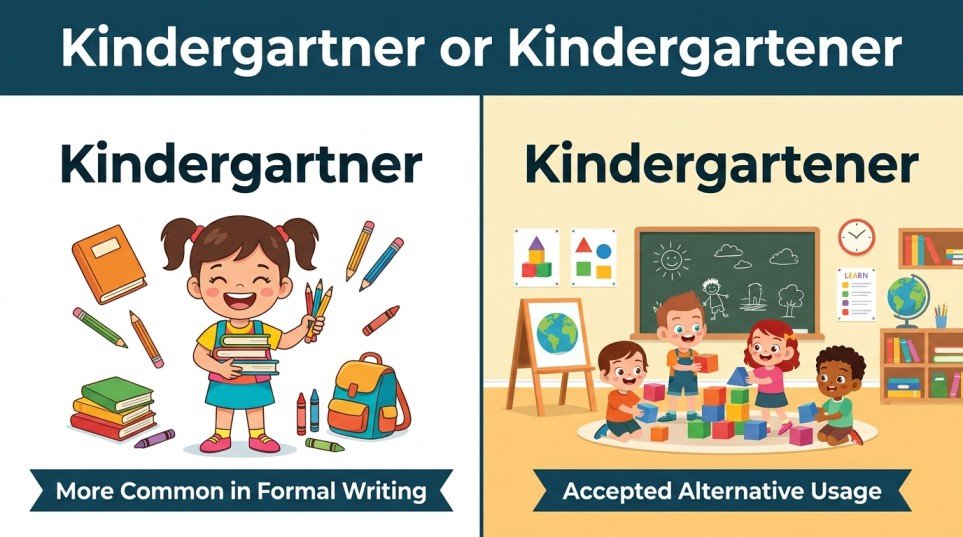
Quick Ans: The difference between kindergartner or kindergartener is mainly regional and stylistic. Both words describe a child attending kindergarten, but “kindergartner” is more commonly used and widely accepted in modern English. Meanwhile, “kindergartener” also appears in dictionaries and everyday conversation, especially in American English.
Many people wonder about kindergartner or kindergartener because both words sound correct. Teachers use them. Parents hear them often. Schools may even use different versions in emails or classroom materials.
This creates confusion.
One spelling looks shorter and simpler. The other sounds more natural to some speakers. As a result, writers often stop and question which word should appear in essays, blog posts, school documents, or social media captions.
The good news is that both words are real English words. However, one version is far more common in professional and educational writing.
Understanding the difference between kindergartner or kindergartener helps improve grammar, writing clarity, and communication. It also helps students, teachers, and parents avoid mistakes in formal writing.
This complete guide explains definitions, grammar rules, usage examples, regional preferences, common mistakes, exercises, and practical writing tips. By the end, you will know exactly when and how to use each word correctly.
Quick Answer: Kindergartner or Kindergartener
The simplest answer is that both words are correct. However, “kindergartner” is more common and preferred in most writing.
| Word | Meaning | Usage Popularity |
|---|---|---|
| Kindergartner | Child attending kindergarten | More common |
| Kindergartener | Child attending kindergarten | Less common but accepted |
In short, both words work, but kindergartner is usually the safer choice.
What Does Kindergartner Mean?
A kindergartner is a child who attends kindergarten. Kindergarten is the first stage of formal education in many countries.
Children in kindergarten usually learn:
- Basic reading skills
- Counting and numbers
- Social interaction
- Classroom routines
- Creative activities
The word combines:
- “Kindergarten”
- The suffix “er”
As a result, the term means “a person in kindergarten.”
Example Sentences
Here are some examples:
- My daughter is a kindergartner this year.
- Every kindergartner received a welcome package.
- The teacher helped the kindergartners line up quietly.
Because the word appears frequently in schools and parenting content, it has become widely accepted in standard English.
What Does Kindergartener Mean?
A kindergartener has the exact same meaning as kindergartner. It also describes a child attending kindergarten.
The difference is mainly stylistic.
Some speakers naturally add “en” before the “er” sound because it feels smoother in conversation. Consequently, “kindergartener” developed as an alternative form.
Example Sentences
Here are several examples:
- My son is a kindergartener at the local school.
- The kindergartener carried a backpack almost bigger than herself.
- Teachers welcomed every kindergartener warmly.
Although the word is longer, dictionaries still recognize it as correct.
Key Differences Between Kindergartner or Kindergartener
Spelling
The biggest difference is spelling.
- Kindergartner = shorter version
- Kindergartener = longer version
Popularity
Kindergartner appears more often in:
- Educational materials
- News articles
- Professional writing
- School documents
Meanwhile, kindergartener appears more frequently in casual speech.
Writing Style
Many editors prefer kindergartner because it looks cleaner and simpler. However, kindergartener still sounds natural in conversation.
Dictionary Acceptance
Both words appear in major dictionaries. Therefore, neither word is technically incorrect.
Which Word Is More Common?
In modern English, kindergartner is more widely used.
Writers often choose shorter words when two versions mean the same thing. Consequently, kindergartner became the dominant spelling in newspapers, educational websites, and books.
For example, schools commonly write:
- “Welcome kindergartners!”
- “New kindergartner orientation begins Monday.”
You will still see kindergartener occasionally, especially in informal communication.
Why Do People Get Confused?
Several factors create confusion about kindergartner or kindergartener.
Both Words Sound Natural
Many English speakers hear both versions regularly. As a result, neither sounds completely wrong.
English Has Similar Word Patterns
English contains many words ending in:
- er
- ner
- ener
Because of these patterns, people assume both forms follow normal grammar rules.
Regional Preferences
Some regions use one version more than the other. Therefore, exposure influences personal preference.
School Communication Differences
Teachers, schools, and parents may use different spellings in newsletters or emails.
Grammar and Word Formation
Origin of Kindergarten
The word “kindergarten” comes from German. It means “children’s garden.”
Formation of Kindergartner
English speakers added “er” to create a noun describing a student in kindergarten.
Formation of Kindergartener
Later, some speakers naturally extended the sound into “kindergartener.”
Both forms eventually became accepted in English usage.
Advantages and Disadvantages of Each Word
Kindergartner Advantages
- More common
- Preferred in professional writing
- Shorter and cleaner
- Easier to read quickly
Kindergartner Disadvantages
- May sound abrupt to some speakers
Kindergartener Advantages
- Sounds natural in conversation
- Easy pronunciation for some people
Kindergartener Disadvantages
- Less common in formal writing
- Longer word structure
Therefore, the best choice depends on audience and writing style.
Real World Examples
School Newsletter
A school principal may write:
“Every kindergartner should arrive before 8 AM.”
This version sounds professional and concise.
Parent Conversation
A parent might say:
“My child is a kindergartener this year.”
In casual speech, this version feels comfortable and natural.
Educational Blog
Most education blogs prefer kindergartner because it aligns with standard editorial style.
These examples show how context affects the kindergartner or kindergartener decision.
Regional and Global Usage
United States
Both words appear in American English. However, kindergartner remains more common overall.
Canada
Canadian English usually favors kindergartner in formal writing.
International English
Countries using British style English often use “kindergarten student” instead of either version.
Consequently, regional habits influence vocabulary choice.
Related Concepts and Comparisons
Preschooler vs Kindergartner
A preschooler attends preschool before kindergarten. A kindergartner attends kindergarten itself.
Student vs Kindergartner
“Student” is a broad term. “Kindergartner” refers specifically to a kindergarten student.
Kindergartner vs First Grader
A kindergartner studies in kindergarten. A first grader studies one level above kindergarten.
| Term | Education Level |
|---|---|
| Preschooler | Before kindergarten |
| Kindergartner | Kindergarten |
| First grader | First grade |
These comparisons help clarify educational terminology.
Common Mistakes About Kindergartner or Kindergartener
Thinking One Word Is Completely Wrong
Both words are correct. However, kindergartner is more widely accepted in formal writing.
Switching Between Versions
Using both spellings in the same article can confuse readers. Consistency matters.
Assuming Regional Usage Equals Grammar Rules
Regional preference does not make one version incorrect.
Overthinking the Choice
Most readers understand both words easily. The difference is usually stylistic rather than grammatical.
Avoiding these mistakes improves writing clarity.
Beginner to Advanced Writing Tips
Beginner Level
Use “kindergartner” in school assignments and formal writing.
Intermediate Level
Maintain consistency throughout your document. Do not switch spellings halfway through.
Advanced Level
Adjust word choice based on audience. Professional education writing usually favors kindergartner, while conversational content may allow kindergartener.
These strategies improve readability and professionalism.
Step By Step Writing Scenario
Imagine writing a school blog post.
If you choose kindergartner:
- Use the same spelling throughout
- Keep sentences concise
- Follow professional style guidelines
If you choose kindergartener:
- Maintain consistency
- Use conversational tone
- Ensure readability remains smooth
Both approaches work when used correctly.
Exercises With Answers
Exercise 1
Which word is more common in formal writing?
Answer: Kindergartner.
Exercise 2
Are both kindergartner and kindergartener correct?
Answer: Yes.
Exercise 3
Which version is shorter?
Answer: Kindergartner.
Exercise 4
What does kindergartner mean?
Answer: A child attending kindergarten.
Exercise 5
True or False: Kindergartener is always grammatically incorrect.
Answer: False.
When Should You Use Kindergartner or Kindergartener?
Use kindergartner when:
- Writing professionally
- Creating educational content
- Following formal style guides
- Writing school documents
Use kindergartener when:
- Speaking casually
- Writing conversational content
- Following regional preference
In most situations, kindergartner remains the safest option.
FAQs About Kindergartner or Kindergartener
Is kindergartner or kindergartener correct?
Both words are correct and refer to a child attending kindergarten.
Which is more common, kindergartner or kindergartener?
Kindergartner is more common in professional and educational writing.
Do dictionaries recognize kindergartener?
Yes. Many major dictionaries include kindergartener as an accepted variation.
Why do people say kindergartener?
Some speakers find the pronunciation smoother and more natural in conversation.
Should teachers use kindergartner or kindergartener?
Most professional education writing prefers kindergartner.
Is kindergartener informal?
It is slightly more conversational but still correct.
Can I use both words in the same article?
It is better to choose one version and stay consistent.
Which spelling appears more in schools?
Schools usually use kindergartner in formal communication.
Is kindergartner American English?
Yes. It is widely used in American English and Canadian English.
What is the safest word choice for formal writing?
Kindergartner is usually the safest and most professional choice.
Conclusion
The debate over kindergartner or kindergartener mainly comes down to style and usage preference. Both words are correct. Both describe a child attending kindergarten. However, one version appears more often in formal writing.
Kindergartner remains the more common and professionally preferred choice. Educational websites, schools, and editors often favor the shorter spelling because it looks cleaner and reads more smoothly.
Kindergartener still works in everyday speech and informal writing. Many people naturally use it during conversations without causing confusion.
Consistency matters more than the exact version you choose. Once you select one spelling, use it throughout your writing.
Understanding the difference between kindergartner or kindergartener helps improve grammar confidence, communication clarity, and professional writing quality.
Discover More:-
- Right or Racist: Understanding the Difference Between Opinion and Racism
- Lenovo or HP: Which Laptop Brand Is Better in 2026?

Lisa Thompson is a USA-based content writer and language specialist focused on grammar, writing improvement and digital publishing.
She holds a degree in English Language and Communication and has professional experience in educational and web content creation.
As the author of Gramtivo.Com, she aims to help readers improve their writing skills through clear and practical guidance.